The ready room smelled of burnt coffee and floor wax, and I had been sitting in the back row for eleven minutes when the lieutenant at the front decided I did not belong there. I had come in quietly, the way I came everywhere now. A plain gray coat, a worn leather portfolio under my arm, no rank on my shoulders because there was no uniform on my back. I wore a visitor badge clipped to my collar that the watch had handed me without looking up.
I had come to listen, not to be saluted, and I had made myself into no one, which after nine years of staff jobs in quiet corridors was the easiest thing in the world to do. I had flown in the night before, alone, and I had come a full day early on purpose. A change of command is a piece of theater, and theater shows you only what the cast wants you to see. I did not want the polished version of the squadron.
I wanted the real one, the version that exists at eight in the morning on an ordinary Tuesday when the new skipper is not supposed to arrive until Wednesday. So I walked the spaces alone in my gray coat, and I drifted toward the sound of a brief, and I slipped into the back of it the way you slip into the back of a church, quietly, to listen and not be seen. The brief was standard. A young aviator named Reeves was running it, and he was good.
I will say that for him now because it matters. He was sharp and quick, and he had the room, and the room liked him. He moved through the threat picture and the calm plan with the easy confidence of a man who had never once walked into a place where he was not immediately the most interesting person present. I watched him, and I thought, there I am, sixteen years ago, before the ocean taught me otherwise.
Then he got to a question about a degraded systems recovery, a corner case, the kind of thing that only matters on the worst night of your life. And he answered it wrong. Not badly wrong, confidently wrong, which is worse because confidence is contagious, and a wrong answer delivered with a smile gets written down by thirty pens as the right one. That was the moment Lieutenant Colton Reeves looked up from his notes and found me.
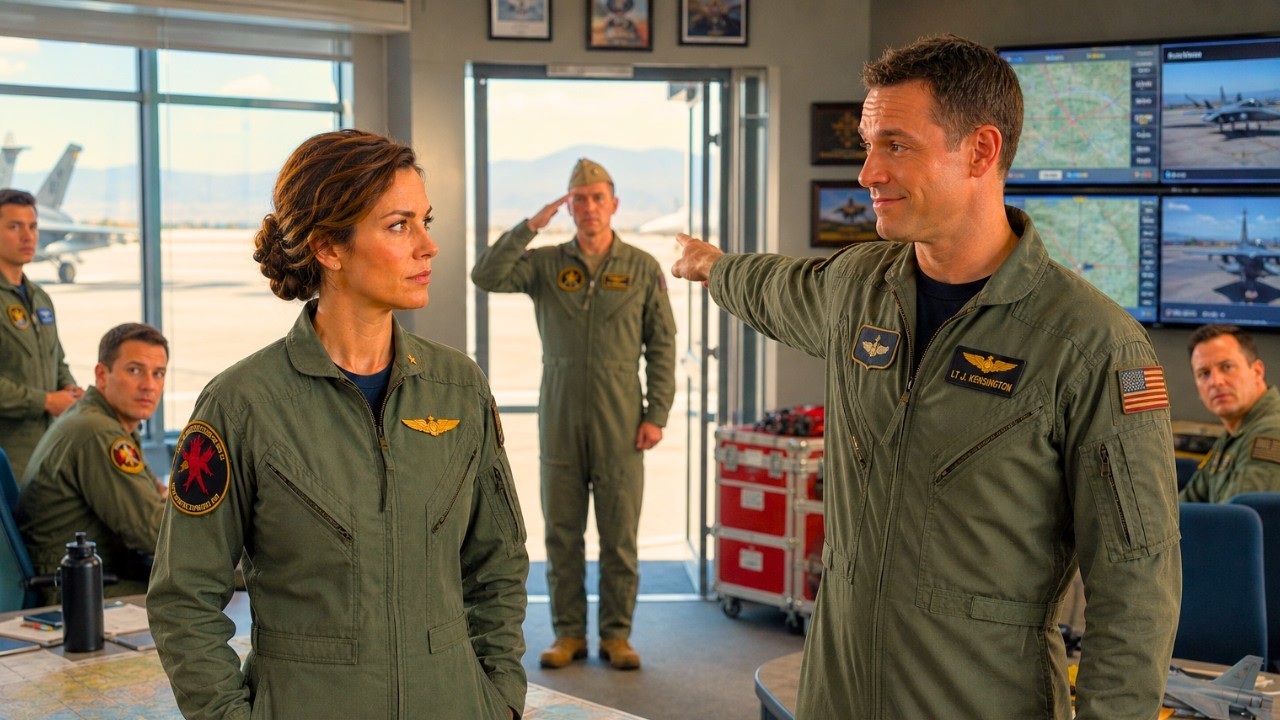
I watched him decide who I was. It took under a second. A woman in civilian clothes in the back, no flight suit, no patch, taking notes like a reporter or a wife or someone who had wandered in from the wrong passageway. He smirked.
It was not even a cruel smirk. It was a friendly, careless, certain smirk, the smirk of a young man about to get a laugh from his friends at no cost to himself. Ma’am, he said, and he pointed at the door with his laser pointer, a little red dot sliding across the bulkhead to land on the hatch. This is a real pilots-only kind of thing.
The spouse lounge is down the hall, second door past the quarterdeck. Go wait with the spouses. We will not be long. The room laughed.
Thirty pairs of eyes, and every one of them decided who I was in under a second, and then thirty mouths laughed at the version of me they had invented. It is a particular kind of cold, being laughed at by a roomful of people who fly the same aircraft you bled in. It went down my spine and pulled somewhere behind my sternum and sat there. I had two choices in that second, and I knew them both well.
I could have ended him. I had the standing to do it and the words to do it with. I could have stood up slowly and told the room exactly who had just sent me to the spouse lounge, and I could have watched the color drain from his face in front of every person whose respect he wanted. Or I could keep my dignity, which is a quieter thing and a harder thing, and it is the only thing I have ever found that no one can take from you and hand to someone else.
So I closed my portfolio, capped my pen, and stood up. Of course, I said. My voice was even. I am sorry to have interrupted.
And I stepped toward the hatch. Let me tell you who they thought I was, and then let me tell you who I was, because the whole morning lived in the gap between those two people. They saw a visitor, a lost civilian, a spouse who had wandered in. They could not have known that I had flown the very jet on their screen before most of them could legally drink, that I had more night traps in worse weather than the front three rows of that room combined, that the degraded systems question Reeves had just answered wrong was a question I had answered right with my own hands in the dark over open water while a man’s life hung on whether I got it right.
They could not see the gold wings I did not wear, or the logbook in my memory, thick and water-stained, or the chalk-dust years at the weapons school, or the cross in the bottom of a drawer in a house three time zones away. I had spent the better part of a decade making myself easy to overlook. I want to be clear that this was a choice, and not entirely a healthy one. After a certain night, being seen had started to feel like being charged for something I could not pay for, and so I had quietly arranged my life so that fewer and fewer people looked.
Staff billets, back rows, plain clothes. A name that meant a great deal to a smaller and smaller number of people every year, until I had almost succeeded in becoming exactly what Lieutenant Reeves took me for. So when he pointed me at the door, some part of me thought, well, there it is. The project is complete.
I have finally made myself invisible, and a stranger has confirmed it for me in front of an audience. There is a cost to making yourself invisible that no one warns you about. You succeed. That is the cost.
You set out to stop being seen, and one day you wake up and discover that you have entirely stopped being seen by everyone, including the people who should have known you, including, on some mornings, yourself. I had taught some of the finest aviators in the fleet. I had stood at the front of the weapons school and turned frightened nuggets into section leads. And I had loved that work more than almost anything.
Then I had left even that, because even teaching had started to feel like being looked at, and I had gone to staff, where you can be excellent and essential and completely unseen all at once. For nine years my job had a great deal of importance and almost no witnesses. I wrote the plans that other people executed and got credit for, and I told myself I preferred it that way. And the strange thing is that I did prefer it.
The way you can prefer a thing that is slowly hollowing you out because at least it does not frighten you. No one in a staff job ever sends you to the spouse lounge, because no one in a staff job sees you at all. I had mistaken not being insulted for being respected. They are not the same thing.
You can avoid every insult in the world by becoming invisible, and at the end of it, you will not have a single piece of respect to show for the peace. So I was going to walk out, and I was going to keep my voice even, and I was not going to give Lieutenant Reeves the satisfaction of a reaction. I reached the hatch. I put my hand out toward it, and the hatch opened from the other side.
You have to understand what walked through that door. To do that, you have to go back fifteen years, to a night I have spent most of my life trying not to talk about. It was 2011. I was a lieutenant then, twenty-seven years old, three years into the fleet, flying off a carrier in weather the ship should probably never have launched us into.
Four jets, a strike that does not matter to the story, and we were coming back in the dark with the deck pitching and the fuel getting thin and one of my aircraft hurt. The radio that night was full of young voices trying not to sound afraid. That is the sound I remember most clearly, more than the weather, more than the fuel state, more than the way the ship’s lights smeared in the rain on the canopy. Young voices working very hard to sound calm and not quite managing it.
Mine was supposed to be the calm one. I was the section lead. So I made my voice calm. You take whatever is happening in your chest and you put it in a box and you sit on the box and you talk like you are reading a grocery list, because the four people on that frequency need exactly one thing from you, and it is not honesty about how frightened you also are.
It is calm. One of those young voices belonged to a junior pilot, a lieutenant junior grade on his first deployment, twenty-two years old, who had taken damage and lost an engine and was, in the most literal sense, falling out of the sky toward a black ocean. I can’t hold it, he said. I can hear the pitch of it, I can’t, ma’am, I’m losing it.
You can, I said. Pitch for the numbers and fly the airplane. Forget the engine. The engine is my problem.
Your problem is the airplane, and you are going to fly the airplane. I am right here. We land together. I talked him through the relight.
I talked him through the approach. I flew my own hurt jet on his wing the whole way down, because a frightened man needs to see a light off his wingtip more than he needs anything else in the world, and I put that light there and I kept it there, and I talked low and even the whole way to the deck. He caught a wire and lived. People think courage in the air is a loud thing.
It is not. It is the discipline to keep your voice flat while your own aircraft is failing because the other person needs your flatness more than you need your fear. His name was Grady Sutter. I did not know that night that I would spend fifteen years not telling his story either, because while I was getting Sutter aboard, I lost someone else.
My wingman that night was a lieutenant named Asa Whitman. He was the best stick I have ever flown with, better than me, and I do not say that easily. He had a softness on the controls that made a thirty-ton machine look like it was thinking for itself. On the ground he was the one who remembered every new pilot’s name and where they were from and whether their kid had been sick that week.
He used to say that the squadron was just a family that happened to own jets, and he meant it. He had stayed back to cover the recovery. And Asa Whitman did not come back. We searched.
The ship searched for a long time, longer than the fuel math allowed for hope. Then the search ended the way searches end, with a frequency going quiet and a name said once on the radio and then never again on that net. They gave me a Distinguished Flying Cross for that night. A few months later I stood on a hangar deck and an admiral pinned it on me and called it heroism.
I said, thank you, sir. And I went back to my stateroom and I put it in a drawer, and that is more or less where it stayed for fifteen years. A medal is a strange thing to receive for the worst day of your life. They hand you a cross for the three you saved, and they have no medal at all for the one you lost.
So the cross becomes a kind of receipt, a bill of sale, a thing that says, here is what we paid you for Asa Whitman. Every time I looked at it, I saw the price tag and not the honor. And so I did the only thing I knew how to do. I stopped letting it be public.
I stopped telling the story. I turned down the interviews and the talks. I went to the weapons school and taught, because teaching let me give the thing away instead of being celebrated for it. Then I went to staff, and I got quieter and quieter, and the cross stayed in the drawer, and fifteen years went by.
I heard from Grady Sutter twice in fifteen years. Once, a card, the first Christmas after that cruise, with nothing in it but his name and four words: Thank you. I mean it. I never answered it.
Not because I did not care, but because answering it meant talking about the night, and talking about the night meant Asa, and I had built my whole life around not doing that. Years later, second hand, I heard that a Lieutenant Commander Sutter had made a name for himself as one of the hardest and best instructors in the strike fighter community. And I remember thinking, good, he made it, and then closing the thought before it could lead anywhere near the water. So you understand.
When the hatch opened that morning and Grady Sutter walked through it, he was not just the squadron’s instructor pilot. He was the boy I had talked down out of a black sky on the night I lost the best of us. And he had spent fifteen years owing me a debt I had never once asked him to pay, and he was about to pay it whether I wanted him to or not. He came through the door with a coffee in one hand and his helmet bag in the other, mid-sentence, talking back over his shoulder to someone in the passageway.
He was a lieutenant commander now, broad and weathered, with the deliberate stillness that the best instructors get, the men who have washed out so many aviators that they no longer raise their voices because they no longer have to. He stepped through the hatch and he saw me. I watched it happen on his face. The coffee stopped halfway to his mouth.
His face went through confusion and then recognition and then something much older and heavier than either, all in about the time it takes to blink. Ma’am? he said. Just that, quiet, like he was checking whether the ocean had given something back.
Then Lieutenant Commander Grady Sutter set his coffee down on the nearest table, slowly, like it had become very important not to spill it. And he came to attention so hard that I heard his boots come together, and he filled his lungs. Commander on deck, he said. On your feet.
The room did not understand. You could feel it not understand, that particular confused silence that happens when a command is given that does not match the picture the room is holding. Chairs scraped uncertainly. A few aviators stood out of pure reflex.
Most of them just looked back and forth between Sutter and the woman by the door, the visitor, the spouse, trying to make the math work and failing. Reeves was the one who said it out loud, and to his small credit he said it quietly, with real confusion in it and not defiance. Sir, he said. She is not she just walked in.
She does not have a flight suit. She is a visitor. Sutter did not look at him. He kept his eyes on me and held his salute.
She is Commander Marlowe, he said. She taught me to fly, and she is the reason I came home from a night that three other people did not. The room went very still. Thirty aviators were on their feet now.
Not one of them was laughing. The laugh had died somewhere in the middle of Sutter’s first sentence, and it did not come back. And in its place was the specific, awful silence of a room full of confident people realizing all at once that they had been wrong about something in front of each other. I stood there with my hand still half raised toward a hatch I was no longer going to walk through.
I lowered it, and I looked at Grady Sutter holding a salute he had waited fifteen years to give me. I returned it. It was the first one I had returned in a long time that I let mean what it is supposed to mean. Stand easy, I said to the room.
My voice came out the way it had come out on the radio that night, even and unhurried, because that is the voice that lives in me underneath all the quiet years, and it had simply been waiting. Take your seat, Lieutenant Commander Sutter. It is good to see you. You have gotten old.
A few of them laughed this time, and it was a different laugh, relieved and nervous, the laugh of people who do not yet know how much trouble they are in and are hoping it might be funny. It was not funny exactly. But I had decided in the space of Sutter’s salute that I was not going to make it a funeral either. The hatch opened again before anyone had fully sat down, and Captain Holden Ramsey came in.
He was the air wing commander, a tall, spare man of about forty-eight, with the kind of calm that has been earned the hard way and the kind of eyes that take in a whole room in one pass and miss nothing. He stopped just inside the hatch and read the room in that single pass. The standing aviators, Sutter at rigid attention, Reeves pale at the front, me by the door in a gray civilian coat with a visitor badge. And I watched something cross his face that was not quite a smile and not quite anger, the expression of a man who has just understood a joke that is going to cost someone.
Commander Marlowe, he said. I have been looking for you all morning. I see you found the squadron without my help. They were very welcoming, sir, I said.
Ramsey looked at the room, then he looked at Reeves, then he said the sentence that I think Lieutenant Colton Reeves will hear in his sleep for the rest of his career. Gentlemen, Captain Ramsey said, unhurried, letting it land. The woman your lieutenant just sent down the hall to wait with the spouses takes command of the squadron on Friday. I have been in some quiet rooms.
I am not sure I have ever been in a quiet like the one that followed that sentence. It had a physical weight. Reeves did not move. He had gone past pale into something gray, and his eyes had the fixed, far-away look of a man watching his own future rearrange itself in real time.
And here is where this story could have become a different kind of story. The room turned to me, all of them, the way a room turns when it knows a reckoning is owed and it wants to watch it paid. The hunger I told you about, the appetite a room gets for a reversal, was at its absolute peak. They had laughed at me eleven minutes ago, and now they wanted, almost all of them, to watch me destroy the man who had started the laughing.
It would have been just. He had earned it. The room had earned it. That is exactly why I did not.
Revenge is a thing you can have right now. That is its entire appeal. It is sitting on the table fully cooked, and all you have to do is pick it up. Dignity is slower.
Dignity asks you to put down the thing on the table that everyone is telling you to pick up and to walk away hungry and to trust that you will be fed later by something better. Most people cannot do it, not because they are weak, but because the table is right there and the food is hot and the whole room is chanting your name. I looked at Lieutenant Colton Reeves, twenty-eight years old, gray-faced, certain he was finished, and I did not see an enemy. I saw a doorway.
I had stood in that doorway, not his exact one, but I had been the cocky young one, and I had been offered an easy cruelty and taken it once or twice when I was young, and it had never once made me into anything I was proud of being. I had made enough of those receipts. I did not need another. The command master chief was watching me.
I had not noticed him until that moment. Vernon Markham, fifty years old, the squadron’s senior enlisted leader, standing along the side bulkhead with his arms folded, the still, evaluating look of a man who has watched a great many officers walk into a great many rooms and has learned to tell fast which ones are going to be worth following. He caught my eye just for a second and said one thing, low enough that it stayed between us. Whatever you do with him, ma’am, he said, this room will remember it longer than the brief.
He was right. They forget the threat picture and the calm plan inside a week. They never forget watching what a leader does with power the first moment she is handed it. So I made my decision, and I made it without spectacle.
I turned to Captain Ramsey. Sir, I said quietly, just to him, although the room was silent enough that it carried anyway. With respect, hold the formal correction. He is my problem now.
Let me have him. Ramsey looked at me for a long moment. Then he nodded once. He is all yours, Commander, he said.
Friday or now? Now is fine, I said. I did not take Reeves apart. I did something I think he found harder.
I walked to the front of the room, sat my worn leather portfolio on the table next to his notes, and told the room to sit down. They sat. Then I picked up where the brief had stalled. I went back to the degraded systems recovery question on the screen, the corner case, the one Reeves had answered wrong with a smile.
And I answered it. Correctly, coldly, completely, with the kind of detail you only have if you have done the thing in the dark with your own hands and a man’s life on the frequency. I did not say, I know this because. I did not reference the night or the cross or Asa Whitman.
I just answered the question the way it should have been answered, and I walked them through why the confident answer Reeves had given would get a pilot killed on exactly the night it mattered, and I laid out what to do instead, step by step. I did not need to tell them I belonged. I let the answer be the argument. By the time I finished, the room had recalibrated all the way.
You could feel it, that almost silent sound of thirty people realizing at once how badly they had misjudged the morning and going very still while they rebuild their picture of the world to make room for the thing they just learned. Then Captain Ramsey, who had stayed at the back, did me the favor of asking Sutter the question I would never have asked for myself. Commander Sutter, he said, for the room, the night you mentioned. Tell them.
Sutter did not embellish it. That was the mercy of how he told it, flat, like a maintenance report, which is the only way a thing like that can be told without becoming a performance. 2011, he said. I was a nugget.
First cruise. We launched into weather we should not have, and I took damage on the recovery and lost an engine, and I was going into the water. I had given up. I had stopped flying the airplane, and Commander Marlowe, Lieutenant Marlowe then, flew her own damaged jet onto my wing in the dark and talked me through a relight and an approach, and she did not stop talking until I caught a wire.
Three of us came back that night because of her. One of us did not come back at all. Lieutenant Asa Whitman stayed back to cover the recovery, and he did not make it home, and she has carried him every single day since. That is who just walked into your brief.
That is who you sent to wait with the spouses. Somebody in the back row said it very quietly, almost too quiet to hear. Two words. The Whitman section.
And I understood, standing at the front of that room, that the story had outlived my silence. For fifteen years I had been carefully not telling it, keeping it in a drawer like the cross, and it had gone on being told anyway, quietly, pilot to pilot, the way the true ones always are, until it had become a thing a young aviator in the back row of a squadron I had never served in could name in two words. I had spent fifteen years trying to keep Asa Whitman private, and the fleet had spent fifteen years refusing to let him be forgotten, and the fleet had been right, and I had been wrong. Sutter found me for a moment in the shuffle as the room broke up.
He stood in front of me with fifteen years on his face. I sent you a card once, he said. You never wrote back. I know, I said.
I am sorry. I was not writing anyone back those years. It was not you. He nodded like he had always known that.
I have spent fifteen years trying to be the instructor you were to me, he said. Half this room can fly because I was trying to be you. I just wanted you to know that. The night did not only take things.
It gave some, too. You undersell yourself, Grady, I said, when I could. No, ma’am, he said. I have just had a long time to do the math on what I owe and who I owe it to.
And he came to attention one more time, and this time I did not feel like an impostor receiving it. I felt like a person being handed back a piece of herself she had given away and forgotten she was missing. The brief ended. The aviators filed past me on the way out, and most of them did the thing people do when they are ashamed and do not know how to say it, which is to make brief, serious eye contact and a small nod, an apology with no words in it.
I returned each one, because I was not in the business of collecting apologies that morning. One of them stopped, though, a young lieutenant junior to Reeves who had laughed along with the rest at the start because that is what you do when the room laughs, and who now looked like she could not live with having done it. Ma’am, she said. I laughed, too.
I am not going to pretend I was one of the ones who stayed quiet. I am sorry. I looked at her, and I liked her at once, because the easiest thing in the world in that moment was to slip out the hatch in the crowd. And she had refused to do the easy thing.
You just did the hardest thing anyone has done in this room today, I told her. You owned a thing you could have hidden in a crowd. Hold on to whatever made you stop. That is the part of you that is going to make you worth following one day.
Reeves waited until last. Of course he did. He stood by the front table with his notes in his hands, the look of a man waiting outside a courtroom for a verdict he has already decided will be guilty. When the room was empty, he came over to me, stood at attention, and made himself say it.
Ma’am, he said. I am sorry. There is no excuse for it. I made an assumption, and I made it loudly, and I made it about a senior officer in front of the squadron, and I will accept whatever you decide.
If that is the end of my career, I understand. I let him stand there for a moment. Not to be cruel, but to let him feel the size of the moment, because a lesson that costs nothing teaches nothing. Lieutenant, I said.
Look at me. He looked at me. You are not going to lose your career today, I said. You are going to do something harder than that.
You are going to fly for me for the next three years. You are going to be in my ready room every day, and every day you are going to remember this morning. And you are never again, as long as you wear those wings, going to decide who a person is by the clothes they walked in wearing or the seat they chose or whether you recognize their face. Because the day you do that to the wrong person in the wrong cockpit, somebody dies.
Not your pride. Somebody’s life. The whole reason we are hard on each other in this community is that the ocean is harder, and the ocean does not care how confident you sounded in the brief. Yes, ma’am, he said.
One more thing, I said. You answered the recovery question wrong, with a smile, and thirty people wrote down your wrong answer because you sounded sure. That frightened me more than anything you said to me. Confidence is not knowledge.
Learn the difference fast. That part is not a punishment. That part is the most important thing I will ever teach you. There were tears standing in his eyes that he was working very hard not to let fall.
And I let him keep that dignity, because I know what it is to need to keep your dignity in a room. And I had just gotten mine back, and I was not about to take his. Go fly, I said. I will see you Friday.
He went. Captain Ramsey was waiting for me by the hatch. He had watched the whole thing. This squadron has needed exactly that for about a year, he said.
Not the reveal. The other part, the part where you let him live. He is a good pilot, sir, I said. He is just a young one.
We were all the thing he was this morning. Some of us never stop being it, Ramsey said. You will do fine here, Commander. And he left.
Vernon Markham held the door for me on the way out. He did not say anything. For most people, holding a door is a courtesy. From a command master chief who has decided whether or not he is going to follow you, holding the door is the entire verdict delivered in silence.
I understood it, and I said, thank you, Master Chief. And he gave me a nod that I have been chasing the meaning of ever since. And I think it meant, all right. We will follow this one.
I went back to the ready room that evening after everyone had gone. The change of command was two days off, and I had a thousand things to do, and not one of them required me to be in an empty ready room at dusk. But I went, and I let myself in, and I stood in the dim space with the chairs all empty and the screen dark. I looked at the heritage board on the bulkhead, the one I had been sitting under that morning when Reeves pointed me at the door.
The usual thing. Squadron patches through the decades, photographs, and a panel of names, the names of the ones the squadron had lost over the years, going back further than anyone now living could remember. Each one a person who had walked into a ready room exactly like this one and laughed at exactly these kinds of jokes and then one day did not come home. Asa Whitman’s name was not on that board.
He had been lost from a different squadron, on a different ship, in a different decade. But I stood in front of those names anyway. And I understood something about the morning that I had not let myself understand while it was happening. Recognition is a door that swings both ways.
The same morning that gave me back my name gave me back my grief. For fifteen years I had kept them locked in the same drawer, the cross and the loss, the honor and Asa. I had thought that keeping the honor private was a kind of humility. It was not.
It was hiding. I had been hiding from the medal because the medal made me look at the loss, and I had been hiding from the loss because the loss had no bottom. And that morning, a man I had saved fifteen years ago had walked through a hatch and looked at me and refused to let me keep hiding. I stood in front of the names and I said it out loud, the thing I had not said out loud in years, in an empty room where no one could hear me.
We landed together, Asa, I said. I just took a long time getting here. And the strange thing, the thing I did not expect, was that the room did not feel empty when I said it. For the first time in fifteen years, saying his name did not feel like spending him.
It felt like keeping him. It felt like the difference between a receipt and a memory, and I had spent fifteen years on the wrong side of that difference. I sat down in the back row, in the same seat I had been sitting in that morning, the seat I had been ordered out of, and I let myself sit in it on purpose this time. It is a strange thing to choose the seat you were thrown out of, but I wanted to feel the room from there one more time, from the back, where you see who people really are.
And I realized that I had been treating the back row as a hiding place when it had always actually been a teacher’s seat. The best instructors I ever had watched from the back. You do not hide in the back of a room. You learn it.
I had been doing the right thing for the wrong reason for fifteen years, and it was time to start doing it for the right one. Two days later, I took command. I wore my service dress blue, and on the left breast of it, for the first time in fifteen years, I wore the things I had kept in a drawer: the gold wings and the Distinguished Flying Cross. I want to tell you it was easy to pin them on.
It was not. I stood in front of a mirror in a small room off the hangar at seven thirty that morning and held the cross in my hand for a long time before I put it on. I thought about the price tag I had always seen on it, the price for Asa. Then I thought about the back row of the ready room and the two words a young aviator had said: the Whitman section.
And I understood that the cross was not a receipt. It had never been a receipt. It was a place where his name was allowed to live in the open, where people who never knew him would ask about it and I would get to say it. Asa Whitman, the best stick I ever flew with.
And so I pinned it on. And it felt less like a weight than it had in fifteen years. The hangar was full. Three hundred people, the whole squadron and the air wing staff and the families, and yes, the spouses, in the very front rows, where they belonged, where they have always belonged.
Go wait with the spouses. Reeves had meant it as the bottom of the ladder, the least important place a person could be sent. And that, more than the insult to me, was the thing I wanted to take apart gently for the whole squadron. Because the spouses in those front rows are not the bottom of anything.
They are the ones who carry the weight on the ground while we carry it in the air, who do the deployments without the adrenaline, who get the phone call or spend a year dreading it. I made a quiet note to make sure the word spouse was never again used as a punchline in any space I commanded. Captain Ramsey read the orders. The outgoing skipper handed me the watch.
Then it was my squadron. I had a speech in my pocket, three index cards, the kind they teach you to give, full of the right words about heritage and standards and team. I did not read it. Instead, I told them about a night in 2011.
I told them about the young voices on the radio trying not to sound afraid. I told them about a junior pilot falling out of the sky and a light off his wingtip and the words we land together. I told them about a man named Asa Whitman who stayed back to cover the recovery and did not come home. And I said his name in front of three hundred people, clearly, on purpose, and I watched three hundred people receive it.
I saw Grady Sutter standing very straight with his jaw set, and I saw a young lieutenant named Colton Reeves in the ranks with his eyes forward and his face composed. I spent nine years making myself easy to overlook, I told them. I was good at it. Some of you met the result of it on Tuesday in a ready room in a gray coat, and you can be forgiven for what you assumed, because I had worked very hard to make you assume it.
I am telling you this because I am done doing it. I am your commanding officer. I earned these wings, and I earned this cross, and I am going to wear them where you can see them. Not because I need you to be impressed, but because behind every piece of metal on this uniform there is a name, and the names deserve to be carried in the daylight.
A squadron is not the jets, I told them. The jets are extraordinary, and we are lucky to fly them, but the squadron is the voice on the radio at the worst moment of someone’s life, the calm one, the one that says I am right here, we land together, and means it. Every one of you is going to be that voice for someone on a night you cannot predict. And the only question that will matter is whether you spent the easy days becoming the kind of person who can be calm on the hard one.
I do not care this morning how confident you sound. I care whether you are becoming that voice. Spend your easy days well. That is the whole job.
Everything else is detail. Then I came to attention and rendered honors to the formation, three hundred people, my squadron, and they rendered them back. And Grady Sutter’s voice carried across the hangar, exactly the way it had carried across the ready room, and this time there was nothing in it but welcome. Welcome aboard, skipper, he said.
It took you long enough. It had. It had taken me fifteen years and a long, quiet detour through the back rows of my own life. But I had finally walked all the way through the door I had almost walked out of.
And I returned the salute to the whole formation. And for the first time in a very long time, I let it mean exactly what it is supposed to mean. I want to say one thing before I go, because I think some of you are carrying a Tuesday morning of your own. Maybe you have been laughed out of a room you had every right to stand in.
Maybe someone took one look at you, at your clothes, or your age, or your face, or your quiet, and decided in under a second who you were. And they were wrong, and the whole room laughed, and you felt that particular cold go down your spine and pool behind your sternum and sit there. Here is what I have learned, and it is the only thing I really know. Do not perform your worth for them.
The moment you start arguing with a room about who you are, you have agreed to let the room decide, and the room decided in a second, and it will not be reasoned out of it. You cannot win that argument, so do not have it. Keep your dignity instead. It is the one thing no one can take from you and hand to someone else.
Gather your notes, keep your voice even, do the work in front of you correctly, coldly, completely, and let the work be the argument you refuse to make out loud. And then wait. Not forever, and not as a doormat, but with the patience of someone who knows something the room does not yet know. Because the truth has a way of walking in right behind you.
Sometimes it is a man you saved a long time ago. Sometimes it is a record that surfaces, or a result that cannot be argued with. But it comes. It almost always comes.
And when it does, the room does not get to decide who you are anymore, because the truth has already said your name. Dignity is not the same as silence, and patience is not the same as surrender. There is a time to speak clearly and once. There will be days when the work alone is not enough, and you will have to stand up and say the true thing out loud.
But notice the difference between speaking your truth once, plainly, and arguing for your worth on a room’s terms. The first is strength. The second is a trap, because it concedes that the room gets a vote on who you are. It does not.
It never did. The vote was never theirs. It was always only yours and the truth’s. They told me it was real pilots only, so I kept my dignity, and I did the work, and I let the truth walk in behind me.
And then I went and took command of the room.