For more than seventy years, one of history’s greatest mysteries shrouded the fate of Tsar Nicholas II and his family, until the collapse of the Soviet Union finally allowed archaeologists and forensic scientists to open the ground and answer one of the twentieth century’s most haunting questions.
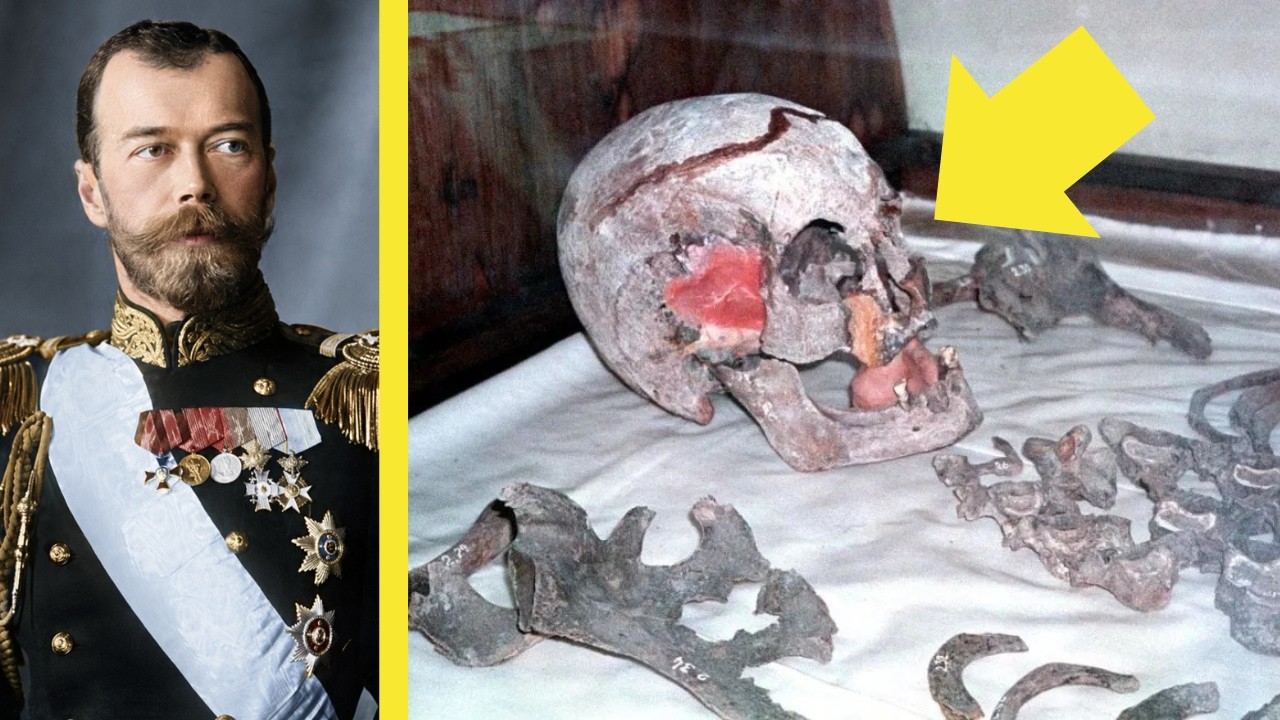
The last emperor of Russia, his wife, their five children, and four loyal servants were executed during the Russian Revolution in 1918, but no one outside a small circle of Bolsheviks knew precisely where their bodies had been buried. The killers went to extraordinary lengths to conceal the corpses, hoping no grave would ever become a shrine for supporters of the old imperial order.
Instead, the secret burials fueled rumors, conspiracy theories, and false claims that some family members had survived for decades. Only after the Soviet Union fell in 1991 were authorities finally able to permit proper excavations and modern scientific analysis.
Nicholas II ascended the Russian throne in 1894 after the death of his father, Tsar Alexander III. He ruled the largest empire in the world, stretching from Eastern Europe across Siberia to the Pacific Ocean. Despite his deep belief in the divine right of kings, Russia was undergoing rapid change, with industrialization, poverty, political unrest, and growing demands for reform placing enormous pressure on his government.
His decision to lead Russia into World War I made matters worse. Military defeats, food shortages, and economic collapse destroyed public confidence in the monarchy. In March 1917, Nicholas II was forced to abdicate during the Russian Revolution, ending more than 300 years of Romanov rule.
Nicholas hoped his family would eventually be allowed to leave the country, perhaps for Britain, where King George V was his cousin. But political conditions changed rapidly. The family remained under guard as Russia slid into civil war between the Bolsheviks and their opponents.
By the spring of 1918, Nicholas, his wife Alexandra, their daughters Olga, Tatiana, Maria, and Anastasia, and their young son Alexei had been moved to the Ipatiev House in Yekaterinburg. Four loyal servants joined them, choosing to remain despite the danger. Conditions grew harsher.
Windows were painted over, guards watched every movement, and the family had no idea what the future held.
On the night of July 16 to 17, 1918, the family’s imprisonment ended violently. They were ordered downstairs to the cellar under a false pretext that fighting was approaching the city. Instead, a Bolshevik execution squad entered the room and read a brief statement announcing the death sentence for the former tsar.
Moments later, the executioners opened fire.
 The small cellar quickly filled with smoke, chaos, and panic. The execution did not go as smoothly as the killers expected. Some bullets ricocheted off jewels sewn into the grand duchesses’ clothing.
Several victims survived the initial gunfire and had to be killed with additional shots or bayonets. The horrific scene lasted far longer than the executioners had planned.
After everyone was dead, the bodies were loaded onto a truck and driven away under cover of darkness. The Bolsheviks realized they had committed an act that could become politically dangerous if the burial site were discovered. They decided to hide every trace of the crime.
The bodies were taken to forests outside Yekaterinburg, where the executioners stripped them of jewelry and valuable clothing in the hope of removing anything that might reveal their identities. Sulfuric acid was poured on many of the bodies in an attempt to disfigure faces and clothing. Some items were burned, and the killers repeatedly changed their plans as they struggled to dispose of the corpses.
In the end, most of the victims were buried together in a shallow grave, while two bodies were buried separately nearby after further attempts to conceal their identities. For decades afterward, the Soviet government refused to disclose what had happened. Official accounts were often vague or deliberately misleading.
The location of the grave remained one of the Soviet Union’s most closely guarded secrets.
Without a known burial place, rumors spread. The greatest mystery centered on the children. Because the grave had never been found, many believed one or more members of the imperial family had somehow survived.
The most famous legend involved the youngest daughter, Anastasia. Over the years, several women claimed to be the surviving grand duchess, insisting they had escaped the massacre. The most famous was Anna Anderson, whose story attracted global attention for decades.
Books, films, and newspaper articles helped keep the mystery alive, though historians increasingly doubted her claims.
The truth began to emerge only in 1979. Two amateur researchers, Alexander Avdonin and Geli Ryabov, used historical documents and the memoirs of one of the executioners to identify what they believed was the burial site in a forest near Yekaterinburg. They quietly confirmed the discovery but realized Soviet authorities were unlikely to permit a proper investigation.
Fearing political repercussions, they kept the location secret.
Everything changed after the collapse of the Soviet Union in 1991. For the first time, Russian authorities officially allowed archaeologists and forensic experts to excavate the grave. When the excavation began, investigators discovered the skeletal remains of nine people.
Historical records indicated there should have been eleven victims in total. The discovery immediately raised new questions. Had two members of the family survived after all?
 Or had they been buried elsewhere?
The excavation was carried out with extreme care. Every bone, button, piece of clothing, and personal item was recorded and examined meticulously. Archaeologists wanted to preserve as much evidence as possible before the remains were transferred to forensic laboratories.
Scientists began by studying the skeletons themselves. They estimated each person’s age, height, and 𝒔𝒆𝒙, while examining evidence of injuries. Many of the skeletons showed gunshot wounds consistent with the execution described by witnesses.
Some also showed damage from bayonets. The evidence matched the written accounts left by members of the execution squad to a remarkable degree.
Physical examination alone, however, was not enough to prove the skeletons belonged to Nicholas II and his family. The real breakthrough came through DNA analysis. In the early 1990s, DNA testing was a relatively new tool in historical investigations, but it offered an unprecedented opportunity to identify the dead.
Scientists compared genetic material taken from the skeletons with DNA from living relatives of the Romanov family. Prince Philip, Duke of Edinburgh, was among the most prominent volunteers. Through his mother’s family, he was directly related to Empress Alexandra.
His mitochondrial DNA matched that found in the remains believed to belong to Alexandra and her children. Other tests compared DNA from descendants of Nicholas II’s relatives. Together, the results provided extremely strong scientific evidence that the skeletons were indeed those of Russia’s last imperial family.
The investigation also explained why only nine skeletons were initially found. Historical records written by the executioners indicated that two bodies had been moved from the main grave after the original burial plans were changed. Researchers therefore continued searching the surrounding forest.
In 2007, archaeologists finally located a second burial site a short distance from the first. The grave contained burned bone fragments and teeth belonging to two young people. Once again, DNA testing provided the answer.
The remains belonged to Tsar Alexei and one of his sisters. Later analyses strongly confirmed that the second body was that of Grand Duchess Maria. The discovery finally ended one of the longest royal mysteries in history.
All members of Nicholas II’s immediate family had been identified.

Although the scientific evidence was compelling, the findings were not immediately accepted. The Russian Orthodox Church questioned aspects of the investigation and called for additional studies before fully acknowledging the remains. Because the church had declared Nicholas II and his family saints, absolute certainty was considered essential.
As a result, further examinations were conducted in later years. Additional DNA tests, including a new analysis conducted in 2015, once again confirmed the earlier conclusions. Independent scientific teams continued to reach the same result.
The remains belonged to Nicholas II, Alexandra, their five children, and their loyal servants.
Long before these final tests, Russia had already begun to rehabilitate the family in its national history. In 1998, eighty years after their deaths, Nicholas II, Alexandra, three of their daughters, and four of their servants were reburied with full official honors in the Cathedral of Saints Peter and Paul in St. Petersburg, the traditional burial place of Russian emperors.
Thousands attended the funeral, while millions more watched on television.
The funeral was not merely a burial of a family. It was also a reckoning with one of the darkest chapters of Russian history. The remains of Alexei and Maria were discovered later and have not yet been buried with the rest, given continuing discussions between the Russian Orthodox Church and the Russian state about their final interment.
Today, historians no longer debate whether the Romanovs escaped. Modern archaeology, forensic anthropology, and DNA analysis have provided answers earlier generations could only dream of. The discovery of Tsar Nicholas II’s grave transformed a mystery that inspired countless books, films, and conspiracy theories into one of the best-documented criminal investigations ever conducted.
The grave of Tsar Nicholas II was opened by historians seeking the truth about the fate of Russia’s last imperial family. The excavations allowed archaeologists to recover hidden remains, enabled scientists to identify them using the most advanced forensic techniques available, and finally disproved rumors that persisted for decades about Romanov survivors living more than 70 years after the murders in a cellar in Yekaterinburg.
Nicholas II, his family, and his servants have finally been identified, honored, and restored to their proper place in history.