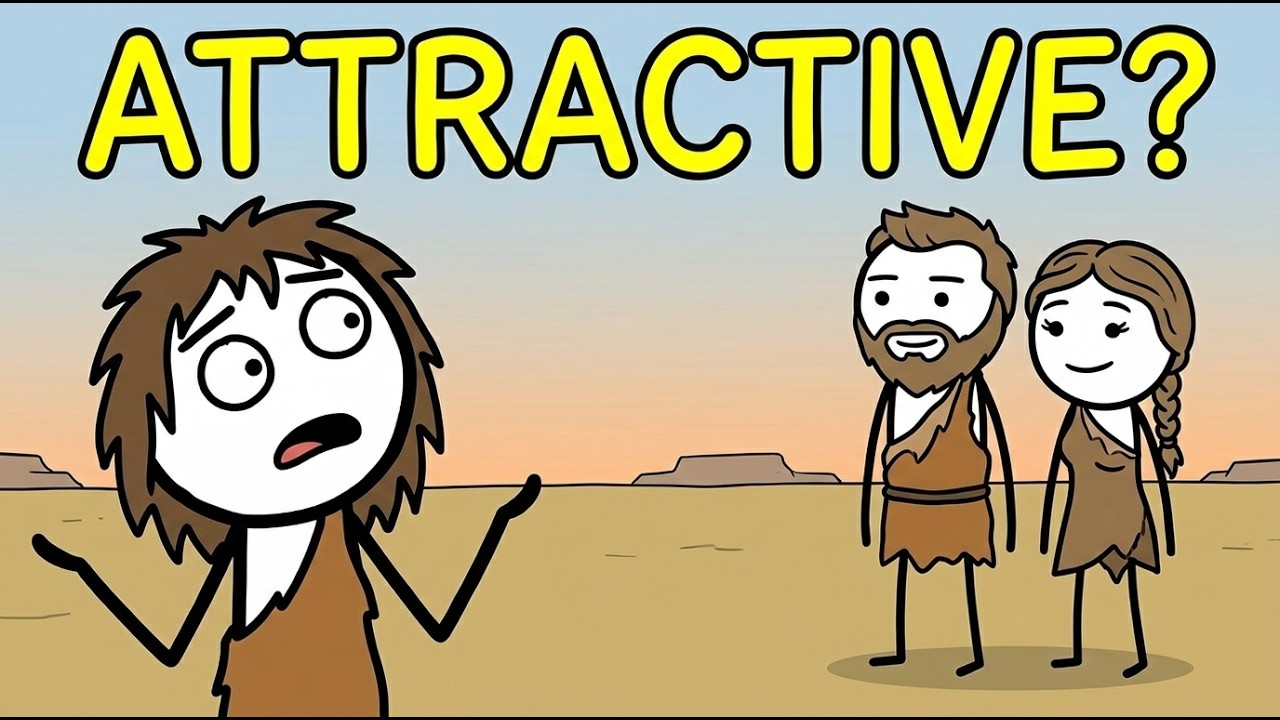
Forensic artists have reconstructed the faces of numerous ancient humans using skull structure and tissue depth data, and the results often look less like primitive cave dwellers and more like people you might pass on the street without a second glance. That raises a genuinely loaded scientific question: Were ancient humans actually attractive by any standard, or have we been picturing them wrong the entire time? The honest answer requires separating two distinct questions that tend to get mashed together. There is the question of whether ancient humans would be considered attractive by today’s specific beauty standards, and there is the more interesting underlying question of what attractiveness biologically represents.
Researchers studying cross-cultural preferences have found that facial symmetry, clear skin, and certain proportional relationships between features are broadly preferred across unrelated cultures. These traits are not arbitrary; they function as honest signals of health, developmental stability, and genetic quality. Facial symmetry, for example, correlates with stable development during childhood, since significant illness, parasitic infection, or nutritional deficiency during growth periods tends to produce lasting asymmetry. Clear skin signals an absence of current infection.
Our brains evolved to find these traits appealing because, across countless generations, preferring partners who displayed them produced healthier offspring. Ancient humans were operating under these exact same pressures, even if the cultural packaging looked different. Ancient human skulls, particularly from earlier periods, frequently show more robust brow ridges, broader facial structure, and heavier bone structure than the modern average. That raises a nuanced question about whether those differences would register as unattractive by modern standards, which often favor a more delicate bone structure.
Populations closer to the emergence of anatomically modern Homo sapiens, roughly 200,000 years ago, actually show facial structures considerably more similar to modern humans than popular imagination assumes. The robust, heavy-featured faces most people picture are more associated with earlier hominins or with Neanderthals specifically. Neanderthals possessed notably larger brow ridges, a more pronounced mid-face projection, and more robust bone structure compared to Homo sapiens. Evaluated purely against current mainstream beauty standards, those features would likely register as unusual to most modern observers.
But Homo sapiens and Neanderthals interbred repeatedly across an extended period, which means at least some Homo sapiens populations clearly found Neanderthals attractive enough to produce offspring together on a meaningful scale. Whatever the calculus was regarding cross-species attraction, it clearly was not an insurmountable barrier. Evidence of self-adornment and grooming shows that ancient humans cared enormously about personal appearance. Red ochre and other pigments were used as body decoration during life, tens of thousands of years before written records.
Jewelry made from shell, bone, and ivory dates back tens of thousands of years, deliberately crafted and strung for personal adornment. Ancient combs made from bone and antler represent dedicated grooming tools, showing that maintaining well-groomed hair was a real priority. Several ancient cultures also practiced deliberate body modification, including dental filing and scarification, which required real commitment and often genuine physical discomfort. Venus figurines, small carved figures depicting female forms with exaggerated features around the hips, breasts, and abdomen, appear across numerous Paleolithic sites.
For a long time, popular interpretation treated them as straightforward representations of ancient beauty ideals. More recent scholarship has pushed back, suggesting they may represent fertility symbolism, self-representation from a first-person perspective, or some entirely different ritual purpose. A single piece of ancient art does not necessarily tell us definitively what ancient humans found attractive. Direct evidence regarding what ancient humans themselves considered attractive is thin, since written records obviously do not exist for the deep prehistoric period.
Once we move into periods with written records, such as ancient Egypt, Greece, and Mesopotamia, we find more explicit evidence of specific beauty standards. These varied considerably depending on social class, gender, and regional culture. Even within just the past few centuries, body size preferences, skin tone preferences, and facial feature preferences have shifted measurably, frequently correlating with economic and social conditions. Modern facial reconstruction technology has provided some of the most direct evidence-based attempts to visualize what specific ancient individuals looked like.
A reconstruction of a Neanderthal woman received considerable public attention because the resulting face looked more familiar and conventionally presentable than popular stereotypes had led most people to expect. This reinforces that our cultural imagination of ancient humans has frequently exaggerated and distorted their likely appearance. Ancient human populations almost certainly contained a full range of individual variation, just like any modern population. Some individuals would have displayed the facial symmetry, clear skin, and proportional features that trigger strong attraction responses, while others would have displayed considerably less of those traits due to illness, injury, or simple natural variation.
A population’s historical circumstances, periods of relative abundance versus genuine hardship, would have directly influenced how many individuals displayed robust visible health markers. Attraction also extends beyond static facial features. Research has found that voice qualities related to pitch, resonance, and vocal stability function as honest signals connected to health. Humans can detect health and personality traits from observing someone’s walking pattern alone.
Physical appearance represents only one piece of a larger puzzle that also includes demonstrated competence, kindness, reliability, and social status. An ancient human displaying genuine hunting skill or valued craft work likely received attraction-relevant social credit for those qualities. Given shorter average lifespans and demanding physical labor, signs of youth and physical vigor likely carried even more practical weight in ancient mate selection than in many modern contexts. Older individuals were not necessarily considered unattractive; demonstrated skill and accumulated resources provided meaningful counterbalancing value.
Modern dating platform data has found the same core preferences emerging consistently across different cultural backgrounds. Symmetry, proportional facial ratios, and signs of health keep showing up reliably, whether researchers are studying contemporary swiping behavior or piecing together evidence from tens of thousands of years ago. The very fact that we are capable of asking this question tells us something about human nature. Attraction was not some optional modern luxury that emerged alongside mirrors or social media.
It represents a deeply ancient part of what it has always meant to be human. Were ancient humans attractive? The honest answer is yes, in exactly the same complicated, individually variable way modern humans are attractive, built on the same underlying evolutionary foundation of symmetry, health signaling, and proportional feature evaluation. Some ancient individuals would have displayed strikingly symmetrical, healthy, proportional features that triggered strong attraction responses in their contemporaries.
Others would have displayed considerably less of those traits. The cultural packaging, which features got emphasized or modified through grooming and adornment, varied considerably across populations and time periods. But the underlying biological machinery evaluating symmetry, clear skin, and signs of robust health has been running in essentially the same way for an extraordinarily long time, connecting every generation of humans back to whichever ancient person first decided they wanted to look just a little bit better.