Washington, D. C. — The United States military maintains a vast, largely invisible architecture of special operations forces whose combined reach spans every continent, every domain of warfare, and every spectrum of conflict, from surgical counterterrorism raids to the quiet manipulation of entire populations — and a newly surfaced comprehensive analysis has laid bare the full scope of these units, their brutal selection processes, and the uncomfortable truths behind their operations.
The examination, which draws on decades of publicly available documentation, operational histories, and firsthand accounts, reveals that America’s elite warriors are not a single monolithic force but a constellation of highly specialized units, each designed for a distinct and often overlapping purpose. Together, they form what defense analysts describe as the most lethal and least understood instrument of national power ever assembled.
At the apex of public recognition stand the Navy SEALs, the maritime special operations force created in 1962 by direct order of President John F. Kennedy. Their training pipeline, known as Basic Underwater Demolition/SEAL, or BUD/S, spans more than six months and is deliberately engineered to break candidates psychologically before rebuilding them.
The infamous “Hell Week” — five days without sleep, constant physical torment, freezing ocean exposure, and relentless instructor harassment — eliminates roughly seventy-five percent of all who attempt it. Only about 2,500 active SEALs currently serve across eight principal teams, and they remain best known for Operation Neptune Spear, the 2011 mission that killed Osama bin Laden, and the 2009 rescue of Captain Richard Phillips from Somali pirates.
Yet the SEALs represent only the most visible tip of a far deeper spear. The 75th Ranger Regiment, a light infantry force of approximately 3,000 operators organized into three battalions, traces its lineage to 1756 but was formally reestablished in its modern form in 1974. Rangers are trained at the grueling sixty-one-day Ranger School, conducted largely in the swamps of Georgia, where sleep deprivation, caloric restriction, and unrelenting stress are used to forge leaders capable of functioning as their bodies shut down.
Unlike the SEALs, Rangers are designed not for stealth but for overwhelming direct action — seizing airfields, capturing enemy positions, and launching mass nighttime offensives. They led the 1983 invasion of Grenada, jumped into Panama in 1989, and formed the core of the ill-fated 1993 operation in Mogadishu that inspired the film “Black Hawk Down.”

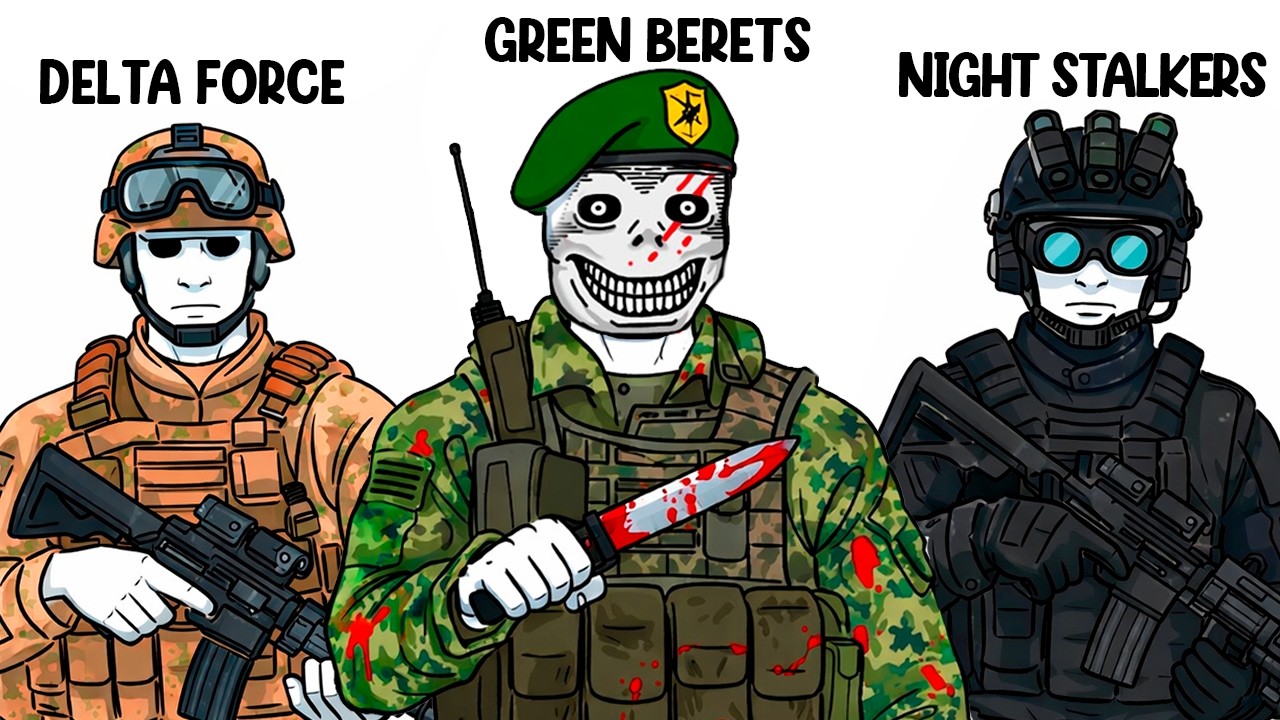
Operating in a more cerebral and ambiguous realm are the Green Berets, formally known as U. S. Army Special Forces, created in 1952 with the explicit mission of teaching foreign forces how to wage revolution.
Each operator is cross-trained in weapons, communications, medicine, and demolition, and works in twelve-man Operational Detachments Alpha, or ODAs, capable of independent operations. With roughly 7,000 active personnel across seven regionally focused groups, Green Berets have operated in Vietnam, Afghanistan, Iraq, Syria, and locations that Congress has never formally authorized. Their motto, “De Oppresso Liber” — to free the oppressed — belies the complexity of missions that can destabilize entire nations.
The Marine Raiders, numbering approximately 2,400 across three battalions, represent a more recent addition to the special operations ecosystem. Unlike other units, they accept no civilian applicants; selection occurs exclusively from within the Marine Corps through three weeks of physical and psychological testing in hostile environments. Organized into fourteen-operator teams, Raiders have deployed to the Philippines, Africa, and the Middle East, often in areas where conventional forces have already failed.
Their effectiveness has grown to the point that fellow Marines reportedly avoid facing them in joint training exercises — not out of respect, but because of the statistical outcomes.
 Air Force Special Tactics operators occupy a unique tripartite role: they fight, coordinate real-time airstrikes, and conduct armed medical rescue simultaneously. Some infiltrate alone to prepare landing zones in remote terrain, guiding aircraft in the midst of combat. Others embed with ground units to direct airstrikes from the front lines, marking targets for fighters flying at over 30,000 feet.
Their training can last up to two years and includes advanced medicine, HALO jumps, combat diving, and survival in hostile environments. In multiple documented instances, a single operator has managed air traffic control for an improvised desert base while combat raged nearby.
Beyond these acknowledged units lies a shadow tier of forces whose existence is either unconfirmed or deliberately obscured. Delta Force, founded in 1977 by Colonel Charlie Beckwith after studying the British SAS, operates without patches, identifiable uniforms, or official listings. Its operators are recruited directly from other elite branches, subjected to psychological evaluations and simulated missions designed to assess how they think when everything fails.
They work in teams of four to six and can be deployed anywhere in the world with orders that bypass traditional chains of command. Their base at Fort Liberty, North Carolina, is so heavily protected that Google Earth renders it blurred.
The Intelligence Support Activity, created in 1981 after the failed Iranian hostage rescue, is a clandestine group of armed spies operating with false passports and cover identities. Its operators infiltrate countries as journalists, NGO workers, or businessmen, intercepting communications and identifying high-value targets months before any military deployment. Reports, though unconfirmed, suggest agents have feigned mental illness to infiltrate psychiatric institutions and worked as personal drivers for armed leaders, recording their routes with hidden cameras.
The 160th Special Operations Aviation Regiment, known as the Night Stalkers, provides the aerial backbone for these operations. Founded in 1981 after the Desert One disaster in Iran, the unit flies modified aircraft with systems that are often not publicly documented. They conducted the bin Laden raid, inserted Delta Force into Mogadishu in 1993, and have extracted entire teams under enemy fire, flying between buildings without lights and without margin for error.
Finally, Civil Affairs and Psychological Operations units represent the most overlooked yet potentially decisive element of American military power. Civil Affairs specialists embed in conflict zones to rebuild infrastructure, negotiate with local leaders, and restore governance. Psychological Operations personnel design propaganda campaigns, manipulate social media, and exploit cultural and religious divisions to destabilize enemies from within.
Both operate in civilian clothing, often indistinguishable from aid workers or journalists, and their success is measured not in explosions but in silent surrenders and collapsed rebellions.
Collectively, these forces represent a continuum of capability that stretches from the most visible combat operations to the most invisible influence campaigns. Their operators live in what analysts describe as a state of controlled chronic violence, where the smallest error can cost lives and where success often means that no one will ever know what happened. As one former operator summarized, “If the mission succeeds, it never officially occurred.
If it fails, we were never there.”