LONDON — At 8:19 on the morning of October 8, 1952, three trains converged at Harrow and Wealdstone station in northwest London in a matter of seconds, producing the worst railway disaster Britain had seen since the First World War and leaving 112 people dead in wreckage that investigators would spend months trying to explain.
The crash destroyed sixteen vehicles, killed ninety-eight people outright and left fourteen more to die later in hospital, and it happened so fast that most of the victims never had a chance to move. What made it worse, and what has haunted the official record for more than seventy years, is that no mechanical fault, no signal failure and no defect in the track could be found to account for it. The signals were working.
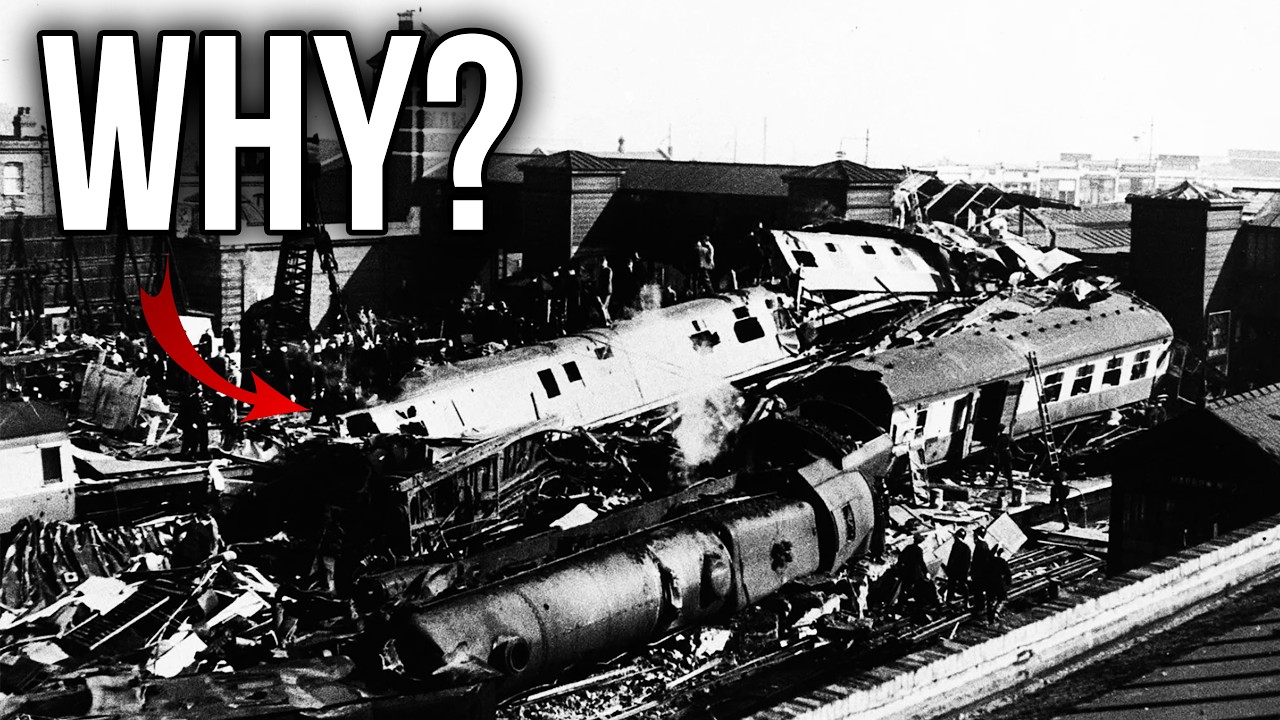 The weather was ordinary. The only explanation the inquiry could offer was a single moment of lost concentration by one driver, and that explanation has never satisfied everyone who has studied the case.
The morning had begun unremarkably. Commuters filled the platforms at Harrow and Wealdstone, a busy interchange on the West Coast Main Line where slow local stopping services and long-distance overnight expresses shared six tracks. A low fog hung over northwest London, dense enough to be noted by the Met Office but not unusual for October.
Visibility was poor, but witnesses and investigators alike agreed it was not poor enough to explain what followed.
The first train was the 7:31 local passenger service from Tring to Euston, nine non-corridor coaches hauled by a tank engine, packed with commuters heading into London. It had crossed onto the up fast line and stopped at platform four, where it stood for about ninety seconds with its brakes released, preparing to pull away. Among the passengers was eighteen-year-old Keith Cheyne, who had moved to the front coach with a friend because the rear carriages were full.
He later recalled a terrific bang at the back of the train just as it was ready to leave, followed by smoke and steam everywhere and a scene so obscured that no one could see what had happened.
The second train was the overnight express from Perth to Euston, eleven vehicles including four sleeping cars, running at fifty to sixty miles per hour and showing no sign of slowing. Approaching Harrow and Wealdstone, it passed a colour-light distant signal at caution and then two semaphore signals at danger. Each one instructed the driver to reduce speed and prepare to stop.
The official investigation would later establish that the train passed all three without slowing at all. The brakes were applied only at the last possible moment, far too late to have any effect on a train of that weight and speed.
At approximately 8:19, the Perth express struck the rear of the stationary local train at the top of the platform ramp. The impact telescoped the last three coaches of the local train into a space barely longer than one, shunting the entire train forward by about twenty yards. The wooden bodies of the two rear coaches shattered as they were driven through one another.
The brake compartment and two adjacent passenger compartments of the third coach from the rear were demolished, and the coach body was torn from its underframe and thrown onto the platform, coming to rest beneath the station footbridge alongside the Perth engine.
The engine of the Perth train derailed to the right onto the down fast line and came to rest roughly upright, but its tender overturned and crushed the left side of the cab. It travelled a further seventy-eight yards before stopping, coming dangerously close to the sixth coach of the local train. Behind it, the leading vans and passenger coaches of the express piled up, their underframes and bogies compressed into a mass of wreckage about a hundred feet long, scattered across the fast lines between the platforms.
 Then came the third train. The 8:00 a. m.
express from Euston to Liverpool and Manchester, fifteen vehicles double-headed by two locomotives, was travelling north on the down fast line at not much less than sixty miles per hour. Debris from the first collision, including the derailed Perth engine, had been thrown across its path. The driver had almost no time to react.
The leading engine of the Liverpool train struck the Perth engine head-on only a second or two after the first crash, in effect stopping the Perth engine from travelling further down the line while both locomotives were smashed into scrap.
Both engines of the Liverpool train were forced off to the left across a platform and overturned, fouling the up electric line. The resulting short circuit cut the current immediately, and an approaching electric train from Watford was able to stop well clear, its way protected by the home signal being thrown to danger. The leading engine of the Liverpool express was, in the words of the report, practically reduced to scrap apart from its boiler.
Its first and third coaches were destroyed, the fourth rode diagonally across the wreckage of the Perth train and came to rest on the up fast platform with most of its roof torn away against the girders of the footbridge.
The fifth coach was demolished. The sixth and seventh were carried beyond it and mounted the buried Perth engine, with the seventh coming to rest directly on top of it, its roof about thirty feet above rail level. The kitchen car, which followed, was wedged under the footbridge, and it was only by extraordinary fortune that its gas reservoirs were broken on impact and their contents released, preventing a fire that could have killed many more.
The remaining seven vehicles suffered no serious structural damage.
When the movement stopped, thirteen of the sixteen wrecked vehicles had been compressed into a heap roughly forty-five yards long, eighteen yards wide and thirty feet high. That heap had been full of people seconds earlier. The report described the combined damage to the three express engines and the rolling stock as exceptional.
Of the 112 dead, ninety-eight passengers and railway staff were killed outright at the moment of impact, including the driver and fireman of the Perth express and the driver of the leading engine of the Liverpool express. Ten more passengers died later in hospital. Investigators struggled to establish precisely where each victim had been, because the wreckage was so thoroughly compressed, but they concluded that sixty-four of the dead came from the local train and its rear carriages, twenty-three from the Perth train and only seven from the Liverpool train, a disparity that reflected the difference between older wooden-bodied stock and the newer all-steel carriages.
 Fourteen casualties could not be attributed to any train, and the report concluded that most of them had probably been standing on the platforms and were struck by derailed vehicles.
Among the dead were thirty-six railway staff travelling to work in London, most of them bound for the London Midland Region offices at Euston. A further 157 people were injured badly enough to require hospital treatment, eighty-four of them passengers with extremely serious injuries, and 183 more suffered minor injuries or shock. The human cost extended well beyond the casualty list, to the rescuers and witnesses who carried the aftermath with them for the rest of their lives.
What happened next has been remembered almost as vividly as the crash itself. Rescue began within seconds. Railway staff, uninjured passengers, police, fire brigades, nurses, doctors and local volunteers converged on the station.
The first ambulance and doctor arrived within three minutes, and the first loaded ambulance left at 8:27, only eight minutes after the collision. A United States Air Force medical unit happened to be aboard the local train, and one of its members, Lieutenant Abby Sweetwine, became known as the angel of platform six. She organised triage on the platform and used a tube of lipstick to mark an X on the forehead of anyone already treated and an M for anyone given morphine.
Many believe her swift action saved lives that morning.
Harrow Cottage Hospital on nearby Roxeth Hill cleared beds and laid mattresses on the floors to absorb the flood of casualties. A fourteen-year-old scout named Gilbert Pow, on his way to school, heard the crash, ran to the platform and, because of his small frame, was lowered into the wreckage to search for survivors, calling out the positions of the living so that firefighters could reach them. He was probably the youngest person to help that day.
Mr L. Rowlands of the operating superintendent’s department at Euston, who had been travelling in the fourth coach of the local train, helped organise first aid and rescue and ensured that every railway department was notified. By 12:15 p.
m. the vast majority of the injured had been treated and taken to hospital. It was not until about 1:30 the following morning that rescuers determined no one else could be found alive.
The station was back in operation within twenty-one hours. The official inquiry, conducted by Lieutenant Colonel G. R.
 S. Wilson, examined every possible cause and eliminated each one in turn. The signalling in the area had not failed.
The signals displayed the correct caution and danger aspects. The fog, while present, was not exceptional and had not prevented two drivers travelling shortly before from reading the signals clearly. The signalman was exonerated.
Incapacitation by sudden illness was ruled out on medical evidence. Driver Jones of the Perth express, who died in the crash along with his fireman, had considerable experience and a good record, had been driving well that day and had stopped correctly at earlier signals.
The report concluded, inconclusively but unmistakably, that the most likely cause was a simple lapse of concentration on the part of Driver Jones, who missed the signals and never slowed in time. It noted that the safety of railway traffic must depend at all times on obedience to signals, but also observed that no reasonable arrangement of the existing safety rules could have prevented this kind of human error. That finding, that the system had worked and a man had simply failed to see it, was a shock to British Railways and became the catalyst for change.
Wilson used the report to argue forcefully for automatic warning equipment providing a direct link between signal and cab, removing the possibility of a driver missing a signal altogether. Drawing on decades of accident data, he argued that automatic train control could have prevented or mitigated many past disasters, including all 112 deaths at Harrow and Wealdstone. The crash became one of the strongest drivers of the wider adoption of automatic warning systems on Britain’s main lines, though it would take further disasters before those systems were installed everywhere.
It is a familiar pattern in railway history: safety rules written in blood.
In 2002, a plaque commemorating the disaster was installed outside the main entrance to the station, in memory of the 112 people who lost their lives at Harrow and Wealdstone on October 8, 1952. A mural on the footbridge now includes a small tribute to the crash as part of a timeline of the local area. More than seventy years on, the question in the title of so many accounts of that morning still carries its original force.
The signals were set, the weather was ordinary, the crews were experienced, and yet 112 people died. The answer the inquiry gave, human error, remains the official one, and it remains the reason the station at Harrow and Wealdstone is remembered not only for what was lost there but for the safety systems that were built because of it.