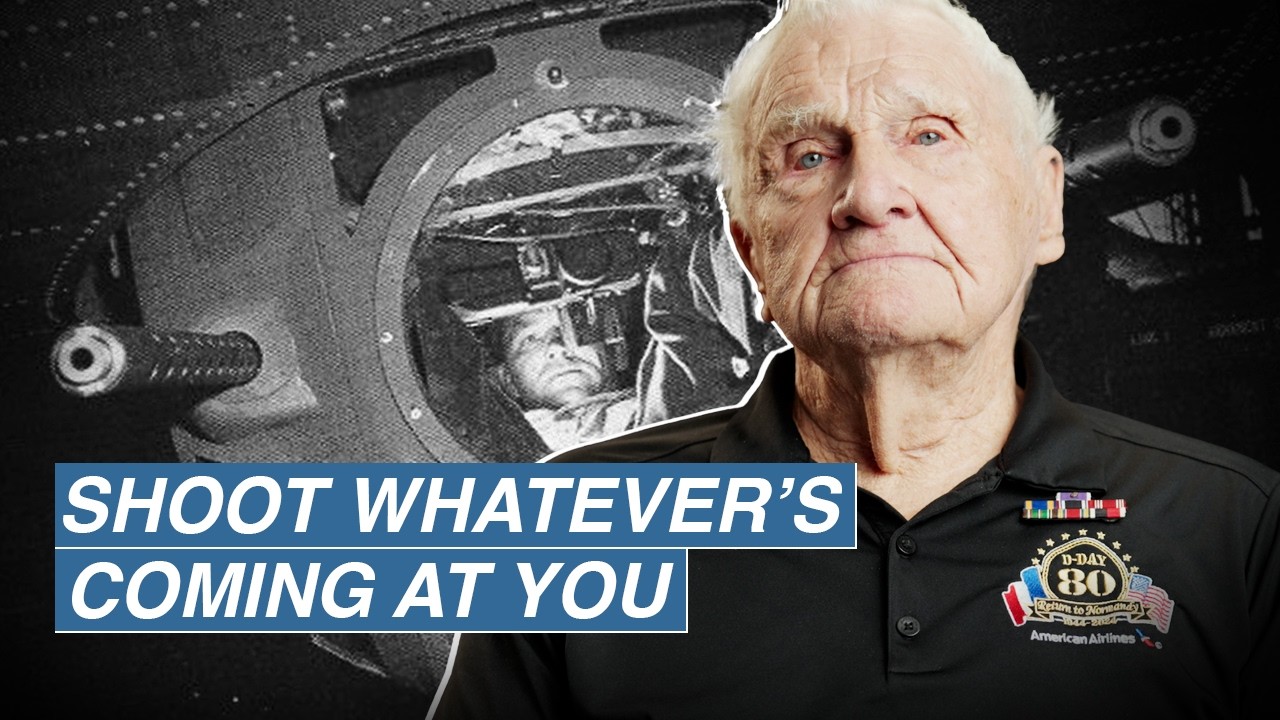
Lester Schrenk was the last man picked for the crew, and the position that fell to him was the one nobody else wanted — the ball turret, a three-foot sphere of aluminum and glass slung beneath the belly of a B-17 Flying Fortress, the most 𝓮𝔁𝓹𝓸𝓼𝓮𝓭 and most lethal station on the most dangerous aircraft of the Second World War.
He had trained on B-25s and B-26s, aircraft that carried no such turret, so he had no idea what he was volunteering for when the pilot asked him aboard. When the weather finally cleared and he climbed into the ball for the first time, he discovered he was far too large for it. He tried to give the position away.
No one would take it.
The ball turret measures exactly three feet across. Inside that sphere a gunner had to fit himself, two Browning . 50-caliber machine guns, all of their ammunition, his oxygen equipment, his heated suit, and a bulky computerized gunsight.
To describe the space as cramped, Schrenk says, is an understatement of the first order.
The typical ball turret gunner stood five feet five, five-six, perhaps five-seven. Schrenk stood five-eleven and a half. He was, in his own words, really scrunched in there.
He could not wear his heavy flying outfit. He could not wear a helmet. He could not wear a flight jacket.
He wore the heated suit and little else, and he was, as he puts it, asking for it.
He had to fold himself down as far as his body would allow, knees nearly alongside his cheeks, doubled up about as much as a man can be doubled. Even then he could just barely see the gunsight, because he was far too tall for the position. And the flights were long.
On a mission lasting as long as fourteen hours, he occupied that folded posture for nearly the entire duration.
By that stage of the war, the Germans could be anywhere, even around the bomber bases in England, and nightly air raids kept crews on edge. Gunners did not climb into the ball for takeoff. Schrenk waited until the aircraft was several thousand feet off the ground, then slipped into the turret while the plane was in flight.
Getting into position and ready to fire took a minute, perhaps two.
That brief window was crowded with tasks. The electric heated suit had a long cord that had to be threaded under his feet and plugged into a socket with a half turn, a maneuver he describes as genuinely unhandy in the confined space. He had to hook up his oxygen mask.
He had to arm his guns. He had to test-fire them. All of it with his knees up in his face.
Operating the turret itself, by contrast, was simple. Two control handles tipped one way or the other, back and forth, and the ball pivoted smoothly. Each handle carried a switch, and either thumb could fire the guns.
The arrangement allowed a gunner to fire both Brownings by depressing either thumb, an elegant piece of engineering inside an unforgiving shell.

When enemy fighters appeared, there was no elaborate choreography of who would shoot at what. You shot at whatever was coming at you. But the training that preceded combat was exhaustive.
Gunners had to memorize the silhouette of every enemy fighter: wingspan, length, every identifying feature, all of it committed to memory before a single round was fired in anger.
Hitting a moving target from a moving aircraft was another matter entirely. German pilots favored a tactic of attacking from high and diving through the formation. The B-17 flew forward at roughly 250 miles per hour; the fighter might come against it at 350.
The closure was violent and rapid. A gunner led the plane as best he could and shot the heck out of it. That, Schrenk says, was about the best you could do.
The guns were . 50-caliber Brownings, and when the moment came to use them, instinct took over. Schrenk describes the first engagement as automatic, everything done without conscious thought, adrenaline flooding the body.
The strange part, he recalls, is that a gunner could be colder than heck, with temperatures dropping to fifty or sixty degrees below zero, and yet find himself sweating while shooting at enemy airplanes.
The arithmetic of survival was brutal. Crews were supposed to fly twenty-five combat missions before being sent home. Schrenk did not know of a single crew that completed twenty-five.
The average number of missions flown before a crew was either killed or shot down, during the period he flew, was 6. 1. His own crew managed ten before they were shot down.
The mission that ended his war began with a small contingent of about twenty B-17s sent to Denmark. They were a decoy, intended to lure the Luftwaffe away from the main targets in the Ruhr. The formation lost four bombers, ten men each.
Of the forty crewmen involved, thirty-one were killed and nine were captured.
When the aircraft was hit and it became clear it would go down, Schrenk had to ask the pilot for permission to leave the ball turret. Permission was granted, and that single exchange saved his life. Most ball turret gunners, he explains, could not escape in time when a plane went down, because too many tasks stood between them and the open air, and because a spinning, burning aircraft offered no time to perform them.
Paradoxically, the ball turret was among the safest places to be during combat. Curled into that small sphere, a gunner presented a smaller target than a man standing upright alongside him. But once the aircraft was shot down, the position became a death trap.
If a bomber had to land on its belly with a gunner still trapped inside, the man was crushed. Schrenk recalls that this happened a few times.

He was ready to jump when the order came, and he was surprised by his own calm. He knew they were going down, and he made the best of it. He said a few prayers and felt sorry for what his parents would go through.
That, he says, was about it.
The parachutes issued to gunners were deliberately made small, because German pilots so often shot at men descending under canopy. The countermeasure was a chute that even training instructors compared to jumping off a two-story building. Schrenk does not think they exaggerated.
He hit the ground hard on a bright, warm, sunny day, with the ground frozen but thawed and muddy at the surface. He slid through the mud.
No one else from the crew landed near him. The right waist gunner reached the door ahead of him, jammed in the opening, and froze. Schrenk kicked him in the rear with his boot and sent him out, then jumped next.
He waited to open his parachute, and when he pulled the cord, the chute did not deploy. It was not, he says, a big deal. He reached down, found the canopy stuck in its covering, pulled it free, and it blossomed out nicely.
He descended to the ground.
Capture was immediate. The crew had already bombed the target and was well out over the water on the way back to England when they were hit. The navigator had told the pilot it was twenty minutes to the nearest land.
Schrenk had permission to leave the turret and plenty of time to sit and wait for landfall. During that time the aircraft trailed fire some twenty-five to thirty feet. The fuel tank kept exploding, each blast so hard it wiped out the flames entirely, until the hot metal re-ignited them.
It went on steadily, and as more fuel burned off, the explosions grew harder and harder. They barely made landfall when one last loud explosion blew the wing tip off.
The crew all bailed out successfully except the pilot, who landed in a lake covered with thin ice and broke through. Danish civilians tried to rescue him. The Germans would not allow it.
They let him die, and only after he was dead did they make the Danes go out and recover his body.
For the most part, the crew was held together at Stalag Luft VI, and their experiences were similar. But the interrogation that followed capture was, in Schrenk’s words, absolutely horrible. For three or four days he had nothing to eat.
He was held in a room with about five hundred other airmen, all shot down within the previous days. In the background came a constant stream of terrible noise: beating, men crying out in pain and begging for mercy, and an occasional gunshot.
Prisoners sat for hours listening to those sounds, not knowing what to expect except that torture was coming. When a prisoner was taken away for interrogation, he never came back to the room. It was a one-way trip, and no one ever learned what happened to him.

When Schrenk’s turn came, he was met by a squat guard who looked like a Hollywood casting director’s dream for the role. The man had one arm. He carried a burp gun, similar to a Thompson submachine gun, and a great scar ran through his face where an eye was missing.
He said nothing. He prodded prisoners with the gun barrel to indicate which way to go.
The interrogator began as though he were a best friend. He greeted Schrenk by name and asked where he had been. Then he walked to a file cabinet and returned with details that stunned the young gunner.
He knew Schrenk had lived on a dairy farm. He named Schrenk’s mother and father. He offered to let them know their son was well and unhurt, and produced a Red Cross form for Schrenk to fill out.
The first lines were easy, because the Germans already knew his parents’ names. But further down the form asked for the type of plane flown and the intended target, military information. Schrenk handed it back blank.
That set the interrogator into a rage. He shouted that they knew Schrenk had flown out of a B-17 and ordered him to write it down. Schrenk gave his name, rank, and serial number.
The interrogator kept pressing, beating him on the head and slapping his face while a German guard behind him jabbed him in the ribs with a gun barrel. The ordeal felt like an eternity, though Schrenk doubts it lasted more than five or ten minutes. Finally the interrogator put the gun barrel to his temple and told him he had better answer the next question or else.
Schrenk remembered the gunshots he had heard, composed himself, and again recited his name, rank, and serial number. The guard kicked him in the rear hard enough to send him flying out the door, and he thanked heaven the interrogation was over.
He later learned that if he had given even the least bit of information, they would have beaten him to a pulp trying to extract more. The training he had received on how to handle capture had been minimal. Instructors told the airmen that Germany had signed the Geneva Convention and that they would be treated fairly.
They said the only requirement was to give name, rank, and serial number, and nothing else. They did not say a word about torture. Schrenk believes the training could have been much better, though he concedes that telling young airmen what actually awaited them might not have been good for them either.
His account stands as a rare first-person record of a station that claimed a disproportionate share of the war’s casualties. The ball turret gunner occupied the smallest space, carried the heaviest equipment, endured the coldest temperatures, and faced the longest odds of escape. Schrenk survived because a pilot said yes to a request, because a parachute that failed to open was fixed by hand, and because a man with a gun to his temple refused to say anything but his name, rank, and serial number.
He was the last one selected for the crew. He was, by his own measure, much too big for the job. And he lived to describe what almost no one else could.