FLORENCE — For more than five centuries, the death of Lorenzo de’ Medici has been shrouded in mystery, with Renaissance physicians baffled by the ailments that claimed the man known as “Lorenzo the Magnificent” at the age of just 43. Now, modern medical researchers believe they have finally identified the true cause: acromegaly, a rare hormonal disorder caused by excessive growth hormone production.
The revelation comes after contemporary analysis of Lorenzo’s reported symptoms and a subsequent examination of his skeletal remains, offering a scientific explanation for the mysterious illness that tormented his final years. The condition, which results from a pituitary gland malfunction, would have caused progressive physical deterioration, severe discomfort, and ultimately death.
 Lorenzo de’ Medici was born on New Year’s Day in 1449 into the powerful Medici family that dominated the Republic of Florence. His life was predetermined from birth. The Medici dynasty, built on generations of banking wealth, had produced Cosimo de’ Medici, one of the richest men in all of Europe and the first to simultaneously lead both Florence and the family bank.
Cosimo established a precedent that would define the family for generations: using vast wealth to fund art and public works. Lorenzo’s father, Piero, continued this tradition, though he showed less interest in managing the family’s commercial affairs, leaving that responsibility to his brother Giovanni. Lorenzo’s mother, Lucrezia Tornabuoni, was a gifted and intelligent woman who wrote sonnets and engaged with philosophers at the local academy.
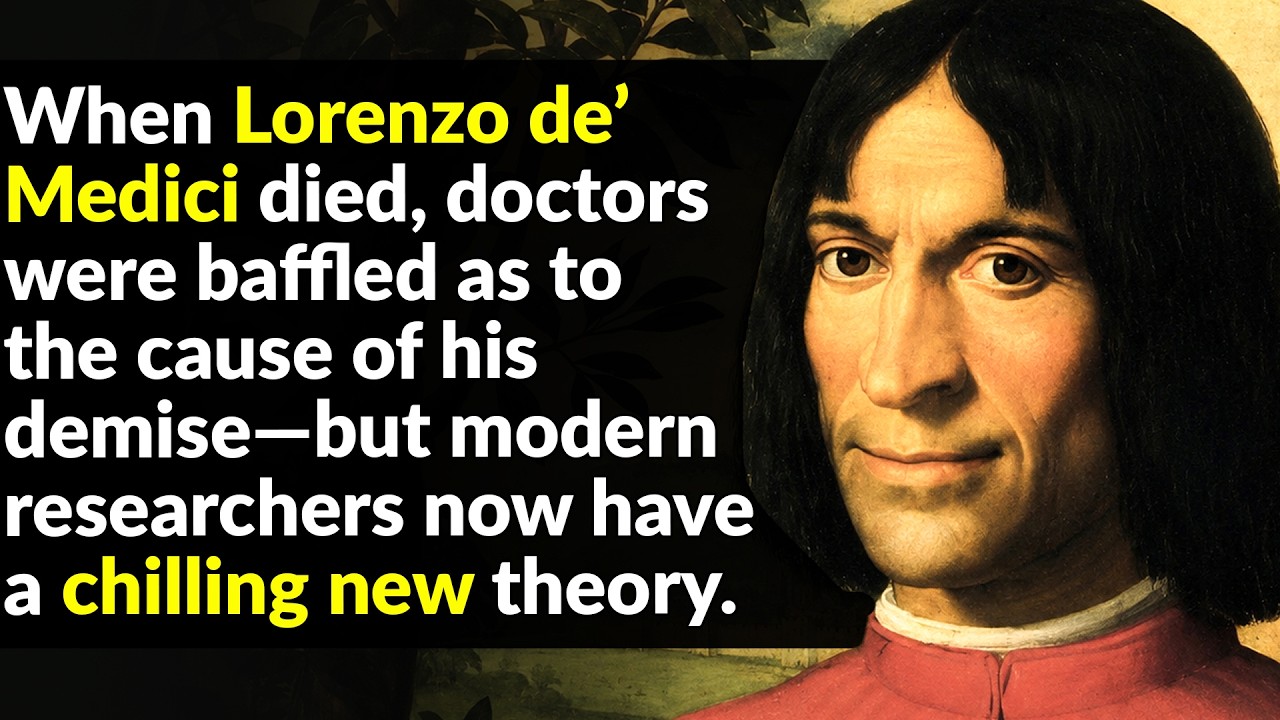
Despite his family’s wealth and influence, Lorenzo did not inherit the striking good looks that characterized many of his relatives. He was described as plain-featured, stocky, with a flat nose and a coarse voice. His younger brother Giuliano, by contrast, was remarkably handsome and appeared far more frequently in Botticelli’s paintings, most notably as the alluring figure of Mars in “Venus and Mars.”
But Lorenzo possessed qualities his brother lacked. Despite his ordinary appearance, he had an extraordinary mind. A close friend, contrasting Lorenzo’s humble looks with his intellectual gifts, noted that nature had been a generous mother in everything she created in his mind.
His dark-complexioned face carried an air of dignity that commanded respect from all who spoke with him.
Recognizing his exceptional potential, Lorenzo’s parents invested heavily in his education. He studied under Bishop Gentile de’ Becchi, the respected Florentine diplomat, and Marsilio Ficino, the leading humanist philosopher. His passion for learning extended to Greek language studies with the influential Renaissance scholar John Argyropoulos.
 Lorenzo’s youth was not confined to scholarship alone. He pursued falconry, hunting, horse breeding, and fencing, the latter becoming a particular passion. In 1469, at just 20 years old, he entered a major jousting tournament sponsored by the Medici family and emerged victorious, an achievement celebrated in a poem by Renaissance poet Luigi Pulci and recorded by Machiavelli himself.
On February 7, 1469, Lorenzo married Clarice Orsini, a union that strengthened diplomatic ties with Roman nobility. The couple would have ten children, though only six survived to adulthood. Following the assassination of his brother Giuliano, Lorenzo and Clarice adopted Giuliano’s son Giulio, who would later ascend to the papacy as Clement VII in 1523.
After the deaths of his uncle and father, Lorenzo assumed leadership of Florence at just 20 years old. Lacking elder family members to guide him, he turned to his mother Lucrezia, who became his closest advisor. Together they navigated the treacherous waters of Florentine politics.
The Medici were never official rulers of Florence, but their immense wealth gave them powerful influence over city politics, making them de facto rulers. Lorenzo governed indirectly through bribes to council members, strategic marriages, and continued philanthropy. In 1471, he estimated his family had spent approximately 663,000 florins on public benefits since 1434, equivalent to roughly $460 million today.
Not everyone welcomed Medici dominance. The Pazzi family, among the most dangerous rivals, conspired against Lorenzo. On April 26, 1478, the Pazzi conspiracy, backed by Pope Sixtus IV, reached its bloody climax in the Cathedral of Santa Maria del Fiore.
 Giuliano was brutally stabbed to death, while Lorenzo escaped with only a minor neck wound thanks to the courageous intervention of poet Poliziano and banker Francesco Nori, who died defending him.
Florence’s citizens, generally devoted to the Medici, rose in fury against the conspirators, executing many Pazzi family members and the Archbishop of Pisa. The failed plot ultimately strengthened the Medici position. Pope Sixtus IV, enraged, seized Medici assets, excommunicated Lorenzo, and placed Florence under interdict.
Undaunted, Lorenzo employed his diplomatic genius. He personally traveled to Naples, surrendering himself as a prisoner to King Ferdinand I. Over several months, he persuaded the king to end the invasion, emerging from enemy captivity stronger than before.
The ordeal enhanced his standing in Florence and allowed him to negotiate constitutional changes that consolidated his personal power.
Lorenzo pursued policies of balance among northern Italian states while keeping other European powers distant from Italy. He maintained good relations with the Ottoman Empire, a major trading partner. However, the family’s financial situation deteriorated significantly during his rule due to mismanagement, costly wars, political expenses, and a series of bad loans.
 In desperation, Lorenzo embezzled credit and state funds in an attempt to maintain financial balance. His efforts largely failed, and as Medici influence waned, the monk Girolamo Savonarola rose to prominence. Ironically, Lorenzo had played a role in bringing Savonarola to Florence in the first place.
As his power diminished, Lorenzo’s health deteriorated. He finally succumbed to his illnesses on April 8, 1492, at age 43. Savonarola visited his deathbed amid rumors that the monk had cursed the ailing banker.
Strange events were reported at the moment of his death: lightning striking the Florence cathedral dome, ghostly apparitions, and fighting among lions in a nearby zoo.
Lorenzo was buried with his brother Giuliano in the family tomb at the Basilica of San Lorenzo. Decades later, his descendants moved the bodies to a new tomb within the same basilica, where Michelangelo’s statue of the Madonna still stands above the final resting place of the Florentine leaders.
Despite the turbulent final years of his life, Lorenzo remained a steadfast diplomat to the end. He negotiated and maintained the Peace of Lodi of 1454, a treaty that preserved stability in Italy. But upon his death, that peace quickly collapsed.
Lorenzo’s steady hand was lost, and his reputation reflected the magnitude of that loss.
The new medical theory about acromegaly offers a poignant explanation for the suffering of one of history’s most influential figures, a man whose intellectual brilliance and diplomatic skill shaped the Renaissance but whose body ultimately betrayed him.