Every human being alive today shares 99. 9% of their DNA with every other human on the planet. If the full genome were printed out, 999 of every 1,000 letters would be identical between any two people, no matter where they live. That measurement stands in direct contradiction to one of the most widely accepted ideas in human history: the belief that humanity is divided into distinct biological races.
The visible differences between populations are real. Skin color, hair texture, and facial features do vary geographically, shaped by generations of ancestors living under different suns and climates. But those traits are controlled by an extraordinarily small fraction of the roughly 20,000 genes in the human genome. The features people use to sort each other into racial categories represent a tiny slice of total human genetic variation, and for most traits, there is more variation between two people from the same population than between the average profiles of populations labeled as separate races.
Race as a biological concept is surprisingly recent. For most of human history, people divided themselves by tribe, clan, religion, kingdom, and language. Ancient Greeks noted visible differences between distant peoples, but they did not build a biological hierarchy from those observations. Romans enslaved people of every appearance, and medieval Europeans enslaved other Europeans.
The institution of slavery did not originally require a theory of biological race. That theory was built in the 1600s and 1700s, deliberately, by people who needed a justification. The transatlantic slave trade was an economic machine of staggering scale, and it created a moral problem for European societies that were simultaneously developing Enlightenment ideas about liberty and human dignity. Those ideas and chattel slavery did not fit together, so some thinkers built a theory asserting that Africans were not fully the same kind of human, that the differences between populations were fundamental rather than visible, and that the resulting hierarchy was natural rather than unjust.
Scientists in the 18th and 19th centuries then spent enormous effort trying to make race real. They measured skulls, cataloged features, and built elaborate classification systems. But the more carefully science looked, the more the categories fell apart. The traits did not cluster cleanly, the boundaries did not hold, and there was never a genetic line where one race ended and another began.
Variation across geography turned out to be a continuous gradient, like the colors of a sunset, not discrete stripes on a flag. When the Human Genome Project completed its work in the early 2000s, the conclusion was unambiguous. Human populations vary, but they do not vary in the discrete, bounded, ranked way the concept of race requires. There is no genome for black or white.
There are populations, frequencies of certain genetic variants, and traces of where ancestors lived, but no biological races. Yet race remains real, just not biologically. This is the part people often find confusing. Money works the same way: a dollar bill is only paper, chemically worthless, but everyone agrees to act as if it has value, and that agreement creates entirely real consequences.
The paper is not magic; the system built around the paper is. Race works identically. The biological categories were fiction, but centuries of laws, inheritance, violence, opportunity, and exclusion built around those categories were not fiction at all. A person classified as black in 1850s America lived inside legal and social realities that shaped everything in their life, not because biology determined it, but because the system built around race determined it.
The fiction had real consequences. This is why dismissing race as nonexistent is insufficient. Dismantling an idea is not the same as dismantling its effects. The fiction was written into law, enforced, and used to distribute wealth and poverty across generations, and those effects are still running today.
What is actually real is human population genetics. Groups of people whose ancestors spent generations in the same region do share certain genetic variants at higher frequencies and carry visible and invisible traces of different ancestral environments. That is genuine biology. But it is not race.
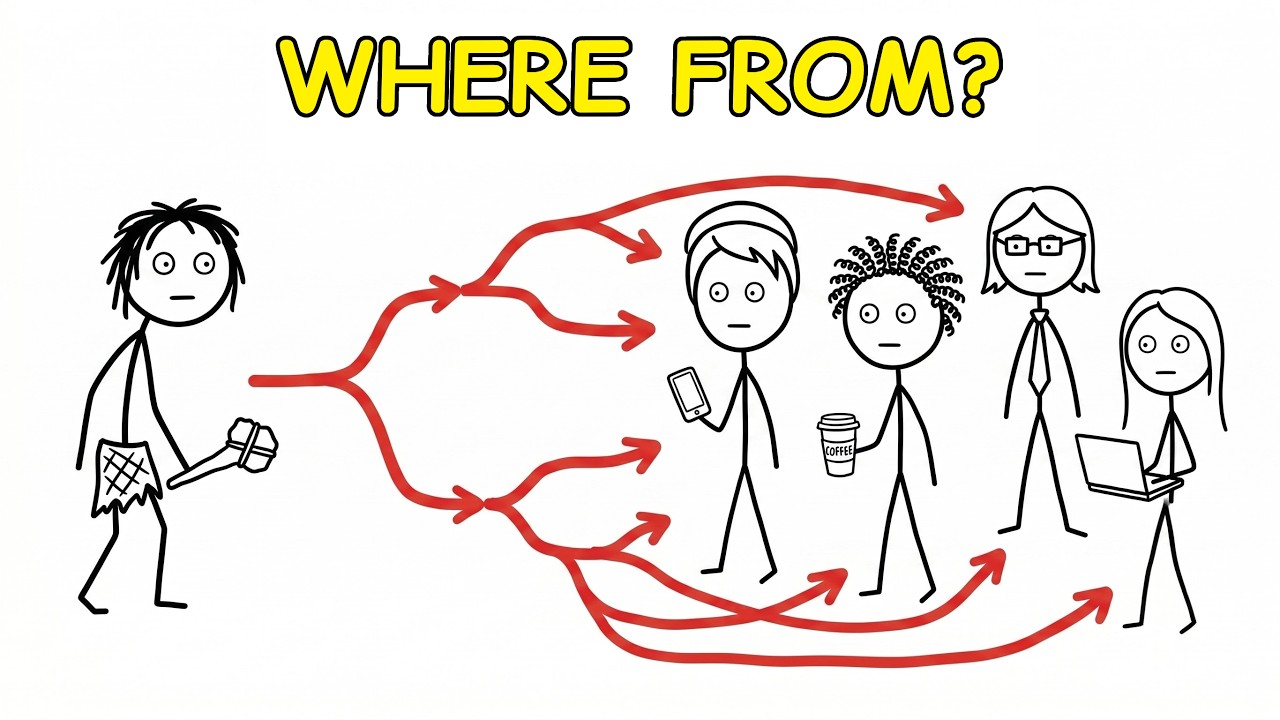
Race claims categories are discrete, natural, and meaningful enough to extend to intelligence, ability, and worth. Population genetics shows variation is gradual, geographically shaped, and tells almost nothing about those qualities. The actual human story is one of movement and mixing. Modern humans left Africa roughly 60,000 to 70,000 years ago, spread in waves, met each other, and mixed.
In some regions they even interbred with other human species like Neanderthals, whose DNA still runs in small amounts through most non-African populations today. Almost no population on Earth can claim a single clean ancestral line. Race tries to draw hard borders through that story, but the story is not made of borders; it is made of movement. Categories themselves are not the problem.
The human brain needs them to navigate the world. The problem arises when categories stop being tools and become prisons, when people forget they drew the line and start believing the line was always there. Humans drew a line around skin color and called it nature, then built civilizations on top of that line. The line felt permanent because the civilizations were real, but the line was always drawn and can be examined.
Examined closely enough, through history, genetics, and actual biology, that line does not lead to natural kinds of humans. It leads back to a small group of 17th-century people who needed a justification and built one. The variation in humanity is real, and every visible difference between populations is a record of where an ancestor lived, a problem they solved, a sky they adapted to, a migration they survived. Underneath the variation, the architecture is the same.
The genome is nearly identical, the family tree connects, and every human alive today descends from the same founding population. Race was the story humans told about that variation, but it was not the truth.