A voice is reading these words inside your head. You are not aware of producing it, yet somewhere between seeing the text and understanding it, a silent narration is taking place. This process is so automatic that stopping it feels impossible. But the question of how you acquired that voice, and where language itself came from, leads to one of the most contested puzzles in all of science.
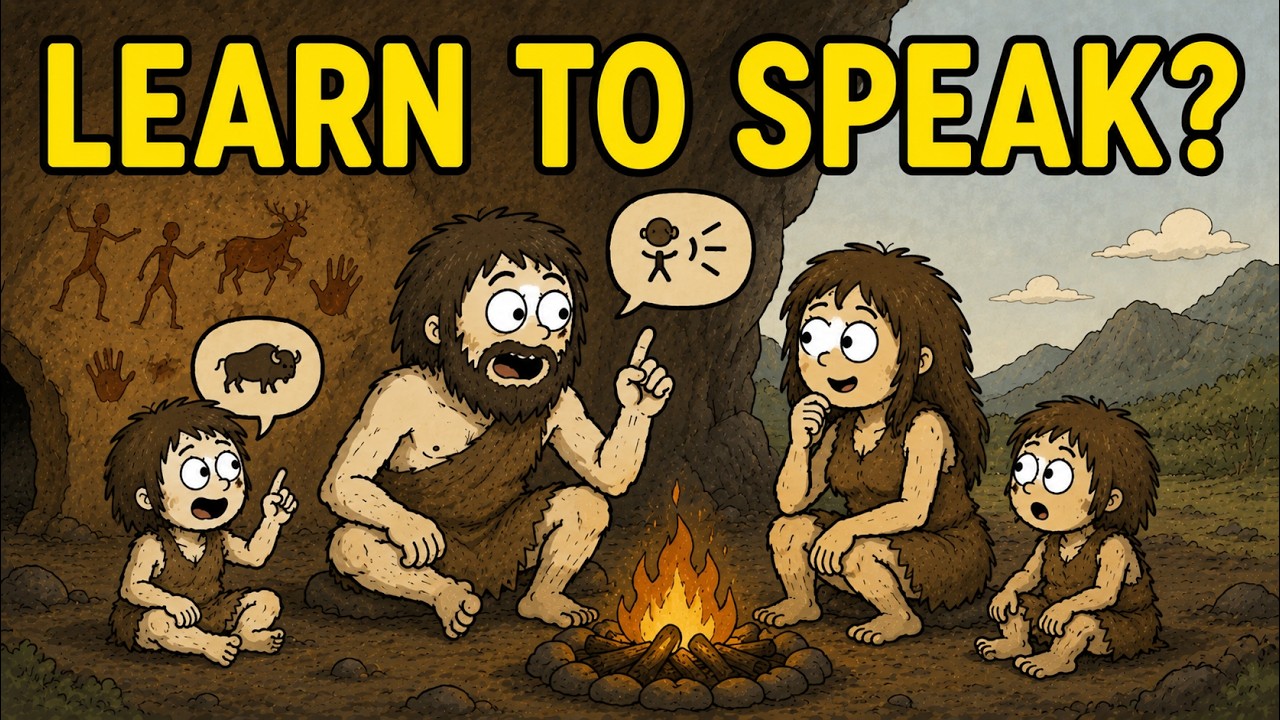
Hundreds of thousands of years ago, there were human ancestors on the African savanna who had thoughts, emotions, and families, yet had never spoken a single meaningful word. They had no names. No one had ever described a memory or told a story. Then something changed.
Understanding what changed, and why, is complicated by the fact that speech leaves no physical trace. You cannot dig up a word or carbon date a sentence. Unlike stone tools or fossils, the greatest transformation in human history vanished into the air the moment it occurred. Homo sapiens appeared around 300,000 years ago with anatomically modern features, but the archaeological record from that period shows little evidence of symbolic thinking.
There were stone tools and signs of fire use, but beads, engravings, and deliberate burials appear much later, roughly 50,000 to 100,000 years ago. Some researchers believe language arose recently as part of a broader cognitive revolution, while others argue it evolved gradually over hundreds of thousands of years. Neither camp has won the debate. Examining animal communication reveals what early humans had to work with.
In the early 1980s, researchers Robert Seyfarth and Dorothy Cheney conducted experiments with vervet monkeys in Kenya. They showed that the monkeys produce distinct alarm calls for leopards, eagles, and pythons, and that the troop responds appropriately to each. When recorded calls were played through hidden speakers in the absence of predators, the monkeys still responded correctly. The sounds carried specific information about the world.
But vervet calls are a closed set. The monkeys cannot combine calls or discuss events from yesterday or tomorrow. The physical machinery for speech took millions of years to evolve. A chimpanzee’s larynx sits high in the throat, limiting the range of sounds it can produce.
In humans, the larynx descended lower, creating a longer chamber that allows the tongue to move in two dimensions. This enables the wide range of vowel sounds essential to spoken language. Fossils of earlier human relatives like Homo heidelbergensis show a transitional vocal tract. In 1989, researchers at Kebara Cave in Israel found a well-preserved Neanderthal hyoid bone dating to roughly 60,000 years ago.
Its shape was nearly identical to that of modern humans, with internal architecture consistent with speech-related stress patterns. Control of breath is equally important. A wider canal in the spinal column, allowing a denser nerve supply to breathing muscles, appears in the fossil record around 600,000 years ago. These anatomical changes made speech physically possible, but they did not create language.
A parrot can produce complex sounds but cannot compose sentences. In 2001, scientists studying a British family known as the KE family made a significant discovery. Roughly half of the 30-person family had a speech and language impairment inherited across three generations. The cause was a mutation in a single gene, FOXP2.
Media outlets dubbed it the language gene, but the reality is more complex. FOXP2 regulates the development of brain circuits connecting the cortex to the basal ganglia, which are involved in learning coordinated sequences of movement. The human version of the protein differs from the chimpanzee version at two positions. Ancient DNA research showed that Neanderthals carried the same two changes, pushing their appearance back to before the split between Homo sapiens and Neanderthals.
More recent genomic analysis has suggested dates as far back as 1. 8 to 1. 9 million years ago. The changes are not uniquely human, and language did not spring from a single recent mutation.
Other intelligent animals, including dolphins and crows, possess impressive cognitive abilities but have not developed anything resembling language. A chimpanzee named Kanzi demonstrated understanding of spoken English sentences, but never spontaneously invented symbols or produced recursive sentences like human children do by age four. The difference involves specific cognitive mechanisms. Joint attention, the ability to direct another’s attention to a shared object, is the foundation of word learning.
It appears much more limited in other great apes. Linguist Noam Chomsky described recursion, the ability to embed structures within structures, as another critical capacity that appears uniquely human. Fire restructured time. Before its control, life was dictated by daylight.
Anthropologist Robin Dunbar argued that the hours around a campfire created a genuinely new category of human time, safe and social. Research on hunter-gatherer communities like the Hadza of Tanzania shows that daytime conversation tends to be practical, while nighttime fireside talk shifts to stories, relationships, and discussions of events from the past and future. Anthropologist Polly Wiessner published research in 2014 documenting this pattern among the Kung San of the Kalahari. Cooking also reshaped anatomy by reducing jaw size over generations, producing a more mobile jaw suited to precise speech movements.
Ecological pressure likely pushed early humans toward more precise communication. Coordinated group hunting required assigning roles, planning ambushes, and responding in real time to unexpected developments. Voice carries further than gesture and works when people cannot see each other. Groups that coordinated hunting through more precise vocal communication would have had a survival advantage.
Cognitive scientist Steven Pinker has argued that language was shaped by natural selection because it conferred real advantages in cooperative activities. A competing view holds that the hands came first. Great apes use gestures in highly flexible, intentional ways, unlike their largely involuntary vocalizations. Mirror neurons in the primate premotor cortex fire both when an animal performs an action and when it observes the same action.
In humans, the corresponding region is Broca’s area, one of the main language regions. Sign languages provide powerful support for this view. They are fully developed linguistic systems with their own syntax and grammar. The Nicaraguan sign language emerged in the 1980s when deaf children were brought together in schools.
Within a single generation, it developed from simple home signs into a complex grammatical system. Infant development offers a compressed view of this process. Newborns prefer their mother’s voice within hours of birth. By around three months, they engage in proto-conversations, matching caregivers’ timing and tone.
By nine months, they begin following gaze and pointing, creating the triangular relationship of infant, caregiver, and shared object. First words typically appear between 10 and 14 months, and grammar emerges gradually. By age four or five, children use relative clauses and construct narratives without formal instruction. Grammar transformed language from a list of words into a system capable of describing anything.
The same words arranged in different orders can change meaning drastically. “The lion followed the hunter” versus “the hunter followed the lion” could be a fatal distinction. Grammar also enables displacement, the ability to talk about times, places, and events that are not present. The evolutionary origin of grammar remains one of the deepest unsolved problems.
Chomsky has proposed a mental operation called merge, which combines elements into larger units that can be combined again. Whether this emerged all at once or gradually is fiercely debated. Neanderthals, our closest evolutionary relatives, coexisted with Homo sapiens for perhaps a hundred thousand years. They had brains at least as large as ours, made complex tools, controlled fire, and buried their dead.
Their hyoid bones were anatomically similar to ours, and their auditory anatomy was tuned to frequencies important for human speech. They carried the same FOXP2 variants. Whether their communication reached the level of grammatical complexity of modern human language is unknown. They disappeared from the fossil record by roughly 40,000 years ago, though genomic analysis shows they interbred with modern humans, and most people outside sub-Saharan Africa carry between 1 and 4 percent Neanderthal DNA.
Some researchers have proposed that differences in linguistic complexity could have contributed to an adaptive gap, with modern humans coordinating across larger groups and accumulating knowledge more effectively. This hypothesis cannot be confirmed but is not implausible. Before language, knowledge died with the person who held it. Techniques could only travel as far as direct observation allowed.
Language changed this completely. A technique could be described, a warning issued about a danger the listener had never encountered, a social rule stated and explained. This shift from knowledge stored in individual minds to knowledge stored in shared language was the beginning of culture. Over 7,000 distinct languages are currently spoken on Earth.
Beneath their surface diversity, all human languages have nouns and verbs, ways of asking questions, marking time, and expressing negation. They use a small set of sounds combined in rule-governed ways. These universals suggest a shared underlying cognitive architecture. The first true word, a sound used deliberately with shared understanding of its meaning, is lost forever.
Every word spoken before the invention of writing, approximately 5,000 years ago, has been absorbed by the air. The physical prerequisites for speech were in place at least several hundred thousand years ago, and the social and ecological conditions favoring complex communication were present even earlier. By the time humans produced symbolic art tens of thousands of years ago, they almost certainly possessed language capable of supporting complex symbolic thought. But the specific sound, in the specific moment, by the specific person that crossed the threshold from signal to symbol is gone.
Language was not invented the way a specific individual invents a device. It evolved biologically over millions of years and culturally over hundreds of thousands, through countless interactions among countless individuals responding to the pressures in front of them. Biological evolution favored individuals who communicated more effectively. Cultural evolution happened through imitation and coordination.
When one person produced a sound that others associated with a consistent meaning and began using themselves, a word was born. The first meaningful sound was probably not recognized as an invention. It was just a sound that worked.
Out of that unremarkable beginning came every word in every language ever spoken.