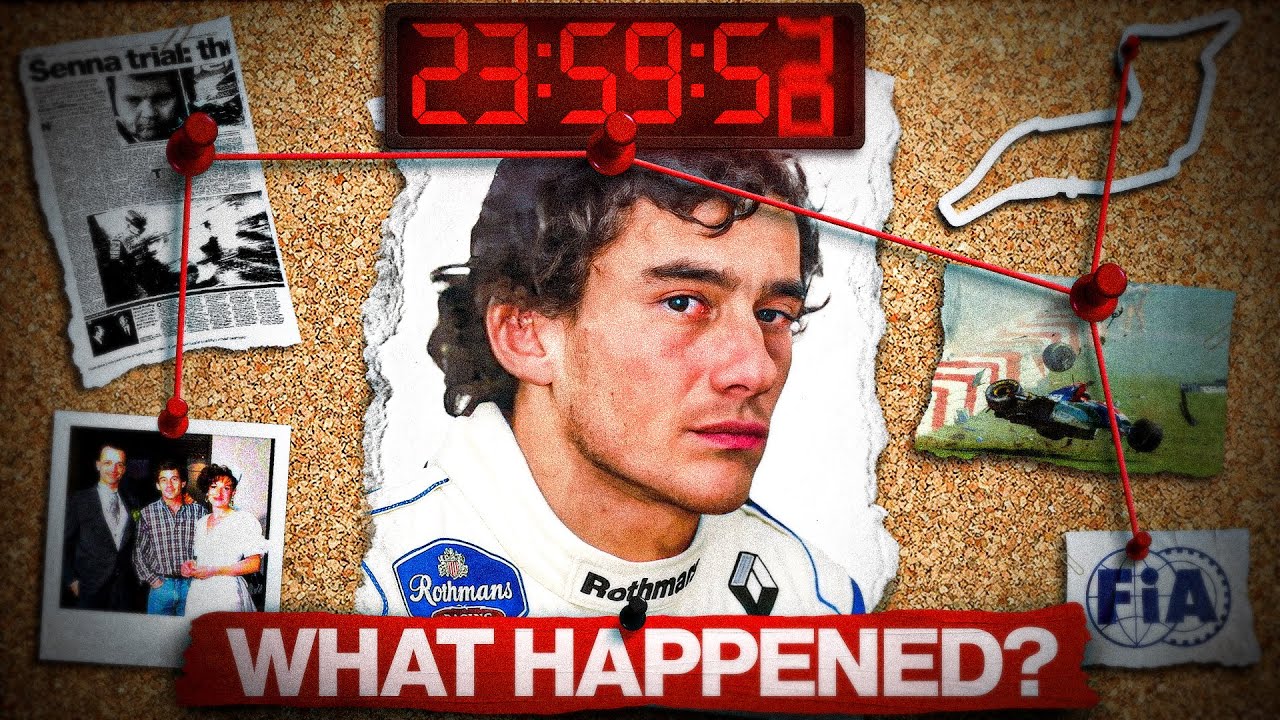
IMOLA, Italy — The blackest weekend in the history of Formula One began not with the roar of engines but with a sickening thud against a concrete wall, a sound that would echo through the sport for three decades and counting. On April 30, 1994, during Saturday qualifying for the San Marino Grand Prix, Austrian driver Roland Ratzenberger, just 33 years old and competing in only his third Formula One weekend, suffered a catastrophic crash at the Villeneuve curve. His Simtek-Ford slammed into the barriers at speed, the impact so violent that the car was left twisted and lifeless.
Within hours, the Majori Hospital in Bologna delivered the news that no one in the paddock wanted to hear: Ratzenberger had succumbed to his injuries. It was the first fatality in Formula One since Riccardo Paletti at the 1982 Canadian Grand Prix, and for a generation of drivers, mechanics, and journalists, it was the first time they had to confront death in their sport.
 The man most shaken by the tragedy was Ayrton Senna. The three-time world champion, then driving for Williams-Renault, had watched the crash unfold on a garage monitor and could not contain his emotion. He climbed into an official car and rushed to the Tamburello corner, arriving moments after Ratzenberger had been airlifted to the hospital.
What he found was a scene that would haunt him: the Austrian’s car sitting motionless, its driver already gone. Back in the pits, Senna went straight to Professor Sid Watkins, the head of the FIA medical team and a man he considered a genuine friend. He hoped for good news.
Watkins could only deliver the worst. The news rippled through the paddock like a shockwave. The atmosphere turned heavy, funereal.
Drivers, engineers, and team personnel wandered in a daze, asking one another what they were even doing there. The point of it all seemed to evaporate in an instant.
Senna was not merely another competitor that day. He was the sport’s conscience, its elder statesman, the guardian of a close-knit community of drivers who risked their lives every fortnight. He took Ratzenberger’s death personally.
At the end of 1993, he had already begun planning an independent safety commission, but those plans had been put on hold because of a two-race suspension hanging over him. He had been one of the harshest critics of the FIA’s regulatory changes for 1994, changes designed to slow the cars and improve the racing. The governing body had banned controversial electronic aids such as active suspension and traction control, devices that had allowed the richest teams, like Williams-Renault, to dominate.
The idea was to make the cars harder to drive, more unpredictable, more exciting. The reality was that the cars remained blindingly fast but became twitchier, more prone to sliding, and far less forgiving. It was, as many would later observe, a recipe for high-speed crashes.
The weekend had already been marred by violence. On Friday, during practice, the young Brazilian Rubens Barrichello had slammed into the barriers at over 140 miles per hour. The crash looked brutal, and Senna, who regarded Barrichello as his heir and the next great Brazilian driver, was visibly distraught.
He was the first person to arrive at the hospital to check on the young man. Barrichello escaped with a small fracture to his nose and a dislocated rib, a miracle given the ferocity of the impact, but the incident left the entire paddock uneasy. Ratzenberger’s death the following day only deepened the sense of dread.
Senna was completely shattered. Watkins, seeing how shaken his friend had become, asked him why he did not simply retire from the following day’s race, or from the sport altogether. Senna grew upset and wept.
Watkins told him he had been a three-time world champion, the fastest man in the world, and that he liked fishing. Why not quit, Watkins suggested, and the two of them could go fishing together. Senna replied that he could not quit.
When qualifying resumed, Senna did not go back out on track. His earlier time still held, and he ended up on pole position. Yet he did not appear at the pole position winners’ press conference.
Neither did Michael Schumacher, who had finished second. Only Gerhard Berger, who came third, attended. Senna was summoned to a meeting with the race stewards, led by race director John Corsmit, who wanted to reprimand him for taking an official car to the crash site.
Given the tragic circumstances and Senna’s evident emotional state, Corsmit decided not to take further action. For Senna, Ratzenberger’s death was devastating. He saw himself as the protector of the drivers’ community, and he had taken the loss as a personal wound.
That evening, he fulfilled his obligations with the team and the press, but he could not get the images out of his head. After two retirements in the first two races of the season with his new team, Williams, he had arrived at Imola hungry to win and restore his credibility. He was the best driver, now in the best team, and the pressure to win was immense.
 But the car had proven incredibly tricky and difficult to handle. Imola was supposed to be a key race in the championship fight against Schumacher’s Benetton, the big favorite after two wins. Senna’s dominant days with McLaren were behind him, and in a new team and environment, he had to prove himself all over again.
But none of that mattered anymore.
After finishing his track commitments, Senna returned to the Hotel Castella, about twenty minutes from the circuit, the place he usually stayed with a small team when he raced at Imola. When he arrived, he spotted a couple celebrating their wedding in the hotel restaurant. They asked for a photograph, and he happily agreed, wishing them all the best.
He then headed up to suite 200, the room he usually stayed in, to drop off his belongings. A bit later, he went to Trattoria Romagnola with friends and journalists to celebrate the birthday of his physiotherapist, Josef Leberer. After receiving a message from Frank Williams, he went to see the team owner in his room.
By then, Senna seemed a bit more at peace and told Frank he was ready to race the next day. Around midnight, he went to bed with his head full of thoughts that would not let him sleep well.
He woke, gathered his things at the hotel, and flew by helicopter with his friend and fellow driver Gerhard Berger to the circuit for the warm-up session that traditionally precedes the race. During the session, Senna filmed an in-car lap with commentary for the French broadcaster TF1, hosted by his old rival Alain Prost. “A special hello to my dear, our dear friend Alain,” Senna said.
“We all miss you.” He finished first in the session and told his engineer there was no need to change anything because he was happy with the handling. It seemed, at last, that things were going well with his Williams after so many problems at the start of the season.
The drivers gathered for the usual Sunday morning race briefing, and Senna arrived with Berger. Everyone observed a minute of silence to remember Ratzenberger. Afterward, Senna raised his concerns about the use of the pace car during the warm-up lap.
The pace car had been introduced only two weeks earlier at the Pacific Grand Prix in Japan to keep the cars grouped before the start. Senna argued that it did not go fast enough to properly warm up the tires. Everyone agreed, and they decided to drop the pace car for the formation lap.
Senna was also worried that the safety car was not fast enough. During the meeting, he spoke with other drivers about holding another safety meeting when they reconvened in Monaco. He, Schumacher, and Berger had already agreed to explore bringing back the Grand Prix Drivers’ Association, which had been dissolved in the early 1980s and originally created to discuss precisely these kinds of issues.
After some team commitments, Senna shut himself away to gather his thoughts and find maximum focus, a routine he always followed. He felt the pressure weighing down on his shoulders. It was going to be a crucial race for the championship.
Half an hour before the start, he was restless, and those around him could tell. He did not want to race. Not because he believed something bad was going to happen.
He was sure he was going to win. He knew he had a well-built car, well prepared by the mechanics. But he wanted to get this tragic weekend over with and go home.
His mind was miles away, but it was time to race.
 The lights went out, and chaos erupted almost immediately. A big crash between Pedro Lamy’s Lotus and JJ Lehto’s Benetton brought out the safety car, and the entire paddock was on edge. While marshals cleared the debris, the drivers cruised behind the safety car.
Senna’s warning had been prophetic. Lap after lap, the tires grew colder, and the safety car simply was not pushing the pace. The tension built.
By lap six, the race restarted, with Senna and Schumacher pulling away from Berger and Damon Hill. It was clear the battle would be between those two. Even with a fully loaded car and cold tires, Senna was flying, pulling a gap on Schumacher.
Both were pushing at extraordinary speeds.
Then came the moment that changed everything. Senna’s Williams left the track at Tamburello, a flat-out left-hand curve, and struck the concrete wall at approximately 130 miles per hour, almost head-on but at a slight angle. The impact tore the right front wheel and the nose cone from the car, and the chassis spun before coming to a stop.
Senna remained motionless in the cockpit. Five fire marshals rushed to the scene before the medical team arrived. Then Watkins appeared in the medical car and confirmed it was Senna who had crashed.
Fear and confusion gripped the paddock once more. What was happening this weekend? Senna was airlifted to Maggiore Hospital while everyone waited anxiously for updates.
At 2:55 p. m. , the race restarted.
Schumacher won, followed by Gerhard Berger and Mika Hakkinen. But there was nothing to celebrate. “I mean, just win a race but I can’t feel satisfied,” Schumacher said afterward.
“Can’t feel happy. What happened this weekend? Never have seen something like this.
Not just one thing, so many things.” While the world waited through agonizing hours for news, the outcome was already sealed. The official time of death was 2:17 p.
m. Ayrton Senna, three-time world champion, was gone. The moment his Williams hit the barriers, Formula One would never be the same.
Bit by bit, more details emerged. The medical team confirmed that a suspension rod from the car had pierced Senna’s helmet visor, causing a fatal head injury. They found that he had an Austrian flag with him, which he had planned to wave after the race to honor Ratzenberger.
A full investigation followed. The Italian authorities concluded that the cause was a faulty modification to the steering column made by Williams, claiming it led to the accident. Williams argued that the column broke after the impact, not before.
 The case dragged through the courts for years, but the team was eventually cleared. Other theories pointed to Senna losing grip because the tires were still too cold after the safety car period. Even at racing speed, Tamburello is not a corner where a driver would ordinarily make a mistake.
Something on the car would have had to fail. Perhaps the power steering. Perhaps the tire temperatures caused the car to skate straight off the road.
The unfortunate reality is that we will never know, and we will never get him back.
Senna’s death did not just shake Formula One. It hit people all over the world. Back in Brazil, the government declared three days of national mourning and gave him a full state funeral.
Over a million people lined the streets for the procession to his burial. He was not just a racing driver. He was a hero, someone a great many people looked up to.
After everything that happened, his legend only grew. Even now, he is still seen as one of the biggest names in the sport, someone from whom we can learn a great deal, and who lives on in the hearts of fans everywhere.
Retired champion Niki Lauda brought back the Grand Prix Drivers’ Association in Monaco as a tribute to Senna. “At the drivers’ meeting of today, we agreed to form the Grand Prix Drivers’ Association,” Lauda announced. It was agreed that the representatives of the GPDA would be Lauda, Schumacher, and Christian Fittipaldi.
From there, a series of major changes began that massively improved Formula One safety throughout the decade. Track layouts were updated. Barriers were reinforced.
Tire walls were added. Stricter safety standards were put in place. Cockpits received higher sills.
Engine sizes were capped at three liters. Barely five years later, the cars and circuits looked entirely different. It was night and day.
There were no fatal accidents in Formula One for over twenty years, until October 2014, when Jules Bianchi suffered a crash at the Japanese Grand Prix that sadly took his life months later.
The legacy of that weekend at Imola is not merely one of tragedy. It is a legacy of reckoning. A sport that had grown complacent in its pursuit of speed was forced to confront the human cost of its own spectacle.
Senna, who had spent his final hours advocating for the safety of his fellow drivers, became the catalyst for the very reforms he had demanded. He did not live to see them, but every driver who has walked away from a crash since owes something to the work he began in those last twenty-four hours. The Austrian flag he carried in his cockpit, never waved, remains one of the most poignant artifacts in the history of motorsport.
It was a gesture of solidarity, a promise of remembrance, and in the end, a symbol of everything that was lost and everything that was learned.