The great dining room blazed with light and heat. The long table was set with silver and crystal, and the guests, the finest names in the county, had come in their silks and their jewels to see the Duke of Ravenwood’s new wife. They whispered behind their hands and smiled with sharp teeth, for this was the night the Duke had chosen to humble his old wife, the merchant’s daughter, the woman he had bought with his title and then grown tired of. And on his arm, glittering from head to toe, was a woman Beatatrice had never once seen at her table before, a woman with dark hair and a cold, knowing smile, a woman who held her clutch of money and secrets like a weapon.
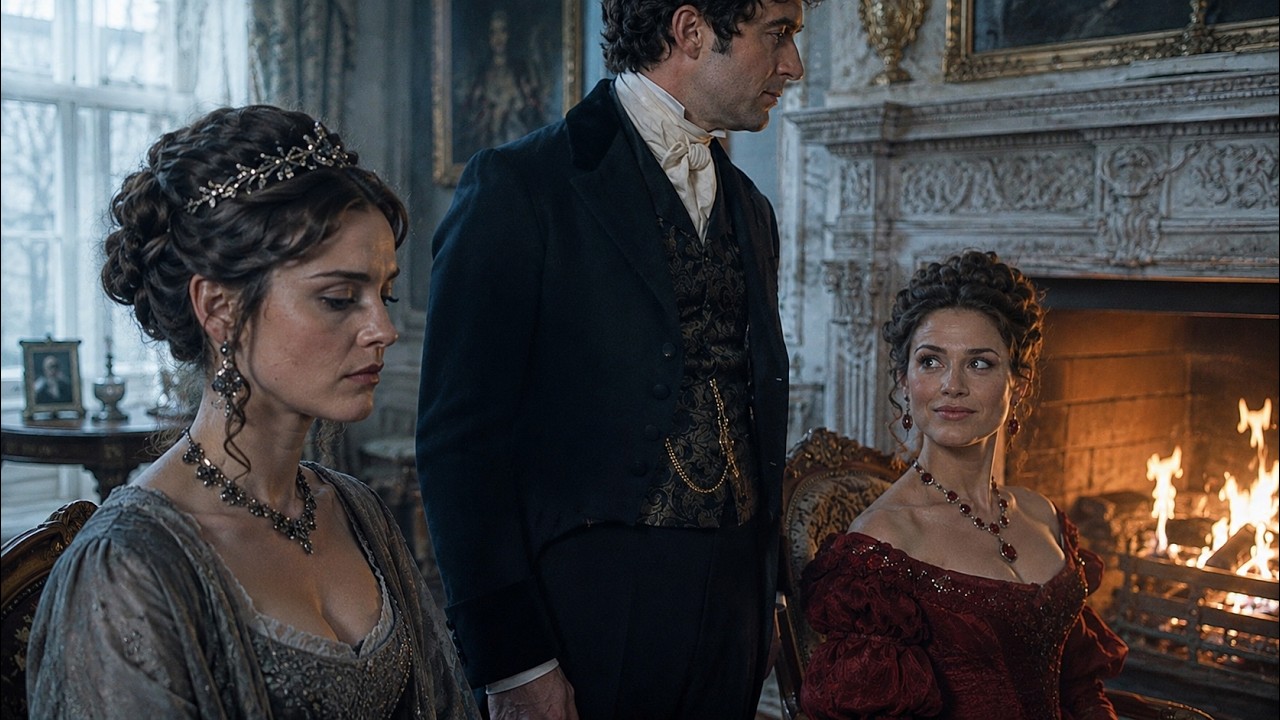
Beatatrice stood in the doorway of the great room, still in her plain gray gown. She had worn no jewels and no paint, and she had watched them all arrive, the carriages crunching over the snow, the laughter floating up the stairs. Now she stood very still, and she felt the eyes of the house turn on her, waiting for her to break, to cry, to shrink away into the cold. But she did not give them the satisfaction.
She gathered the folds of her gray gown, lifted her chin until her neck ached with the effort of it, and walked the length of the room, past the stares and the whispers, until she came to her husband’s side. The woman in gold watched her with a thin, amused smile. Julian, the Duke, did not look at her at all. He was pouring wine and speaking too loudly to the man beside him, refusing to acknowledge that his true wife was standing there in front of all his guests.
Beatatrice drew close to one of the footmen, a young man named Ellison who had always been loyal to her, and she pressed something into his hand, a folded piece of paper, and closed his fingers around it with a surprising strength. “This must go out tonight through the storm if you can manage it,” she said, so low that only he could hear. “Do you understand me? It must leave before morning.
” Ellison looked at her, into her steady gray eyes that held no tears, and he understood something that did not need to be spoken. He was a servant of the house, a man the Duke would have crushed without a thought, but the woman in front of him had always been kind to those the Duke forgot. He nodded once, slipped the paper into his coat, and disappeared toward the back of the house and out into the storm. Beatatrice watched him go, and then she turned and walked back to her own cold chamber, whose door stood open like the mouth of a grave, and she sat down on the edge of the bed and smoothed her gray skirts over her knees.
She should have known the servants would whisper, and that the whispers would reach even here. All the next day, the house buzzed with the news. The Duke had thrown his wife out of their chambers, out of the center of the house, out of his life. The chambermaids spoke in low, breathless voices of the scene when they thought no one was listening.
Sophie, her daughter, had heard them. She crept into her mother’s cold room, her small face pale with worry. “Mama? ” she said.
“Why is the woman in your room? Why did the lady with the pretty dress not want me to touch her things? ” Beatatrice pulled her daughter onto her lap, and she smoothed her hair and held her close, and she did not let the girl see the fear in her eyes. “Listen to me, my dearest,” she said.
“Do you understand the story of the cranes, how they nest in the high places to be safe from the foxes? But the foxes can climb, and so the cranes give away their eggs to the rocks, so the foxes have nothing to eat and go away. Do you understand me? You are my egg, Sophie, and I am your crane, and I will not let the foxes have you.
Never, ever, no matter what anyone says to you, no matter what your father tells you, you are mine. ” Sophie studied her mother’s face for a long moment, and then she nodded, satisfied, and leaned into her arms. To understand how Beatatrice, a merchant’s daughter, came to be sitting in the cold in that house at all, you must understand how she came to Ravenwood Hall in the first place. She had been the daughter of a man rich in trade, a man who had built his fortune on cloth and good judgment, but who had always been looked down on by the titled gentry who borrowed his money and mocked his accent behind his back.
He had wanted more for his only child, and so he had arranged a marriage with Julian, the Duke of Ravenwood, whose title was old and mighty but whose debts were creeping up around his neck. Her father promised to pay them all off, every single one. And in return, the Duke would be faithful to his daughter and a good father to her children. Men of honor, he had said, needed no written contracts, the word of a duke was worth more than any piece of paper.
They shook hands on it, and the great fortune flowed into Ravenwood Hall, and the debts were settled, and the Duke breathed easier. Beatatrice had tried hard to love him the way a wife was supposed to, and for a few years, she had thought she might. And when Sophie was born, she poured every ounce of love she had into her daughter and asked for nothing in return. Then one day, not long before the dinner, a letter had arrived from her father’s solicitor, a man named Edward Crane.
The instructions in it had been written in her father’s own hand, sealed and set aside years ago, meant to be opened only under certain conditions. Inside were careful instructions and warnings that made little sense at the time. “There are things you do not yet understand about your father’s affairs,” Crane wrote. “Do not fight to understand them all at once.
But mark this: as long as you trust no one in that house, and above all trust no one with your mind or your heart, you are safe. If a single word of what I have to tell you were to reach your husband’s ears before the proper moment, all that your father built to protect you would be undone, and you and your daughter would be left with nothing. ” And then came the final, most important words: “Above all, mark this well: your husband must never learn that we have spoken. ” She had burned the letter over the candle flame that night, watching the corner of the page curl and blacken.
And for the first time in nine long years, she was not afraid. But after the woman in gold had arrived, after Julian had thrown her out, she could not simply wait for a letter to show up. She needed advice, and she needed it now. Julian was making appointments, planning to cut her off, talking openly about sending her away and keeping Sophie inside the house.
A father’s right over his child was near absolute in the eyes of the law, a mother’s near nothing. If Julian said the child would stay and the mother would go, then that was the law, and there was no court in the land that would tell a duke otherwise. She had to get to Crane’s office, to that trusted solicitor whom she had never met. It was madness.
The roads were watched, her husband’s spies were everywhere, and she had no money of her own. A wife had nothing. The law gave her husband everything. She must simply endure.
There was one man who could help her get out, one man who owed her everything and hated Julian with a deep and righteous fury. His name was Ellison, the young footman to whom she had given the note. He had been in the family’s service for only two years, but appearance could be deceiving. And he had come to her one afternoon, his face grim.
“Your grace,” he said, keeping his voice low. “I did what you asked. I left your letter at the offices of a certain solicitor in the city, Mr. Edward Crane, but I was followed.
I am certain of it. And the man who followed me asked after me by name. ”
Beatatrice felt her blood turn to ice. “Then you must leave at once.
It is not you he wants, Ellison. He will use you to get to me, to have me watched more closely. ”
“I’m not afraid of him,” Ellison said, and his eyes were hard. “But I went on my own time, and I began to look into some of those things you asked about.
I found your name in a registry, your grace. And a trust. A schedule of payments that made no sense to me at first, and then it did. ”
“Do you understand it all?
” she asked. “Let me tell you a story instead,” he said. “When your father sold his business and settled his affairs, he did not hand over all of it. Not to the Duke, not to anyone.
He set a part of it aside, a very large part, with a trusted man to keep it safe. He was a careful man, was your father, and he did not trust the woman who had crept into your life any more than you do now. It was the last thing he did before it happened. ”
“Before what?
” Beatatrice asked, though she already knew. “The lady is a fraud,” Ellison said. “Her name is not Vivienne. She is a woman called May Harkness, a clerk’s daughter who learned to be a confidence trickster, and she has been running an elaborate game for years.
She reads the newspapers and the court reports, the respectable ones and the less respectable ones, and she finds a great man with a great name and a growing debt to match, and she becomes whatever he needs her to be in order to take the last coin he owns. Your husband has been her mark for over a year. ”
Beatatrice sat down heavily, because she had expected many things, but not this. All the time she had told herself that a wife had nothing, that the law gave her husband everything, that she must simply endure.
But if her father had hidden the fortune, if Julian had never controlled the money at all but had only been lent it on the condition of good behavior, then everything was different. The power, the real money, the fate of the house, the fate of her child, it all rested with her. She would need Ellison, not as her only wall, but as a witness and a guide through the papers. And a man about to be gloriously avenged.
And so the plan was laid. They had the names of the other victims from the letters, the false names and the furious widows and fathers scattered across the country who had been ruined by the man who called himself Julian’s agent. And in a bank vault in the city, under the care of a trustworthy banker, lay a letter that Ellison had retrieved, written in her father’s hand and sealed with his ring. Now she had a weapon with teeth.
Then, three weeks after the night the woman in gold came to stay, the month was up. Julian had had his fun. On the morning of the dinner he had planned, he appeared at the foot of her stairs with the woman in gold on his arm and a look of pure triumph on his face, and he said, “I have decided that arrangements need to be made. You will be gone by the end of the month, and Sophie is to stay.
”
Beatatrice looked at him, and she did not flinch. She had heard she would be leaving, but her face showed nothing, no surprise, no despair, no plea. She had learned long ago that her silence unsettled him more than any words could. And that afternoon, she sent out letters, dozens of them, to every name her father had left her, and to the lawyers in the city whom she had never met but who had been instructed and paid years in advance to act the instant they received a certain word from Beatatrice herself.
They could not be frightened by a hard-faced man or bought by a gold coin, because they were a hundred miles away and answerable to no one but the law and their own good names. The night of the dinner came clear and cold with a hard, bright moon over the snow. Beatatrice had planned every detail herself. The guests arrived in their finery, expecting a grand celebration, and Julian grew comfortable and expansive, holding forth to the table as he loved to do, laughing too loudly and keeping the woman on his arm close.
Beatatrice came down late, and the guests went quiet, because she was dressed not in her gray but in a gown of deep blue velvet with a pearl choker, and she looked like a woman attending her own funeral. Then she lifted a small silver bell from the sideboard and rang it once, a clear, sharp, carrying note. The room fell so silent that the fire could be heard cracking in the grate. “I have asked you back tonight,” she said, her voice carrying easily through the great room, “because it is right that the same witnesses who saw the beginning of a thing should see the end of it.
”
Julian laughed. “Now, my dear, you are being dramatic. Sit down and let us not make a scene in front of our guests. ”
“I intend no scene,” she said.
“And I will stand, if it is all the same. You have been told that my husband’s fortune is his own, to spend as he pleases, and that I am a merchant’s daughter who was bought with a title, and may now be discarded. ” She paused, and then she let the words fall like stones. “That is not true.
The great fortune you have spent these years was never yours. It was mine. My father did not give it to you, Julian; he only permitted you the use of it. He placed it in a trust years ago, which you have never controlled and do not to this day understand.
And there is one condition attached to your allowance. ”
The silence in the room was absolute. The woman in gold had gone rigid. “The income my husband has lived upon all these years flowed to him on one condition only,” Beatatrice went on, never raising her voice, letting every clear word fall into the silence like a stone into still water.
“That he remain a faithful husband to me and a fit guardian to our child. Should he ever openly take another woman into his house and set his wife aside, the income would stop at once, not after some long battle. And upon such a breach, the full control of the entire fortune, and with it the power over every debt secured against the estate, passes into my hands alone, beyond any power of your husband’s to touch. It is written, and it is law.
”
Julian’s face had gone white, then red, and then a terrible, mottled shade of fury. “Lies! ” he roared. “This is the fantasy of a jealous, spiteful woman!
I will have the lawyers take this to court! ”
“Do that,” Beatatrice said softly. She reached into the small pocket sewn into the seam of her gown, and drew out a folded letter, old and yellowed. “But you must understand that I do not stand here alone.
I have the signed attestation of your own steward, and two further witnesses who have no love for me but who will not swear falsely, which shows that you have been pawning the silver to pay the bills to the money-lenders. ” She let that sink in, and then she turned to the woman in gold, and her voice dropped to a clarity that cut through the room. “And as for you, madam, you have brought nothing to this house but debts of your own. You have the audacity to stand in the home of a woman you have wronged, wearing her flowers and drinking her wine, and you have the nerve to smile as her world comes apart.
But your scheme is at an end. I know that your name is not Vivienne. I know that your name is May Harkness. ”
For a moment, the woman in gold went entirely still.
Then she let out a high, brittle laugh. “You are a common merchant’s daughter,” she said, “and you are speaking in a room full of your own enemies. Do you think any of them will believe a word you say? ”
“They will believe the papers I hold,” Beatatrice said.
She drew a second page from her pocket. “They will believe the sworn statements taken from the man who helped you forge the signatures of Julian’s family on the promissory notes that have been bleeding this estate dry for a year. They will believe the letters you wrote to him, in your own hand, detailing how you would marry your way into wealth and then bury the evidence in a bog. I had one of my husband’s men search your rooms this afternoon.
We found the evidence, and a bag of coin that you took from this very house. ” She turned and looked directly at the woman. “Run. Take whatever you can carry and leave this place before I have the constable and a charge of fraud laid against you.
Leave, and do not try to stop me, or I will see you in debtors’ prison before the month is out. ”
The woman in gold stared at her, her face a mask of pure, naked hatred and terror. Then she picked up the skirts of her dress, turned, and ran from the room. No one tried to stop her.
Her carriages were waiting, and a hoarse cry echoed from the hall, a slamming door, and then the sound of wheels crunching over the frozen snow, fading into the night. She was gone. Julian had not moved. He stood swaying slightly, his face a paper-white mask of rage and confusion.
“You think you have won? ” he hissed, but his voice was thin. “You have ruined me. You have ruined our daughter.
My name is in tatters, and you will take nothing from me. ”
“I will take everything,” Beatatrice said quietly. “I will take this house, which is mine by right of the trust. I will take the main part of the fortune, which was my father’s and was never yours.
I will take the respect of these people, such as it is. ” She looked around the table, meeting each guest’s eye. “And I will take my daughter, who you have tried to use as a weapon against me, and I will raise her in honesty and decency in a place where she can grow up loved. She will not grow up here, watching a mother destroyed by a father who does not care for her.
She will be safe from you. ”
She turned back to Julian, and her voice was no longer cold, but flat and final. “Well, my dear husband. You wanted a divorce so badly.
Now you shall have one. You may keep your title. You may keep your good name, such as it is. I will keep the money, and the house, and the child, and you will leave this place within the week.
”
Julian stared at her, his mouth open. Then, slowly, a terrible, nasty smile spread across his face. “You are a fool, Beatatrice,” he said, his voice silky with hatred. “You think you have checkmated me.
But you have forgotten the most important thing. I am a duke. The house and the land are entailed to the title. You cannot take them from me, trust or no trust.
The money is in your name, but this is my house, and this is my inheritance, and you will not take it from me. ”
He looked around the table, seeking allies, finding nothing but averted eyes. “I will see you frozen out of this house before the week is out,” he snarled. “The law is on my side.
I will take that child, and you will never see her again. ” He made a lurching step toward the door, and then Beatatrice spoke once more, and her voice was so quiet that everyone in the room went still to hear it. “Before you go, Julian, there is one more thing I must tell you,” she said. She looked at the fire, and then back at him.
“You spoke of the law. And you are right, Julian. The law is on your side. But you forgot about the debts.
The debts you have been piling up all these years, the money you thought you had secured on this house, all of it. I have bought up every penny of it, from the smaller lenders who held the older notes, and then through a quiet third party who did not use my name from you. And I do not intend to collect my due, Julian. I intend to call in every debt, every one, all at once, tonight.
You cannot pay me, can you? You have spent everything. The house that is entailed to the title, that is true, and you can keep it, and you can sit here in your cold, empty house with nothing but your title and your mouldering portraits and your mountain of debt. I will take the money, and I will take the child, and I will be gone before the month is out.
You are not a duke, Julian. You are simply a man standing uninvited in a house that does not belong to you, having sold away his only claim to it for a fistful of coin. You have nothing, and you have always had nothing but the love I gave you, which you threw away. ”
She stood up, and the whole table rose with her, all the guests who had sat in silence, and they watched as she gathered her long skirts and walked past her husband, past the great fire, and out into the cold, leaving him standing alone, silenced, in the ruins of everything.
The guests rose and followed her, and the servants closed the great doors behind them, and soon the room was empty but for the fire, which crackled and settled, and the figure of the man who had been Duke, standing utterly alone. Outside, Beatatrice took a deep breath of the cold, clean air. Sophie was waiting for her in the carriage, wrapped in a thick blanket, and she held out her arms to her mother. Beatatrice climbed in and held her close, and she did not look back.
She did not need to. The carriage rolled down the long, icy drive, through the iron gates, and out into the night, and the great house behind them glittered with lights like a trap empty of its prey. The winter snows fell, and the stream of time flowed on, and eventually the news came back to Beatatrice in her new home, far away, that Julian had gone abroad, as ruined men do. He had tried to maintain his household, had tried to keep the roofs from leaking and the portraits on the walls, but it was no use.
His debts had followed him, and his good name could not buy him credit anywhere. He sold what he could and departed for a quiet and distant place where a title still bought a kind of shabby respect and a small allowance. He did not return. And the woman in gold, the false lady, was never heard of again.
Beatatrice managed the trust wisely, as her father had known she would. She settled her affairs in the county and bought a modest but beautiful manor house in a green valley far from the place where she had spent nine silent years learning to endure. Ellison came to work for her as her steward, and he proved to be as trustworthy and loyal as he had been in the dark days at Ravenwood Hall. He came often now, and if the visits grew longer over that year, and the talk drifted more and more from business to other things, to books, to the garden, to small, quiet matters that had nothing to do with money at all, then no one who saw them together was surprised when, in the spring, he asked her to be his wife, and she said yes.
But before that, on the very night of the dinner, when the carriage had carried them far away from the great cold house, Sophie had wriggled out of her blankets and sat up on her mother’s lap. “Mama,” she said. “I remember the story of the cranes. The ones who gave away their eggs to the rocks so the foxes would have nothing and go away.
”
“That’s right,” Beatatrice said, smoothing her daughter’s hair. “And what happened then? ”
“They flew home with their eggs,” Sophie said. “And they lived happily in the rocks and were safe.
” She looked up at her mother, her face serious in the darkness. “Are we the cranes, Mama? ”
Beatatrice looked at her daughter, at the bright, believing face, and she felt her heart swell. She pulled the girl onto her lap and held her close.
“Yes, my dearest,” she said, and her voice was thick. “We are the cranes. And we have come home. ”
Sophie considered this, and then she nodded, satisfied, and burrowed into her mother’s arms and held on tight.
And Beatatrice held her daughter in the warm and quiet dark of the carriage, and for the first time in nine long years, she was not afraid of anything at all. And a few minutes later, Sophie stirred and whispered, “Mama, the lady with the pretty dress, where did she go? ”
Beatatrice looked out the window at the snow-covered fields rushing past in the moonlight. “I don’t know, my love,” she said.
“But I don’t think she’ll be back. ”
The road stretched ahead, white in the moonlight, and the horses’ hooves beat a steady rhythm on the frozen ground. They were free.
And the great cold house, with its Duke and its debts and its laughter, faded behind them into the night, growing smaller and smaller until it was nothing at all but a light on a far hill, a light that, one by one, went out.