The ad was so ridiculous it should have been a joke. “Nanny wanted. AB Enterprises. Must be available 24/7.
Must be resilient, patient, and emotionally impervious. Applicant must be willing to sign a comprehensive 5-year non-disclosure agreement. Interviewing immediately. ” It was posted in the online classifieds of the New York Chronicles, sandwiched between a used car listing and a psychic’s advertisement.
Claraara Sullivan stared at it, her thumb hovering over the screen, her eyes burning with exhaustion. She had exactly one hundred and twelve dollars to her name, a stack of bills in her apartment that she was afraid to open, and a mother in a care facility on the other side of the city, a mother who depended on her for everything. The threat of the debt collectors was no longer a distant worry; it was a daily pounding on her door. She had been a waitress at the Bluebird Diner for six years, working double shifts, smiling through the vitriol of drunk businessmen and impatient families, telling herself that tomorrow would be better.
It never was. She scrolled desperately, looking for anything else. Night cleaning. Dog walking.
Anything. But the world had a way of closing doors when you were at the brink. This ad, however, was a door she figured she was about to break down. It was probably a trap, some kind of scam that would end with her taking the fall for something that had nothing to do with her.
Or it was the seventeen floors of doom she was already expecting. She looked at the address. it was a penthouse overlooking Central Park. “Table four needs a check,” a voice called from across the diner.
Claraara jammed her phone into her apron pocket and grabbed the coffee pot, the smooth ceramic a familiar comfort in her shaking hands. She had thirty minutes left on her shift, thirty minutes of pretending like her entire life wasn’t dissolving around her. She had just sent her résumé to the job portal, a few clicks of a mouse that felt like a hard right turn. Later, she stood outside the glass and limestone monolith of the Blackwell building, her waitress uniform damp with rain and cold sweat.
She had changed into her best pair of slacks and a blouse she’d borrowed from her roommate, but she still felt like a smudge on the polished pavement. The building loomed over the park, a palace that looked down on the rest of the city. This was a trap, a scam, or her only chance. She took a deep breath and walked inside, past the doorman who barely glanced at her, and into an elevator panel that required a key card she didn’t have.
“I’m here to see Arthur Blackwell,” she said to the concierge, her voice steadier than she felt. “The ad. AB Enterprises. ”
The concierge, a man with a face like a slab of marble, looked her up and down, hesitating at her worn shoes.
“May I ask your name, miss? ”
Claraara gave him her name, and the moment he checked the screen, his entire demeanor shifted. “They’re expecting you, Ms. Sullivan.
Use the private elevator. ”
The elevator deposited her directly into a private foyer larger than the entire Bluebird Diner, a space of marble and white so blinding it hurt her eyes. Before she could take it all in, the inner doors slid open to reveal a tall, severe woman with graying hair pulled into a tight bun. Mrs.
Davies. She gave Claraara a look that suggested she was something unappealing. “Ms. Sullivan.
Follow me. I am Mrs. Davies, the housekeeper. I will be brief.
A word of advice, yes? Do not touch her. Do not ask her questions. And if she presents you with anything, do not, under any circumstances, accept it.
Your employer, Mr. Blackwell, is waiting. ”
Claraara was led into an office of dark wood and floor-to-ceiling windows. Rain hammered against the glass, streaking the view of the park that looked like a postcard from a life she’d never know.
Arthur Blackwell stood silhouetted against the storm, a tall man with sharp shoulders and a grief carved into the lines of his face. He turned to face her, and the corporate edge of him was immediate. “You’re a waitress,” he said, the fact hanging flat in the air. “And you’re the epitome of the customer,” she replied without missing a beat.
“I can’t keep a customer for long, so I’ll be quick. I’ve had businessmen scream at me because their stake was medium instead of medium-rare. I’ve had grown men throw ketchup bottles at me because their order was wrong. I’ve worked holidays, birthdays, and funerals, and I’ve done it all standing for twelve hours with a smile on my face for a fifteen percent tip.
I am emotionally impervious because my life depends on it. ”
Mr. Blackwell studied her, his gaze as unreadable as a locked vault. “Not good enough.
The last five candidates have been referred by headhunters specializing in high-risk child psychology. ” He said the word ‘child’ like it was a test. “The one before that was a former Royal Air Force sniper. The one before that was a child psychiatrist.
They all failed. Why would you, a waitress with no training, be any different? ”
“Because I’m not afraid of them, and I’m not trying to fix anybody,” Claraara said, her voice honest. “Customers are always right.
That’s the rule in the diner. I just need to know what your daughter’s version of right is. ”
A tense silence stretched. Arthur Blackwell looked at her, his jaw working, and for a moment, she thought she saw the faintest flicker of weariness in his eyes.
“The interview is in here. But I will be watching. ”
“Mr. Blackwell, I’ve been watched by drunk men with broken zippers who barked at me for a soup of the day.
You don’t scare me. ”
Davies opened a massive white door. “This is the Red Room. Go in.
Wait. Do not touch anything. ”
Claraara stepped inside, and the door clicked shut behind her, locking with a soft, decisive thud. The room was a cathedral of red.
Red walls, red carpet, red drapes, all of it so vivid it felt like a warning. And in the center, seated in a small, ornate chair, was the girl. She was ten, maybe eleven, with a halo of red hair that fell over her shoulders. She was wearing a velvet dress that looked like it belonged in a painting, her legs dangling.
She wasn’t moving. She was utterly still, watching Claraara with huge eyes the color of a stormy sea. It was like looking at a porcelain doll with a ticking bomb inside. “Hello,” Claraara said softly.
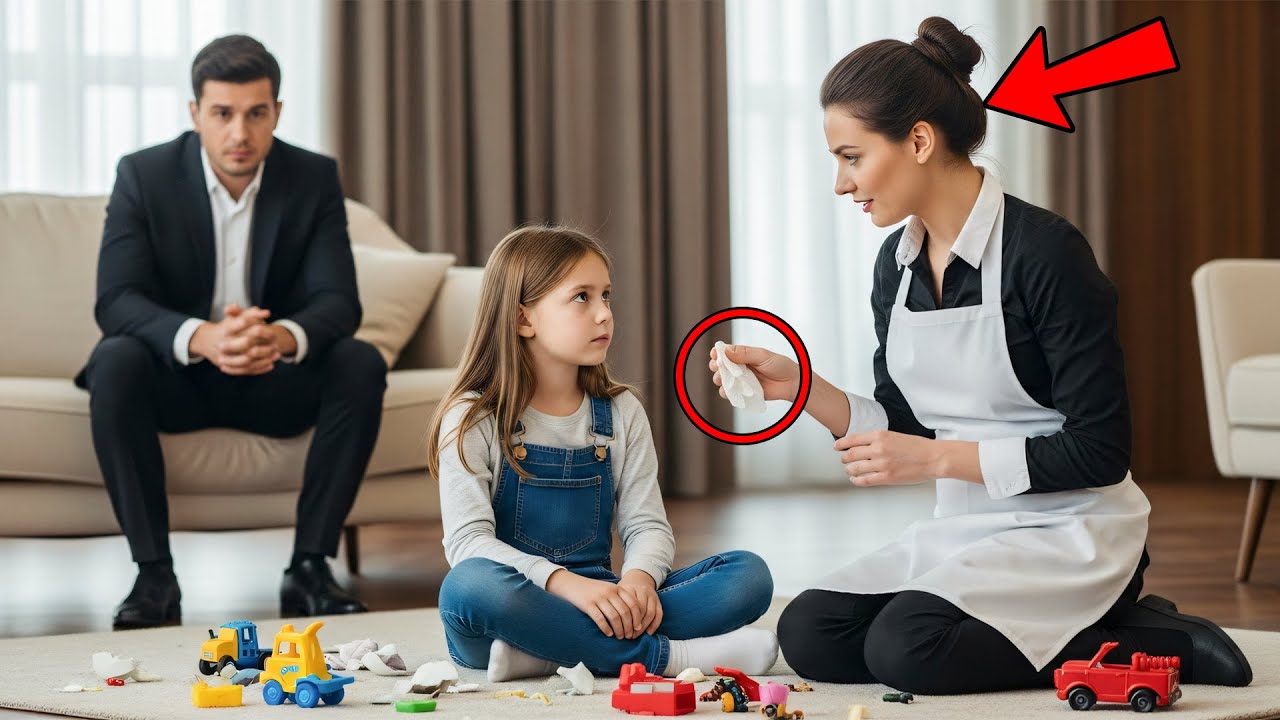
The girl—Sarah, she remembered—said nothing. She just watched. Then, with the faintest movement, she raised her small hand. In her palm was a dead mouse.
It was stiff, cradled in her fingers like a holy relic. She didn’t say a word. She just held it out, a precise, almost clinical gesture. Every instinct told Claraara to back away.
She remembered the elephant. The warning. Do not accept anything. This was the test.
She looked at the mouse, then back at Sarah’s unwavering gaze, and then she did the last thing anyone in the room expected. She bypassed the gesture completely. She reached past Sarah, grabbed a tissue from the box on the desk, gently scooped the mouse from the girl’s hand, and dropped it into the wastebasket. “Okay,” Claraara said softly, wiping her hands.
“That’s a shame. He was a nice little guy. Rest in peace, little fella. ” She looked at the girl, who was now staring at her with something akin to panic and confusion.
“That’s a lot of work. Thank you for sharing. That was very brave. ”
The girl’s eyes narrowed.
“You’re not supposed to touch it,” she whispered, her voice a rusty whisper, as if she hadn’t used it in days. “I know,” Claraara said, sitting down on the floor across from her, bringing them to eye level. “But it was heavier than it looked. I figured he needed a proper funeral.
You want to say a few words? ”
Sarah stared hard at her, searching for the lie. Then, slowly, she got off the chair, walked over to the wastebasket, and stared at the mouse. “He’s a boy,” she corrected.
“His name is Basil. ”
“Well, Basil the mouse is very lucky to have you, Sarah. I bet he had a wonderful life here. ”
The girl’s face crumpled, and she looked away.
The interview was over. Claraara had passed a test she didn’t even know the rules to. Arthur Blackwell appeared in the doorway, his face unreadable. He had watched the entire thing.
“You start immediately,” he said, his hand landing on Sarah’s shoulder. No question. No pleasantries. “Davies will show you to your room.
Your contract is waiting. ”
“5,800,” Mr. Blackwell said, his voice flat. “The amount outstanding was 5,800 something.
It’s the rent for your mother’s facility. You’re in arrears. It’s been taken care of. ”
Claraara froze, her hand on the doorframe.
“What? ”
“Your mother’s bills. They’re current for the next five years. Paid in full, on the condition you never see or speak to her again until the contract is up.
And that you live on the premises. ” He slid a thick document across the desk toward her. “Sign it. It’s an NDA that will make your life a living hell if you ever speak a word of what you see in this house.
But it’s your only option. Welcome to the family, Ms. Sullivan. ”
She signed without reading, because she didn’t have a choice, and because she was too exhausted to pretend otherwise.
The first week was a brutal education. The truce she’d earned with the dead mouse was short-lived. Sarah was a phantom in the white hallways, silent and calculating. She wouldn’t speak, not to Claraara, not to her father, not to Mrs.
Davies. She moved through the penthouse like a ghost, observing everything and offering nothing. Claraara found the note on her third day: “Go away. ” She left it on her own pillow because she had nothing else to do.
On Monday, while Clara was reading in the living room, Sarah snuck in with the stealth of a cat and sliced the power cord to her laptop, her only link to the outside world and her mother. Claraara found it and simply sighed. “Well, that’s a problem. I guess we’ll have to play Go Fish instead of me checking my email.
” Sarah looked genuinely confused. She hadn’t expected the punishment to be a game. On Tuesday, Sarah dumped a glass of water on the floor, then looked at the puddle, her eyes wide and defiant. “You’re not in trouble,” Claraara said, her voice level.
“But there’s a spill. That’s the rule in the diner. We clean it up. ”
When Sarah didn’t move, Claraara picked up the towel and held it out to her.
“Here. You do it. ”
Sarah looked at the towel, then at Claraara, as if she’d been handed a live snake. “I don’t clean,” she whispered, her first words to her in four days.
“Okay,” Claraara said, and she set the towel on the floor. “Then I’ll wait until you’re ready. ” They sat there for a full ten minutes before Sarah, her face a mask of furious reluctance, slid off the bed and dabbed at the puddle with one finger. It wasn’t perfect, but it was a start.
She was testing to see if Claraara would leave if she destroyed the peace. And Claraara wasn’t leaving. The second player in the household, and the most confusing, was Lady Beatrice Croft. She was stunning, a tall blonde English aristocrat with a voice like honey and a wardrobe that dripped effortless wealth.
She was Arthur’s fiancée, and she glided through the penthouse like a perfume ad, leaving a trail of “darlings” and “precious things. ” She was the one person Sarah couldn’t seem to wound but wouldn’t accept. One evening, Beatrice swept into the kitchen and draped a hand on Claraara’s arm. “I tried so hard to find one you’d love,” she cooed at the girl, her smile so bright it hurt.
“Oh, Arthur, she still hates me. But I’ll keep trying. ”
Claraara noticed that Beatrice’s smile never once reached her eyes. There was a hard, calculated glint there—a predator’s gaze hidden beneath a honeyed veneer.
“Apple slices, Sarah? The only thing you’ll eat? ” Beatrice said, ruffling the girl’s hair, her voice laced with a manufactured tenderness. “Oh, she’s just an absolute terror, isn’t she?
But we love her anyway. ”
After that, the dynamic became clearer. Sometimes Sarah didn’t want to be found at all. Claraara found her on the balcony in the middle of the night, dressed in just her thin nightgown, shivering in the cold.
Claraara didn’t say a word. She just walked over, grabbed the thickest, heaviest duvet from the bed, and went back to the door. “Wait,” Sarah said, her voice small and sharp. “You have to come out here and tell me to get inside.
You have to make me. Otherwise, they’ll think… you’ll freeze before I can find a key. ”
Claraara stopped.
“You’re testing me. You’re trying to see if I’ll leave like all the others. ”
“Everyone does,” Sarah said, her voice cracking. “No, I don’t think so,” Claraara said, walking to the other balcony door.
“What are you doing? ” Sarah asked, watching her. “I’m going to be out here with you then. So you’re not alone.
” She pointed to the storm. “Because that’s what people do. But I’m warning you, if we’re out here all night, you’re going to have to be the one to explain to the staff that they need to bring us more blankets, because I am not ready to die this way. ”
“Then you do what we practiced,” Claraara said, kneeling in front of her.
“You stay warm, but you have to cry. You have to let the tears out. And if anyone asks, I was the one who made you, you hear me? It’s my fault.
”
“I can’t,” Sarah wept. “They’ll see. ”
“They’ll see a girl who’s sad, Sarah. A real one.
And that’s okay. Because when I’m done with you, you’ll be like the heroes in your movies. You’ll be a storm. I promise.
”
“I promise,” Sarah sobbed, and she let herself be held. When they got back inside, Sarah’s wet, matted hair stuck to her forehead, and her chest heaved. Claraara didn’t let go. She was going to have to make a stand.
She was going to have to be a feather. She thought about the other nannies. The first one left because she saw Beatrice lock Sarah in the pantry. They believed her.
The second one left when Sarah was accused of being destructive again. Everyone blamed Sarah. The fact was, Sarah was a problem child in a house that didn’t want a problem; they wanted a solution. And her father was the one paying for the solution.
Claraara found Arthur in his office, the door open. He looked up, his face guarded. “Arthur, I need you to listen to me. I know you love your daughter, but you’re blind.
She’s not the problem. ”
“She’s my daughter, Claraara. I’m not blind. ”
“Then why did you let her spend a week in her room with no light?
Why do you let Beatrice isolate her? Sarah is terrified of something,” Claraara said, her voice hard as steel. “And I think it’s her. Your fiancée.
And I need you to help me prove it. ”
Arthur was silent. “You’re talking about my future wife, Claraara. My fiancée.
You have no proof. ”
“Then get me proof,” Claraara said. “I need a camera. I need you to trust me, just this once.
”
It was like a storm inside. The thought of his beautiful, sophisticated, loving fiancée being a monster to his daughter was so absurd, so impossible, that it was easier to believe that Sarah was the monster. But Claraara wouldn’t let it go. And for the first time, Arthur listened.
“That’s not in my job description,” Sarah whispered. “That’s the rule at the diner,” Claraara said, her voice softening. “We clean up the mess. ”
Sarah looked at the camera, her face distorted.
And then she did something Claraara hadn’t expected. She started to cry. The first real, ugly, heart-wrenching sob escaped her. “I can’t do this anymore,” she sobbed.
“I can’t be the villain anymore. ” And she told her everything. “She comes into my room,” Sarah said between sobs, her face buried in Claraara’s chest. “She pinches the burn on my arm.
She tells me I’m worthless. She told me. She said my mother hated me. The other nannies believed her because she’s so good at being nice.
But she does it to me. She does it to me and no one ever believes me. ”
“What happened? ”
“Because it’s my word against yours,” Claraara said, her voice firm.
“But now we have the video. Arthur, press send. Do it now. ”
Arthur held his daughter, looking at the screen.
His face was pale, his expression a mask of pure, unadulterated fury. He pressed send. Later that evening, the penthouse was a war zone. The pre-gala donor dinner was hours away, and Beatrice was pacing across the marble floor, her heels clicking like gunshots.
She had arrived in a swirl of perfume and fury, all her honeyed grace gone. She looked like a cornered wildcat. “Arthur, the wine is wrong, the canapés are all wrong, the lighting is just wrong,” she hissed. “This entire evening is going to be a disaster.
”
“I need to speak with you,” Arthur said, his voice quiet. “About Sarah. ”
“What about that little menace? She ruined my dress.
She’s been waiting all week for her moment to ruin this for me. I swear, if she does anything tonight—”
“Beatrice,” Arthur interrupted. “I know. About the audio.
The video. ”
Every atom of Beatrice’s body went still. The mask snapped into place, but too late. A flicker of pure panic crossed her face before she smoothed it away.
“I-I don’t know what you mean. She’s been lying to you. She’s been telling you lies about me. ”
“She recorded yourself doing it,” Arthur said, his voice dangerously calm.
“And it was a stupid mistake to use the wrong room. The video. The audio. It’s all here.
It’s over. ”
“Arthur, you can’t do this,” Beatrice shrieked, her voice losing all its honeyed polish. “That child is a manipulator! She’s a lying little beast!
She’s always been jealous of me! She’s been waiting her whole life to ruin me! ”
“Honestly? ” Arthur said, and for the first time, Claraara saw a sadness in him that hadn’t been there before.
“I don’t believe a single word you say anymore. I heard you, Beatrice. I heard you telling her that I didn’t love her. I heard you threatening to send her to Switzerland.
”
“This is not about the contract,” Arthur said. “I’ve already had a word with the family’s lawyers. You are to leave this house tonight. You will not see Sarah again.
And if you attempt to contact her or any member of my family, I will destroy you. Do you understand? ”
Beatrice looked gone, deflated. “It doesn’t change anything.
She’s a freak. You’ll see. She’s a monster, just like her mother. ”
Arthur stopped.
“Get out of my house. ”
Beatrice looked at him, and for a moment, her face was a mask of pure, unadulterated hatred. Then she left. The click of her heels retreated down the hall.
The silence was final. Claraara stood in the doorway, unsure if she should breathe. Arthur turned to the window, his hand shielding his eyes. Sarah was clinging to his side, her face buried in his chest.
“Arthur, I’m so sorry,” Sarah whispered. “Don’t you ever apologize,” he said, his voice thick. He pulled back and looked at her. “I’m so sorry it took me so long.
I’m so sorry you had to go through that alone. I failed you, Sarah. ”
“It’s okay, Daddy,” she said, her voice small. “She’s gone.
”
Claraara started to back out of the room, but Arthur’s voice stopped her. “Claraara. You said… the video.
How did you know she would talk? How did you know she would threaten her? ”
“I didn’t,” Claraara said. “But in the diner, you learn that people always betray themselves.
You just have to give them enough time. ”
Arthur laughed, a sound like breaking glass. “My daughter. I need to build her a fortress.
”
“No, you don’t,” Claraara said. “You just need to give her a family that believes her. ”
The gala was canceled. The guests were sent away.
The penthouse felt strangely quiet, the storm having passed along with the woman who’d caused it. Sarah was asleep in her father’s arms, her face peaceful for the first time in what felt like forever. “She’s going to be okay,” Claraara said. “Yeah, she’s going to be okay,” Arthur said, looking at his daughter with wonder.
“She’s going to be okay. ”
The next morning, Arthur sat at the kitchen island, looking haggard but free. He looked at Claraara with a strange, appraising look. “There’s a new job, head of household, my personal assistant, a blank check.
You’re exceptionally good at this. I think you’ll find the compensation… motivating. ”
Claraara poured herself a cup of coffee.
It was true. She had taken a salary; she could have taken a lot more. But money had never been her goal. “I’m not a PA.
I don’t want a blank check. But I do have a proposal. ”
Arthur looked intrigued. “Go on.
”
“I want you to take the money for the rest of the salary, all that money you were going to give me as a raise, and redirect all of it to at-risk youth. There are thousands of kids out there like Sarah, kids with rich parents or poor parents, kids who are invisible. I’ll use my waitress skills, my observation skills, to find the people who really need help. I want to start a foundation.
”
Arthur stared at her. “You do realize I would have given you a blank check, right? You didn’t have to sacrifice your own future. ”
“I’m not sacrificing anything.
This is all I’ve ever wanted,” Claraara said. “But I am going to need a favor. ”
Anything. “Sarah is a smart kid.
She’s going to act out. She’s going to test you. When she does, I need you to remember that she’s not trying to be difficult. She’s trying to be seen.
So, you lose your temper, you get a whistle. You want to yell, you take a breath and say, ‘I hear you. ‘ But the best thing you can do is take her to the diner and buy her an apple pie. ”
“What’s your role in this, then?
” Arthur asked, a hint of a smile on his face. “I’m going to be the closest thing she has to a functional aunt,” Claraara said. “A friend. A bad influence if she needs one.
I’m going to teach her how to be a kid. And I’m going to be the one who holds her hair back when she’s twenty and has too much tequila and thinks a boy is in love with her. ”
“Deal,” Arthur said, and he held out his hand. She shook it.
It felt like a new beginning. A month later, Claraara stood on the steps of the Blackwell residence, a light wind ruffling her hair. She had moved out of the penthouse that morning. She was now living in a small, sunny apartment across town.
The door opened, and a little red-haired blur shot out and wrapped its arms around her legs. “Claraara! You came back! ”
“I told you I’d never leave,” she said, kneeling down.
“Promise? ”
“I promise,” Claraara said. “Now, I hear you’ve been thinking about opening a diner with a play area. Let’s go start a revolution.
”
Later that night, Arthur, standing in the doorway of his now-quiet penthouse, watched the two of them walk down the driveway toward the waiting car, their heads bent together, the future unfurling behind them like a banner. He had never understood a word of the game his daughter played, but he would spend the rest of his life learning its rules. And he realized, standing there, that the most powerful force in the world wasn’t love, or money, or legacy. It was the stubborn, warm, and unshakeable belief of a woman who had seen it all, and was willing to stay.
Claraara Sullivan was a waitress. And she had the power to heal a broken family, just by refusing to believe the customer was always right.