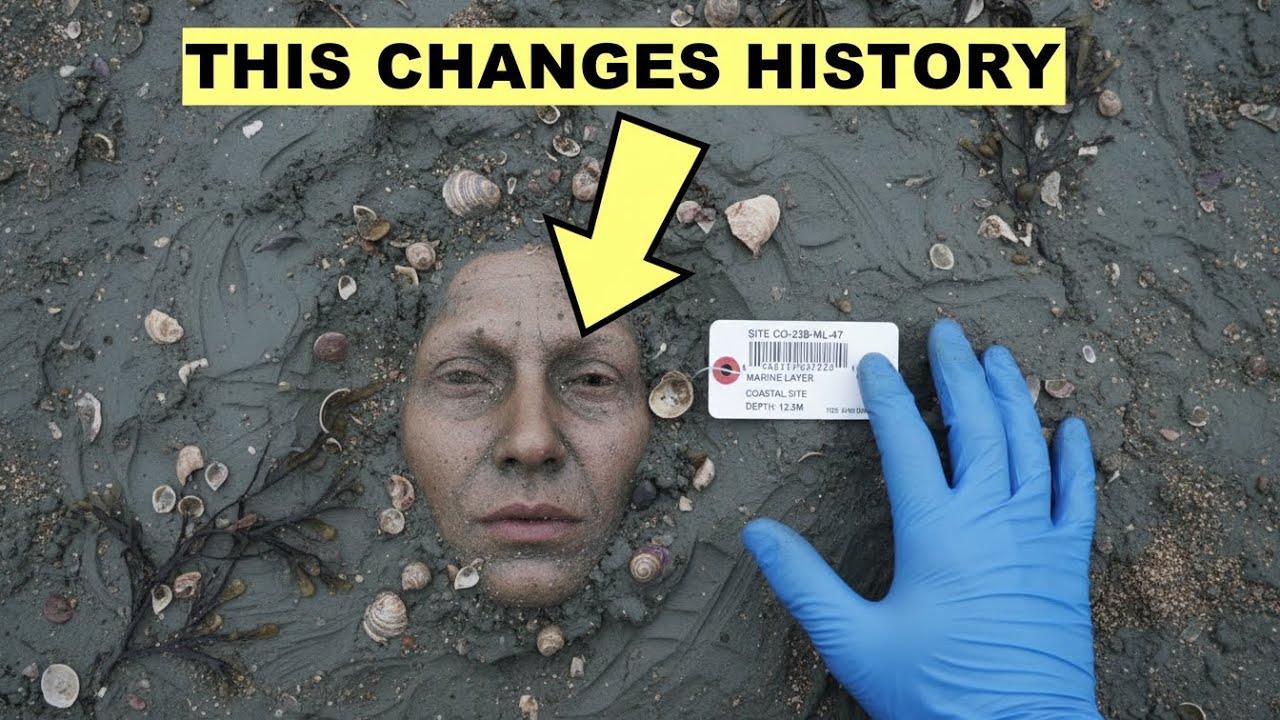
A groundbreaking discovery off California’s coast shatters decades of accepted history, revealing that the first Americans arrived not through an inland ice corridor but via a rich, now-submerged coastal route far earlier than previously believed. This revelation forces a radical rewrite of human migration timelines and origins in the Americas.
For nearly a century, the Clovis-first theory dominated textbooks: ancient humans crossed a frozen inland corridor that opened between retreating glaciers about 13,000 years ago. This corridor supposedly served as the gateway for migration from Beringia, allowing these pioneers to spread rapidly across North America, armed with distinctive fluted spear points.
However, new geological and archaeological evidence reveals that the ice-free corridor was impassable for over 10,000 years, blocked by massive ice sheets and turbulent glacial lakes until roughly 14,000 years ago. This timeline clashes with archaeological sites far older and located thousands of miles south and west of the corridor.
Sites like Monte Verde in Chile predate the opening of this corridor by more than a thousand years, while California’s Channel Islands showcase human activity dating back at least 12,000 years, featuring maritime tools and shell mittens attesting to a seafaring, coastal lifestyle.
Further north, human footprints found on Calvert Island, British Columbia, dated to 13,200 years ago, provide direct physical proof of people moving along the Pacific coast well before the inland corridor opened. These footprints represent a migration route that defies previous explanations.
During the last Ice Age, California’s coastline extended far beyond today’s shorelines due to drastically lowered sea levels. Vast grasslands, estuaries, and kelp forests formed a hospitable corridor ideal for coastal foragers equipped with seafaring skills necessary for island hopping and marine exploitation.
The Channel Islands reveal a treasure trove of artifacts that paint a vivid picture of this maritime culture. Stone tools crafted for hunting waterfowl and gathering shellfish, combined with an overwhelming majority of marine animal remains, underscore a deliberate, sustainable coastal adaptation dating back over 12,000 years.
Remarkably, these islands were never connected to the mainland, meaning early settlers must have used sophisticated watercraft to cross the Santa Barbara Channel — a feat that invalidates accidental migration theories and underscores advanced navigational capabilities among early Americans.
Sonar mapping beneath the Pacific Ocean has uncovered submerged ancient shorelines, terraces, and campsites from 15,000 years ago. As sea levels rose after the Ice Age, these important archaeological treasures slipped beneath the waves, hiding evidence crucial to understanding humanity’s earliest North American journey.
Genetic research further aligns with this maritime migration narrative. DNA studies indicate a single founding population originating in Beringia rapidly dispersing along the Pacific Rim as early as 16,000 years ago, supporting the archaeological record and directly contradicting the traditional inland corridor model.
Notably, the Arlington Springs remains on Santa Rosa Island, dating back nearly 13,000 years, stand as some of the oldest evidence of human presence in the Americas. Though no DNA has been recovered from these remains, their context perfectly matches the broader coastal migration hypothesis.
The combined weight of footprints, tools, submerged landscapes, and genetics form a seamless chain of evidence: early humans traveled swiftly and intentionally along the Pacific coast, perfectly timed with the geological impossibility of the inland ice corridor being open at that period.
This discovery compels a reevaluation of human history in the Americas, elevating the Pacific coastline from peripheral refuge to primary migration corridor, a route rich with resources and sophisticated maritime cultures previously unappreciated in mainstream narratives.
As sea levels continue rising and threaten to erase these submerged sites permanently, the urgency to explore and understand this hidden chapter of human ancestry intensifies. What the ocean hides may hold the key to rewriting our collective origin story.
This breakthrough overturns decades of archaeological dogma, exposing how human history is far more dynamic and complex than textbooks suggested. The first Americans’ remarkable journey was one of maritime mastery, innovation, and survival along a lush, now-lost coastal landscape.
The California coast, once dismissed as marginal, now emerges as a vital, vibrant gateway through which the earliest people navigated the New World, carrying tools, culture, and resilience that laid the foundation for human presence across the Americas.
Scientists emphasize that uncovering more of these submerged sites could radically deepen our understanding of prehistoric migrations and cultural development, urging immediate archaeological efforts before rising tides erase irreplaceable evidence.
This revelation does more than rewrite timelines — it reframes humanity’s adaptive ingenuity, showing that ancient humans mastered ocean navigation and thrived in diverse environments far earlier than once imagined.
The evidence demands scholars update educational materials and reevaluate museum exhibits to reflect a migration story launched from the Pacific shore, not an ice-locked interior pathway.
With every new find along the California coast, the narrative sharpens: the origin of the first Americans is rooted in a maritime journey along a bountiful, now-submerged Pacific corridor that defies conventional migration models.
The search to uncover more artifacts and DNA samples grows desperate and urgent as coastal erosion and sea-level rise threaten to erase this crucial window into human history forever.
This monumental shift not only redefines migration pathways but reshapes our understanding of early human innovation, resilience, and the profound connection between people and their environment.
Researchers are calling for a global reexamination of early American history, advocating a multidisciplinary approach that blends archaeology, genetics, and marine geology to protect and interpret these invaluable coastal records.
Ultimately, this discovery spotlights the Pacific coastline as the true cradle for America’s first inhabitants, rewriting centuries of belief and opening an exhilarating new chapter for explorers of human heritage.
The unfolding story reminds us that history is not static but constantly evolving, urging vigilance in protecting submerged landscapes that silently hold the secrets of our collective past beneath the waves.
As investigations continue, the California coast promises to yield further revelations that may forever alter how we perceive the arrival and survival of humans in the Americas.
This paradigm-shifting discovery arrives at a critical moment, challenging entrenched views and spotlighting the power of science to illuminate forgotten, submerged truths hidden beneath our modern world’s shifting tides.