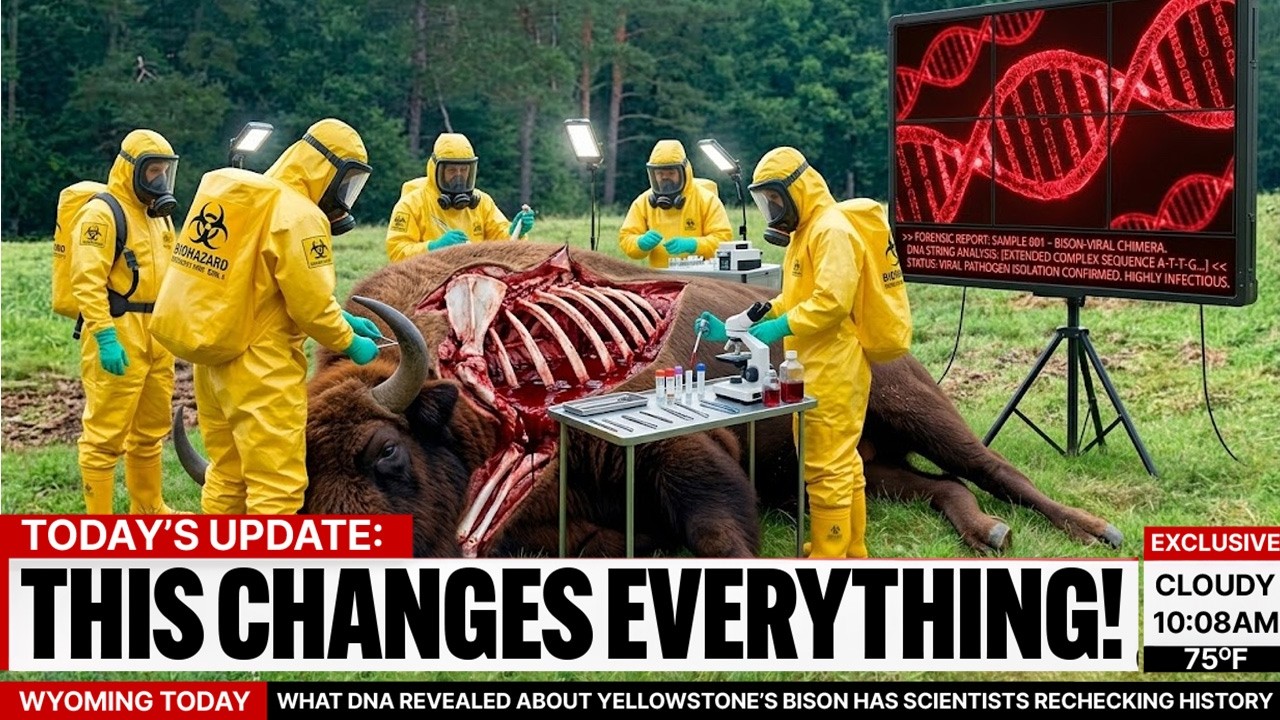
A groundbreaking DNA analysis has shattered long-held beliefs about Yellowstone’s iconic bison herd, revealing traces of cattle ancestry that challenge over a century of wildlife conservation doctrine. Once celebrated as the purest wild bison on Earth, Yellowstone’s herd now forces scientists to rethink how this species was saved from near extinction.
In the 1800s, North America’s bison population plummeted from tens of millions to mere hundreds due to relentless hunting and government-sanctioned extermination. Yellowstone’s herd, protected in the wild, was believed to be the last genetic stronghold—virtually untouched by outside influence—an emblem of species survival.
That belief was unchallenged for more than a century, shaping conservation policies, funding, and research. Yellowstone’s bison were the “gold standard,” held up as the purest survivors of a species nearly wiped out. But in spring 2022, geneticist James Durr’s comprehensive DNA tests painted a very different picture.
Expecting to confirm established science, Durr and his team instead found small yet undeniable traces of cattle DNA embedded in Yellowstone’s bison genomes. This revelation shocked scientists, undermining the myth of purity and forcing a historical rewrite of how the species rebounded from the brink.
The genetic signatures, invisible to earlier methods, revealed crossbreeding was present even in the supposedly untouched herds at Yellowstone and Elk Island. The cattle DNA levels were low—less than a quarter of a percent in Yellowstone’s bison—but they were real and universal, fundamentally rewriting the story.
How did cattle genes infiltrate these iconic wild bison? The answer lies in the very rescue mission meant to save them. In 1902, to revitalize the tiny remnant herd of 23 animals, Yellowstone introduced 21 bison from private herds, some of which descended from cattle-bison hybrids bred during cattle shortages.
These private ranchers had unknowingly introduced cattle genes into their herds decades earlier through hybridization experiments aimed at creating hardier livestock. Thus, the act of saving the species was inseparably linked to introducing cattle DNA—a genetic legacy invisible until modern genome sequencing unveiled it.
The DNA findings sparked heated debate within conservation circles. Some breeders shrugged off the minor cattle influence as insignificant, while others, invested in genetic purity for ecological or economic reasons, felt deeply unsettled. Yet some scientists argued purity is a flawed concept, evolutionary biology embraces hybridization, and the bison’s history is inevitably “messy.”
This revelation dismantles the long-standing notion that any herd is genetically “pure” and sets the stage for a paradigm shift in bison management. Walls between herds can come down; mixing now appears crucial to restore genetic diversity, robustness, and long-term survival of the species battered by a historical genetic bottleneck.
Across the West, bison are returning to native lands in record numbers, facilitated by revised policies and partnerships with Indigenous tribes. Federal and state officials have shortened quarantine periods to accelerate transfers. The largest ever movement of bison, over 200 animals, recently reached tribal territories, signaling a renaissance in restoration.
The restoration of the bison is more than ecological—it’s cultural and spiritual. For Indigenous nations, the buffalo symbolizes survival, sovereignty, and healing. Returning herds represent reclaiming lost heritage and nurturing land and people. The genetic truth does not diminish this profound significance; it enriches the complex story of survival.
Within Yellowstone, the two historically distinct bloodlines—the original survivors and the later introduced herds—have fully merged into a single, thriving population. This amalgamation mirrors the broader reality: the bison’s past is one of interwoven lineages, resilience, and layered ancestry, not isolated purity.
The golden narrative of “99.7% pure” is both true and false simultaneously. The faint cattle DNA is a fingerprint of how the species was saved, a living record of the rescue mission’s complexity. It underscores that every surviving animal carries the memory of near extinction and the human actions that halted it.
As conservationists reconsider genetic purity, the focus shifts toward practical survival and adaptive management. The bison is not a museum piece frozen in time but a vibrant species shaped by history, environment, and unfortunate necessity. Its future depends on embracing this nuanced reality and fostering robust, diverse populations.
The revelation demands urgent attention from policymakers, scientists, Indigenous leaders, and breeders alike. It challenges conservative approaches founded on purity myths and encourages cooperative strategies to sustain and expand bison herds across their historic ranges.
This landmark DNA study redefines the fight to save America’s bison—not just as a quest for a genetic ideal but as a dynamic story of survival, adaptation, and reconciled history. Yellowstone’s bison, once thought untouched, now guide the way forward with a legacy more complicated and inspiring than ever imagined.
In the end, the purest bison herd is not one free of all outside influence but a testament to resilience, shaped by human hands in ways never fully understood until today. The true journey of the bison is one of survival through integration, strength through complexity, and hope born from the narrowest margins.
The scientific community watches now as conservation policies adapt, honoring this complexity. The narrative no longer centers on purity but on the shared genetic heritage of all survivors. This shift promises a more inclusive future for bison and for the people devoted to restoring this symbol of wild America.