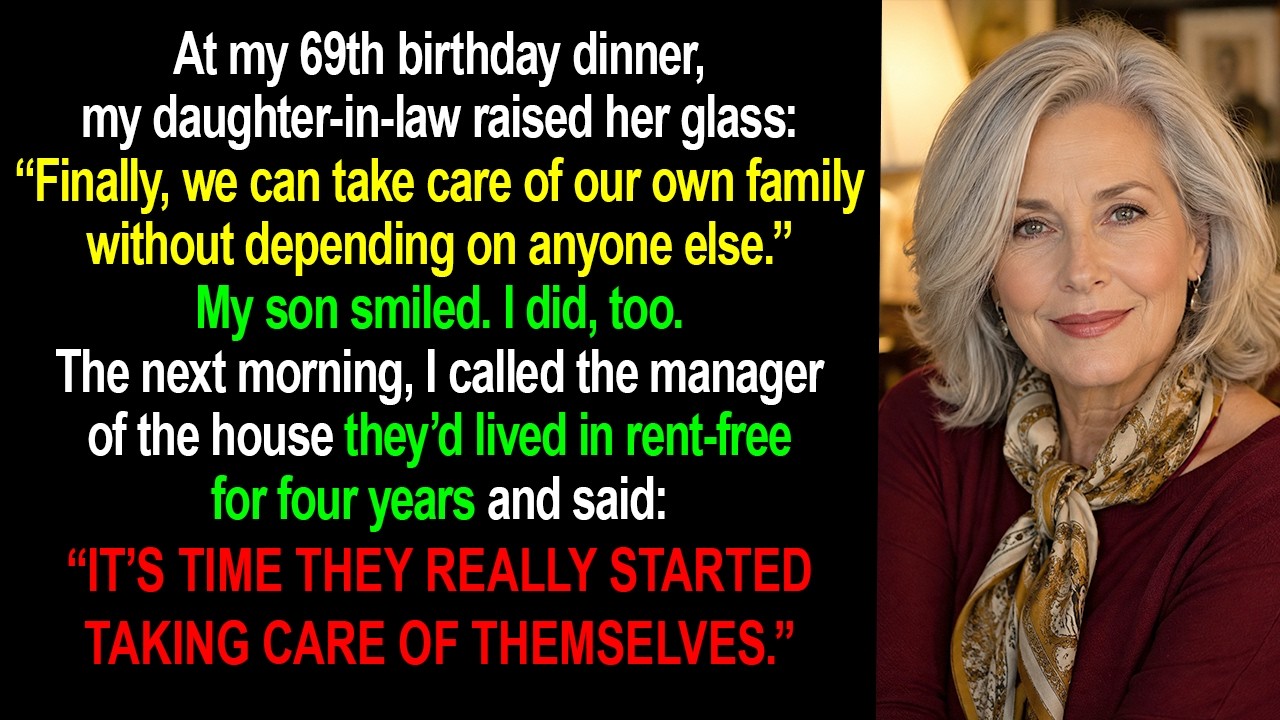
The morning after my 69th birthday, I called Janice, who managed my rental property, and said, “I want the free arrangement to end. ”
There was a pause. “You mean Daniel and Lauren? ”
“Yes.
”
My son and his wife had lived in my house rent-free for 4 years. I looked at the birthday card my granddaughter had made me the night before and added, “Give them proper notice. I don’t want anybody thrown out. I want a fair lease below market.
”
But they start paying their own way. Janice was quiet again. Then she said something I wasn’t expecting. “Maggie, before I send them anything, there’s an email from Daniel you need to see.
”
I didn’t know it yet, but one sentence in that email would explain how 4 years of gratitude had quietly turned into something else. And it had started with a birthday toast. My son Daniel had chosen a little Italian restaurant in Raleigh for my birthday dinner. It wasn’t fancy, which suited me.
At 69, I no longer needed white tablecloths or expensive wine to feel celebrated. I wanted my family around one table. That was enough. Daniel was 43 then.
His wife Lauren was 40 and their daughter Sophie had just turned 12. Sophie sat beside me and slipped a homemade card under my napkin before dinner. “Don’t open it yet, Grandma. ”
“Why not?
”
“Because you’ll cry. ”
Daniel laughed. “She’s probably right. ”
For the first hour, it was a good birthday.
We shared fried calamari. Daniel ordered the chicken piccata I always liked. Lauren told me about a new position she was hoping to get at work. Sophie complained about middle school algebra with the seriousness of someone discussing federal policy.
I remember looking around that table and thinking how fortunate I was. My husband, Robert, had been gone almost 5 years by then. Birthdays had felt different without him. But that night, the empty place beside me didn’t ache quite as badly.
Then dessert arrived. A server brought out tiramisu with one candle stuck in the middle. After Sophie sang much too loudly, Lauren lifted her wine glass. “I want to make a toast.
”
Daniel raised his glass. I picked up mine. Lauren smiled at him before she spoke. “Finally, we can take care of our own family without depending on anyone else.
”
Daniel smiled. Then he clinked his glass against hers. “We’ve worked hard for it. ”
I don’t think either of them intended those words as an insult.
That may have been what hurt most. They believed them. I sat there holding a glass of iced tea and looking at my son. 4 years earlier, Daniel had called me after losing his sales job.
He and Lauren were falling behind. Sophie was eight. They were worried about changing her school, breaking their apartment lease, and burning through what little savings they had left. Robert and I owned a three-bedroom rental house in a quiet neighborhood about 20 minutes from me.
After Robert died, it belonged to me alone. When Daniel needed help, I told him, “Move into the rental. Get steady again. We’ll worry about the rest later.
”
4 years later, “later” never came. They paid utilities and took care of ordinary household expenses. I paid the property taxes. I paid the homeowner’s insurance.
When the air conditioning system failed during a North Carolina July, I paid for that. When part of the roof needed repair after a storm, I paid for that, too. I had never asked Daniel for rent. And now I was listening to him celebrate how completely independent they had become.
I could have corrected him right there. I could have said independent people usually pay for the roof over their heads. I didn’t. Sophie was smiling.
It was my birthday and humiliating my son in a restaurant wouldn’t have made me feel any better. So, I raised my glass to family. We drank. Lauren smiled, relieved.
Maybe she thought I agreed with her. I didn’t. But I wasn’t angry enough to start a fight. What I felt was quieter than anger.
I felt foolish. When I got home, I put Sophie’s card on my kitchen counter and changed out of my birthday clothes. The house was silent. I wandered into the den and noticed an old photograph of Robert and me on the bookshelf.
We were standing in front of that rental house 20 years earlier. Robert was holding a paint roller. I had an old Atlanta Braves cap on because the afternoon sun had been brutal. We had bought that property as an investment.
Nothing glamorous, just a sensible little house that we hoped would provide income when we got older. Robert used to joke that one day the house would pay for our groceries and blood pressure medicine. He never got old enough to see that day. I did.
And instead of producing retirement income, the house had been supporting our son’s family. I had been happy to help. That was the part I needed to be honest about. Daniel hadn’t forced me.
Every extra year had been my choice. But somewhere along the way, helping had stopped feeling temporary. Worse, Daniel had apparently stopped seeing it as help at all. I opened Sophie’s birthday card.
On the front, she had drawn the two of us holding hands. Inside, she had written, “Happy birthday, Grandma. Thank you for always making our family feel safe. ”
That nearly changed my mind.
Nearly. I sat at the kitchen table for a long time. Then I remembered something Robert used to say whenever one of the children needed rescuing. “Help them get back on their feet, Maggie.
Just don’t forget they’re supposed to stand on their own. ”
The next morning, I called Janice. “This one sold for that much? ” Daniel asked.
“3 months ago,” Janice said. “The kitchen is nicer. ”
“It is. And this one has a bigger garage.
”
Janice nodded. “That’s reflected in the adjustment. ”
Daniel leaned back. He looked defeated before we’d even discussed a price.
I didn’t enjoy that. Whatever had happened between us, he was still my son. “I am willing to give you a family discount,” I said. Both of them looked at me.
“And if you have receipts for permanent improvements you paid for, we’ll review those, too. ”
Lauren opened the same blue folder she’d brought to my house. “So, you’ll credit us for legitimate improvements? ”
“Yes.
”
Daniel looked relieved. Then I added, “But I’m not giving the house away. ”
His expression changed. “I didn’t ask you to.
”
“You’ve been talking about it as though it’s already yours. ”
He looked down. Lauren spoke next. “So, we improved your investment for 4 years, and now we have to buy it from you.
”
I could feel the old argument circling back. This time, I didn’t follow it. “You improved the home you lived in for free. ”
Lauren opened her mouth, then closed it.
Janice looked down at her paperwork. The meeting ended with no agreement except one—Daniel and Lauren would speak with a mortgage lender. A week later, Daniel called. “We’re working on financing.
”
“Good. ”
“We may need some information from you about the property. ”
“Have the lender contact Janice. ”
He hesitated.
“You’re really going to make us do this like a regular sale if you buy it? ”
“Yes. ”
He sighed. “Okay.
”
For the first time, he didn’t argue. The financing process took several weeks. I didn’t know every detail, nor did I want to. But eventually, Daniel told me enough.
They weren’t broke. That mattered. Daniel earned a respectable salary. Lauren worked full-time.
Together, they made more money than Robert and I had at their age. But income and stability are not the same thing. They had two expensive vehicle payments. There were credit card balances.
Their Disney trip had partly gone on a card and hadn’t been fully paid off. Daniel had financed new patio furniture. Lauren had several recurring memberships and subscriptions she’d barely thought about. None of those things alone ruined them.
Together, they told a story. For 4 years, housing had cost them almost nothing. Instead of treating that as an opportunity to save aggressively, they had slowly built a lifestyle around the extra money. The house hadn’t made them rich.
It had made them feel rich. One afternoon, Daniel came by unexpectedly. He looked exhausted. “Can I ask you something?
”
“Sure. ”
“Did you know how bad our numbers were? ”
“No. You never wondered.
”
“I wondered why someone who didn’t pay rent needed two new cars. ”
He almost smiled. Almost. Then he rubbed his forehead.
“The lender didn’t say no, but… we’d have to pay off some debt first, and even with your discount, the monthly payment would be…”
He stopped. “Real? ” I asked. Daniel gave a short laugh.
“Yeah, real. ”
He sat at my kitchen table. For a while, neither of us spoke. Then he said, “Lauren thinks you’re trying to teach us a lesson.
”
“I’m trying to stop paying for one. ”
That made him look at me. I hadn’t planned the sentence. It was simply true.
2 days later, Lauren called me. She was angry. Not screaming. Lauren rarely screamed.
Her anger came out clipped and precise. “Daniel says we may have to sell my SUV. ”
“That’s between you and Daniel. ”
“He’s blaming me for spending.
”
“I’m not getting involved in your marriage. ”
“He told me for 4 years that the house was eventually ours. ”
That caught my attention. “Did he say eventually?
”
There was silence. “What do you mean? ”
“Did Daniel tell you it would be yours someday, or did he tell you it already was? ”
Lauren didn’t answer.
That silence told me more than an argument would have. “I have to go,” she said. The next couple of weeks were uncomfortable. Daniel stopped calling.
Sophie texted me occasionally—mostly ordinary things, pictures of her school project, a joke about my old-fashioned emojis. I was grateful she still reached out. I heard through Carol that Daniel and Lauren were fighting. That gave me no satisfaction.
There is a fantasy people have about standing up for themselves—that once you finally do it, everything feels clean and righteous. It doesn’t. Sometimes you can know you’re right and still lie awake worrying about the people who are angry with you. I did that often, but I didn’t withdraw the lease.
Then one rainy Thursday evening, my doorbell rang. Daniel stood on the porch alone. His hair was wet. He looked tired.
In one hand was the unsigned lease. In the other were the keys to the rental house. “Come in,” I said. He walked to the kitchen and placed the keys on the table.
My heart sank. I assumed they had decided to move. Daniel looked at the keys for a long moment. Then he said quietly, “I need to stop acting like these prove something.
”
I didn’t answer. He slid the lease toward me. “I can’t buy the house. Not right now.
”
“I understand. ”
He pulled out a chair but didn’t sit. Then he asked, “If we sign this, will you still give us a year? ”
I looked at my son.
For the first time since my birthday, he wasn’t asking me to prove that I loved him. He was asking for time—for him to prove something himself. “Yes,” I said. “A year.
”
Daniel nodded. Then very quietly, he said, “Okay. ” And picked up a pen. Daniel signed the lease at my kitchen table.
He didn’t make a ceremony of it. He read each page, initialed where he was supposed to, and signed his name on the last one. Then he pushed the papers toward me. “I’ll have Lauren sign tomorrow.
”
I nodded. Daniel picked up the house keys again. For 4 years, those keys had meant something different to each of us. To me, they represented a property Robert and I had worked to buy.
To Daniel, they had gradually become proof that he belonged there. Now, they were simply keys to a house he was renting. Oddly enough, that seemed healthier. The next afternoon, Janice called.
“Lauren signed. ”
“How was she? ”
“Quiet. ”
That sounded like Lauren.
The first rent payment was due the following month. I told myself I wasn’t going to watch for it. Then, on the first, I checked my phone before I’d even finished my coffee. Nothing.
By lunchtime, still nothing. I felt ridiculous. After 4 years of waiting for Daniel to bring up rent, apparently I had become a woman who could barely wait 4 hours. At 2:17, Janice texted, “Rent received in full.
”
I stared at the message. There was no thrill. What I felt was relief. The second month, the payment arrived on time.
Then the third. Something else changed, too. Daniel and Lauren began changing their lives. The first obvious sign was the SUV.
Lauren loved that vehicle. Pearl white, leather seats, panoramic sunroof. One Saturday, I drove past their house on my way to the grocery store and noticed it wasn’t in the driveway. A week later, Lauren arrived at Sophie’s school concert in a 3-year-old Honda.
She saw me looking. “We sold the SUV. ”
I wasn’t sure what to say. Lauren gave a small shrug.
“Turns out heated rear seats aren’t essential to survival. ”
I laughed before I could stop myself. She smiled. It was the first easy moment we’d had in months.
The kitchen renovation disappeared, too. No quartz countertops, no wall removal, no designer cabinets. Daniel started packing lunch for work instead of eating out most days. Sophie complained that her parents had discovered the phrase, “We have food at home.
”
They weren’t living in poverty. They were simply living inside their actual income. And slowly, my son came back. Not all at once.
One Tuesday, Daniel called. “Are you home? ”
“Yes. ”
“Your front railing is loose.
”
“How do you know? ”
“I noticed Sunday. ”
An hour later, he arrived with a drill. Another week, he dropped off groceries because the store had been “on his way.
”
He didn’t mention the house. Neither did I. That was important. Reconciliation couldn’t happen if every kindness became evidence in an old argument.
Lauren took longer. About 6 months into the lease, she called and asked if she could stop by. She arrived carrying the blue folder. I almost laughed when I saw it.
“That thing again. ”
She smiled faintly. “Different contents. ”
We sat at the kitchen table.
Lauren opened the folder. Inside was a simple household budget. Nothing fancy. Mortgage estimates, car expenses, groceries, insurance, savings, debt payments.
She turned it toward me. “I used to look at what Daniel and I earned and think we were doing really well. ”
I waited. “I never counted what we weren’t paying.
”
Her finger rested on the housing line. “I should have. ”
There was no dramatic apology, no tears. But I knew Lauren well enough to understand what those words cost her.
“I should have talked about rent sooner,” I said. She looked surprised. “Why didn’t you? ”
“Because every time I thought about it, I felt guilty for asking your own son to pay rent—for making his life harder.
”
Lauren looked down. “I guess we made yours easier to ignore. ”
That was closer to an apology. I accepted it, but I didn’t say “forget the lease.
”
Instead, I said, “I think all of us let something temporary go on too long. ”
Lauren nodded. “Daniel still says you were right. ”
I doubt Daniel used those exact words.
She laughed. “No, he said mom had a point. ”
“That sounds more like him. ”
By the ninth month, Daniel and Lauren had paid down enough debt to begin looking at houses again.
This time, they weren’t looking at houses like mine. They looked at smaller places in suburbs outside Raleigh—older kitchens, smaller yards, nothing that would impress anyone on social media. One Sunday, Daniel showed me a listing on his phone. “Kitchen needs work.
”
“It has cabinets. ”
“They’re ugly. ”
“They still hold plates. ”
He grinned.
Robert would have enjoyed that conversation. A month later, Daniel called me from his car. His voice sounded strange. For half a second, I worried something had happened to Sophie.
“Mom? ”
“What is it? ”
“We got it. ”
“Got what?
”
“The house. ”
I sat down. Their offer had been accepted on a modest three-bedroom place with an older brick exterior and a maple tree in the front yard. “Oh, Daniel.
”
“We still have inspections and everything. I know it can fall apart, but—”
“You got the offer accepted. ”
“Yeah. ”
I could hear Lauren laughing somewhere beside him.
Then I asked the question I’d been afraid to ask. “Do you need anything from me? ”
Daniel was quiet. “No.
”
One word. Months earlier, that answer might have sounded like rejection. Now it sounded different. “We’ve got the down payment,” he said.
“Closing costs, too. ”
My eyes filled. “Then I’m proud of you. ”
He went quiet again.
“Thanks, Mom. ”
A few weeks later, I stood in their new kitchen, surrounded by cardboard boxes. The cabinets were still ugly. Sophie had already put a handwritten sign on one bedroom door: “Sophie’s room.
Keep out. ”
Daniel walked in carrying a toolbox. “The upstairs toilet is running. ”
I smiled.
“Call the landlord. ”
He looked at me. Then we both started laughing. “There isn’t one,” he said.
“No. ”
He glanced around his little kitchen. For the first time, the word “ours” didn’t bother me—because this time it was true. Moving day came on a Saturday in early spring.
Daniel had rented a moving truck, but half the family showed up with pickups anyway. That is how our family has always moved people. Too many vehicles, not enough moving blankets, somebody forgetting where the tape went, and pizza ordered 3 hours later than it should have been. I brought coffee and breakfast sandwiches.
That was all. I didn’t bring a check. Daniel didn’t ask for one. Lauren stood in the driveway of the rental house, looking back at it after the last box was loaded.
For 4 years, it had been their home. Whatever had happened between us, I didn’t want to erase that. Sophie had learned to ride her bicycle on that sidewalk. She had lost two teeth in that house.
She had painted her bedroom purple when she was nine and stuck glow-in-the-dark stars all over the ceiling. Lauren touched the porch railing. “I really did love this place. ”
“I know.
”
She looked at me. “I think that’s part of why I started believing it belonged to us. ”
There was no accusation in her voice. I nodded.
“Sometimes we get attached to things before we understand what they cost. ”
Lauren gave me a small smile. “Believe me, I understand what houses cost now. ”
At their new place, Sophie immediately began directing everyone as if she’d been appointed general contractor.
“My boxes go upstairs. ”
Daniel carried one past her. “Which room? ”
“The one with my name on it.
”
“Both rooms have your name on the boxes. ”
Sophie sighed dramatically. “Dad, how did you buy a house? ”
I laughed so hard I nearly dropped the paper plates I was carrying.
Their new house was smaller than mine. The kitchen had brown cabinets from another decade. The backyard needed work. The carpet upstairs had been cleaned, but would eventually need replacing.
Daniel loved every inch of it. Around noon, I found him under the kitchen sink. “What happened? ”
“Small leak.
”
“You’ve owned the place for less than a day. ”
“I think the house was waiting for me. ”
“Call your landlord. ”
Daniel slid out from beneath the sink and looked at me.
Then he smiled. “Very funny. ”
We both laughed. That simple moment meant more to me than any apology he could have made.
There was no bitterness left in the joke. Just history. Janice inspected my rental property the following week. Daniel and Lauren had left it in good condition.
There were nail holes to patch, some paint to touch up. And of course, Sophie’s purple bedroom needed attention. When Janice asked whether I wanted the glow-in-the-dark stars removed, I surprised myself. “Leave them.
”
A new family rented the house about a month later at market rate. A young couple with two children. The first rent payment arrived. For the first time in four years, the property began doing what Robert and I had originally bought it to do.
It helped support my retirement. I used some of that first payment to replace my aging water heater. The rest went into savings. Nothing dramatic.
That would have pleased Robert. He had always believed the best financial plans were the boring ones. Life settled down. Daniel and Lauren invited me over for Sunday dinner sometimes.
Other Sundays they were busy. That was fine. Independence, I had learned, wasn’t something I needed them to perform for me either. It meant we could love one another without keeping score.
A few weeks before my 70th birthday, Sophie called. “Grandma, don’t make plans for Saturday. ”
“Why not? ”
“Because you’re turning 70.
”
“I was hoping nobody noticed. ”
“Too late. ”
They held my birthday dinner at Daniel and Lauren’s new house. Nothing fancy.
Daniel grilled chicken in the backyard. Lauren made roasted potatoes. Sophie decorated a grocery store cake herself and somehow managed to get frosting on three kitchen cabinets. I sat at their dining table and looked around.
It wasn’t as large as the dining room in my rental property. The chairs didn’t match. There was still a box marked “garage” sitting against one wall, even though they had moved months earlier. But the house felt settled.
It felt theirs. After dinner, Daniel stood and picked up his glass. For one brief second, my stomach tightened. He noticed.
“Don’t worry, Mom. I’ve learned my lesson about birthday toasts. ”
Everyone laughed. Then he looked at me.
“Last year, I thought being independent meant looking like I didn’t need anybody. ”
The room grew quiet. Daniel continued. “I was wrong.
”
He glanced at Lauren, then back at me. “It means being grateful for the help you got—and knowing when it’s time to stand on your own. ”
That was it. He sat down.
Nobody applauded. I was glad. Some moments become smaller when people try too hard to make them important. I reached across the table and squeezed his hand.
Later, Daniel carried the dishes into the kitchen without being asked. Lauren wrapped leftover cake in foil. I stood at the sink watching them. A year earlier, I had been terrified that one boundary would cost me my family.
Instead, that boundary had forced all of us to look honestly at what we had been doing. Daniel had mistaken help for ownership. Lauren had mistaken income for independence. And I had mistaken silence for kindness.
I had spent years waiting for my son to volunteer to stand on his own while quietly making it comfortable for him not to. That part belonged to me. I wouldn’t make that mistake again. As I was getting ready to leave, Sophie came running down the hallway.
“Wait. ”
She handed me a birthday card. “You can open this one now. ”
“Am I going to cry?
”
“Probably. ”
On the front, she’d drawn two houses. One was larger, with little yellow stars in an upstairs window. Underneath she had written: “Grandma’s.
”
Beside it was a smaller brick house with a maple tree. “Ours. ”
I looked up at her. “That’s pretty good.
”
“Open it. ”
Inside was one sentence. I read it. Then I read it again.
My eyes filled. Sophie wrapped her arms around me. And for the first time, I understood that the best thing I had given my son wasn’t 4 years of free housing. It was the moment I finally stopped giving it.
If you’ve ever had to set a boundary with someone you love, you probably know how frightening that can be. Sometimes the hardest part isn’t saying no—it’s trusting that a healthy relationship can survive hearing it. If this story reminded you of something your own family has lived through, I’d love to hear what you learned from it.
And if you enjoy stories about family second chances and the quiet lessons that sometimes arrive later in life, you’re welcome to subscribe and join me for the next one.