The gift arrived on a Thursday afternoon in late October, when the trees outside our house had gone full amber and the wind had that particular bite that makes you feel like the world is shutting itself down for winter. I unwrapped it in the kitchen: a pocket watch, antique, with a delicate enamel face and a hand-engraved case that looked like it had belonged to someone who’d loved it very much. A card tucked inside the box said simply, “For my Isla, two years. ” G.
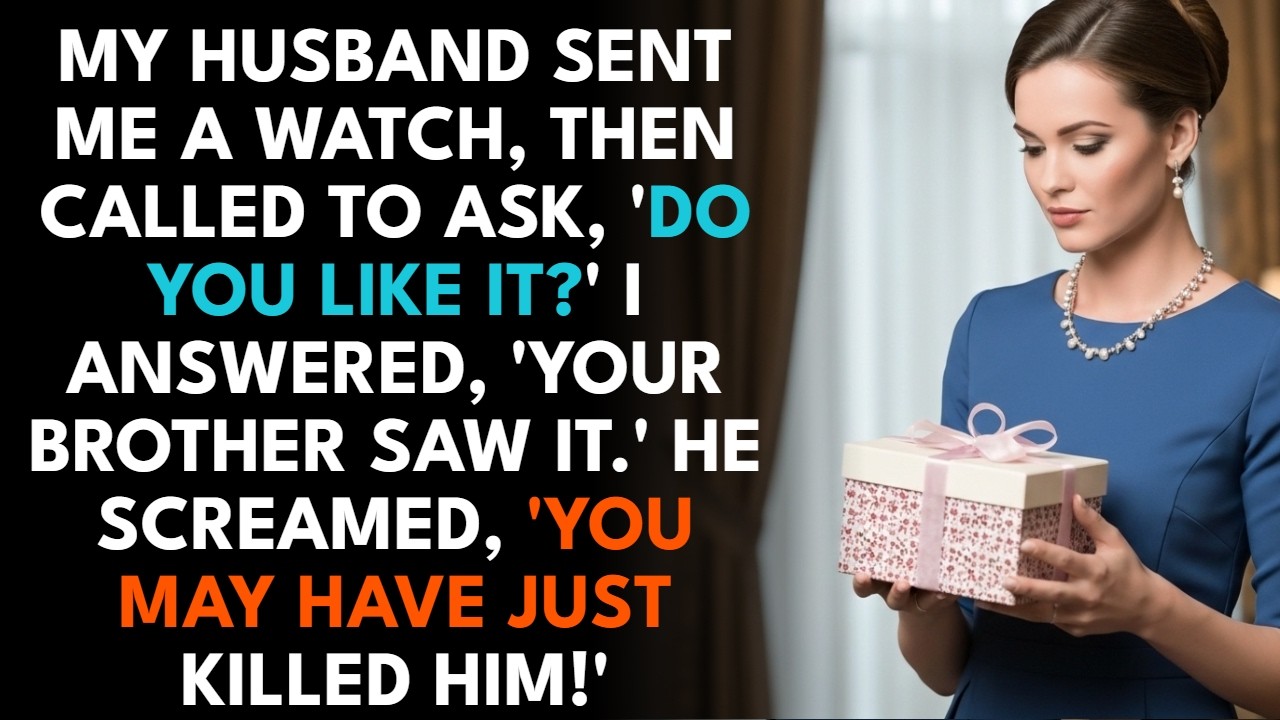
My husband was in Chicago for a work conference. He’d remembered our anniversary. I held the watch in both hands and actually cried a little. The good kind, the kind that surprises you.
I should tell you something about the house I lived in. It sat on three acres of bare land outside Rhinebeck, New York. A tall, gray colonial with steep gables and rooms that echoed when you walked through them. My mother-in-law had lived there for 30 years.
My husband had grown up in it, and for the past two years, so had I, learning the hard way that a house with that many rooms can still have no space for you in it. My mother-in-law is the kind of woman who fills every room she enters, not with warmth, but with presence. She had opinions about everything: how I folded laundry, how I answered the phone, whether the soup I’d made had too much salt. She never raised her voice at me.
She never had to. She had a way of looking at me like I was a maintenance problem she hadn’t budgeted for. And then there was Crispin. My brother-in-law was 31 years old and had lived in the east wing of the house his entire adult life.
My mother-in-law said he had severe schizophrenia, that he’d been diagnosed at 19, that he required constant supervision, that any disruption to his routine could trigger an episode dangerous to himself and others. His door was always locked. His meals were brought to him on a tray. The few times I caught a glimpse of him in the hallway, he looked at me the way someone looks at a face they’re trying to remember but can’t quite place.
My husband talked about Crispin the way people talk about a weather event: with resignation and a kind of practiced grief, as if his brother’s illness had long since passed the point of mourning into something duller. “He’s stable,” he’d say whenever I asked. “The medication keeps him stable. ” Then he’d change the subject.
I didn’t question it, not then. On the afternoon the watch arrived, I was alone in the house. My mother-in-law had gone to her sister’s in Poughkeepsie and wasn’t expected back until dinner. I sat in the kitchen with the watch open in my palm, turning it slowly in the light.
The engraving on the inside of the case was faint but legible. Two initials intertwined: MV. Not my initials, not my husband’s. I assumed it was an estate sale find.
He liked antiques. It didn’t seem strange. What happened next was an accident. I’d forgotten that Crispin’s aide had called in sick that morning, and that my mother-in-law, in her hurry to leave, had not fully latched the east wing door.
I was heading toward the back staircase when Crispin stepped into the hallway. We both froze. He was thinner than I’d expected, with dark circles under his eyes and a stillness about him that didn’t read as calm so much as exhausted. He looked at me, then at my hand, at the watch I was still holding, turning it absently the way you do when you’ve been carrying something for a while.
His face changed completely. He went the color of old paper. His mouth opened. He took one step back, hit the wall, and slid down it until he was sitting on the floor, staring at the watch like it was something that had crawled out of a nightmare.
“Where? ” he said. His voice was barely above a whisper. “Where did you get that?
”
I crouched down. “Grayden sent it. It’s an anniversary gift. Crispin, are you—”
He pressed both hands over his eyes.
“Don’t let him know I saw it. ” His whole body was trembling. “Please, you don’t understand what that is. ”
Before I could ask anything else, he scrambled to his feet and disappeared back through the door, pulling it shut behind him.
I stood in the hallway for a long time with the watch in my hand, my heart doing something irregular. That evening, my husband called. His voice was warm the way it got when he was making an effort. “Did the package arrive?
” he asked. “Do you like it? ”
I almost didn’t say it, but I’d been turning Crispin’s reaction over in my mind for hours, and I wanted to know if my husband’s voice would do anything strange, even over the phone. “Your brother saw it,” I said.
“He came out into the hallway. He saw the watch. ”
The silence that followed was so complete I thought the call had dropped. “Then what did you just say?
”
“He got really upset. He slid down the wall, Grayden. He was shaking. ”
“You let him see it.
” Something beneath the warmth had cracked open. “Do you have any idea what you’ve just done, Isla? You may have just killed my brother. ”
He hung up.
I sat in the kitchen until the light went, and the room went cold, and I couldn’t tell whether I was more frightened by what he’d said or by how completely I believed it. He came home the next morning without warning. I heard the car, looked out the window, and watched him cross the yard with the stride of a man running entirely on adrenaline. He didn’t acknowledge me when he came in.
He went straight to the east wing, and I heard voices behind that door for nearly an hour. His low and controlled, and occasionally something from Crispin that I couldn’t make out but that sounded like pleading. When my husband came out, he looked at me with an expression I hadn’t seen on him before. Not anger exactly.
More like assessment. Like I’d become a problem he needed to solve. “What did he say to you? ”
“He asked where I got the watch.
He told me not to tell you he’d seen it. ”
Something moved across his face. “He was confused. That’s what his episodes look like.
Paranoid fixation. You shouldn’t read anything into it. ”
“He seemed pretty lucid,” I said. “Isla.
” He said my name with a patience that had no warmth left in it. “You don’t know him. I do. Leave it alone.
”
So I left it alone. For about a week. My mother-in-law returned, and life resumed its usual shape. Me cooking meals that were never quite right.
Cleaning rooms that were never clean enough. Sleeping in a bed that felt increasingly like something I was borrowing. My husband was physically present but somewhere else entirely. He stopped touching me.
He slept on the far edge of the mattress. One evening I watched my mother-in-law prepare Crispin’s nightly tonic through the kitchen doorway. She had her back to me and didn’t notice I was there. The smell was herbal and sharp.
Not unpleasant, but unfamiliar. Nothing like any supplement I recognized. She’d done it every night for as long as I’d lived there, but I’d never paid attention to the specifics before. Now I watched her measure it out with a precision that looked nothing like casual habit.
It looked like dosing. I thought about Crispin’s hands shaking. His eyes that were always slightly glazed, the way he moved like he was operating on a slight delay. I’d assumed that was the schizophrenia.
I wasn’t so sure anymore. The opportunity came on a Sunday when both my husband and my mother-in-law drove to Albany for a legal matter. Something to do with my late father-in-law’s estate, they said. They’d be gone all day.
The aide who usually came on Sundays had called out sick again. They left me instructions: Do not go near the east wing. Do not interact with Crispin. Leave his tray outside the door.
They took the east wing key with them. What they forgot was that the door to the back garden connected directly to the east wing sunroom, which had a latch on the inside that had never worked properly. I’d noticed it six months ago and never mentioned it. I left Crispin’s tray outside his door.
Waited 20 minutes, then went around through the garden. His room wasn’t what I’d expected. It was neat to the point of sterile. No photos, no books that looked recently touched, no sign of a life being lived.
There was a hospital-style bed with rails on both sides, which I’d heard about, but seeing it was different from imagining it. He was sitting at the window when I came in, and he turned slowly, like he’d been expecting someone, but not necessarily me. “You came back,” he said. “I wanted to ask you about the watch.
”
He looked at me for a long moment, then closed the door. I sat in the chair across from him, and he told me, slowly, with the halting quality of someone reconstructing something from damaged materials, what he remembered about a night nine years ago. He was 17. His brother was 26 and had been drinking at a colleague’s party.
Crispin had gone to pick him up because Grayden was in no condition to drive himself. They argued in the parking lot. Crispin begged him to get in the passenger seat. Grayden got behind the wheel anyway.
On Route 9 heading south in the rain, they hit a woman on a bicycle. Her name was Mabel Vance. She was 23 years old. She died before the ambulance arrived.
I looked down at the watch on my wrist. The initials inside the case: MV. “The watch was hers,” Crispin said. “She was wearing it that night.
I don’t know how it ended up in our house. I just know that when I saw it in your hand—” He stopped. He pressed his lips together. “I thought I was imagining it.
I thought it was the medication. ”
“What happened after the accident? ” I asked. He looked at his hands.
“Grayden told the police I was driving. I was 17. He was an adult with a career and a family, and he told them I was the one driving. ” His voice had gone flat in the way voices go when an emotion has been processed so many times it’s worn smooth.
“My mother supported his version. I was in so much shock I couldn’t fight them. I was just a kid. ” He paused.
“They settled with her family, paid them off. The case was closed. And then I started having these episodes. They said I started needing supervision, needed medication.
” He looked at me steadily. “I don’t think I was ever sick the way they said I was. I think I kept telling people the truth about that night. And so they told the doctors something different.
And the doctors medicated it. And eventually, I couldn’t tell what was real anymore. ” He looked at me. “Until you walked in with that watch.
”
I drove to the county library that afternoon and spent three hours at a public terminal. It took 45 minutes to find the original reporting on the accident. A brief item in a local paper. The driver identified only as a juvenile.
But a follow-up three months later named a settlement with the Vance family and noted the case had been closed without criminal charges. A related community piece listed an address in Germantown, 12 miles south. I sat in the library parking lot and made a decision. Mabel Vance’s older sister was named Alma.
She was 43 now and still lived in the house where they’d grown up. And when I knocked on her door on a Tuesday and told her who I was married to, she went very still in the doorway. Then she stepped aside and let me in without a word. She had been waiting nine years for someone from that family to show up at her door, she said.
She’d just assumed it would be a lawyer. She’d never believed the settlement. She’d never believed it was a teenager driving. Mabel had known Grayden, not well, but enough.
Alma said Mabel had told a friend at the party that night she was going to leave early because Grayden had been drinking too much and was getting reckless. She’d seen it herself across the room. “I reported what I knew,” Alma said, “multiple times. Nobody wanted to hear it.
The family had money and lawyers, and I had a written account and three friends who’d seen him drinking. ” She looked at her hands. “I never got justice. I got a check I didn’t want to cash.
”
She showed me a folder she’d kept for nine years. Copies of the police report, her own written account of what Mabel had told her, and three signed statements from other guests at the party. She’d never had anyone willing to take them seriously. I photographed every page.
I came home to an empty house. My husband and mother-in-law weren’t back yet. I sat at the kitchen table with my phone face up and thought about what I was going to do with everything I now knew. Grayden had sent me Mabel’s watch.
He’d probably bought it at an estate auction. No idea of its provenance, or so he’d say. But he’d watched his brother deteriorate for nine years. He’d stood by while his mother dispensed whatever was in that tightly measured nightly tonic.
He’d built a whole architecture of control around a 17-year-old boy who had been too shocked to fight back, and then medicated that boy into a state where fighting back was no longer possible. And he had brought me into that house, put a ring on my hand, and never said a word. The anger I felt wasn’t the hot kind. It was cold and very clear.
When he came home that evening, I was sitting at the kitchen table with my phone on the table between us. “I need to tell you something,” I said. He set down his keys. He watched me with the careful expression he’d been wearing since I mentioned Crispin’s name on the phone.
“I spoke to Alma Vance today. ”
Everything on his face closed at once. “I know what happened on Route 9,” I said. “I know who was driving.
I know about the settlement, and I sent a sample of your mother’s nightly tonic to a lab last week. ” That last part was a bluff, but it landed exactly where I needed it to. He sat down heavily in the chair across from me, and in the silence that followed, I watched everything he’d performed for two years. The warmth, the patience, the kindness dissolved like a stage set someone had finally switched the lights off behind.
What was underneath was smaller and more frightened. He looked suddenly exactly like someone who had spent nine years holding up a very large lie and had just felt it start to go. “How much did he tell you? ” he said.
“Enough. ”
He was quiet for a long time. Then: “It was raining. I’d had too much to drink.
I didn’t see her until I was already on top of her. ” His voice was stripped of everything. “I had a wife. I had a career I’d spent years building.
I couldn’t. I knew what it would mean. Crispin was a juvenile. His record would be sealed.
I told myself he’d recover. I told myself it would be fine. ”
“You told yourself a lot of things,” I said. He didn’t answer.
“He is not sick,” I said. “Or if he is, you made him that way. ”
Grayden put his face in his hands. He was crying, which I noted as information, but not as something that moved me.
“What are you going to do? ” he asked. “I’m going to get Crispin out of this house and into real medical care,” I said. “And then I’m going to call Alma Vance again.
What happens after that isn’t up to me. ”
What followed was not clean or simple. These things never are. My mother-in-law, when she understood what was happening, did not rage.
She went cold and quiet and called a lawyer within the hour. There were weeks of legal machinery grinding: documents, depositions, conversations with people I’d never met. I moved out of the house the day after I confronted Grayden, taking my car and two suitcases and Crispin, who came with me with so little protest that it split something open in my chest. He just picked up a small bag and walked out the front door like he’d been packed and waiting for someone to finally open it for him.
I found him a psychiatrist, a real one, one with no connection to my mother-in-law or my soon-to-be former husband. I sat in the waiting room during his first appointment and cried in a way I hadn’t let myself cry in two years. The lab results on the tonic came back three weeks later. It contained benzodiazepines at a level that over long-term use could cause cognitive blunting, memory disruption, and emotional flattening.
My mother-in-law had no medical license. She was not a doctor. She had been keeping her own son sedated and compliant for the better part of a decade. The criminal case took 14 months from the first police interview to the plea.
Grayden pled guilty to vehicular manslaughter and obstruction of justice. My mother-in-law faced charges of unlicensed medication and criminal neglect of an adult dependent. The sentences were not long enough. I don’t think they could have been, but they existed.
The record existed. Mabel Vance’s name appeared in a court document that said plainly and formally what had actually happened to her on that rainy night on Route 9. Alma attended the sentencing. I sat beside her.
She didn’t cry. She held her purse in both hands and listened to the judge’s statement with the focused attention of someone who has waited a very long time to hear specific words spoken out loud in an official room. Afterward, in the parking lot, she thanked me. I didn’t know what to say.
I told her I was sorry it had taken so long, and she nodded once, and we stood there a moment in the thin November light before we got into our separate cars and drove away. Crispin lives in a small rental in Catskill now. He has a doctor he trusts and a part-time job at a greenhouse where he tends to succulents and doesn’t have to make conversation with too many people. The last time I visited, he was sunburned from being outdoors, and he laughed at a joke I made.
A real laugh, full, unguarded, and I thought, “There he is. That’s who he was supposed to be all along. ”
I kept the watch. I know how that might sound.
But Alma said Mabel had loved objects with history. Things that had belonged to people, that carried time in them. She thought her sister would have found it right. Somehow, that the watch ended up in the hands of someone who used it to find out the truth.
So I kept it. It sits on my windowsill above the kitchen sink, and every morning when I fill the kettle, I see those initials: MV. And I think about a 23-year-old woman on a bicycle in the rain who deserved so much better from the world than what she got. I divorced Grayden.
The paperwork was final on a Tuesday in March, which felt right. March always feels like the moment things finally admit they’ve ended. I don’t know exactly what I thought love was when I married him. I thought I knew the kind of man he was.
I thought the kindness was the whole picture. It took a dead woman’s watch and a brother locked in a room for me to understand that kindness performed for an audience and kindness practiced when no one is watching are entirely different things. And that the second kind is the only one that counts. Some mornings the grief of it is still fresh.
Not for the marriage, but for the version of my life I thought I was living. Two years of making myself smaller to fit a house that was never mine, in service of a story that was never true. But then I get up. I make coffee.
I look at the watch on the windowsill, and I think about Crispin laughing in the greenhouse, about Alma sitting straight-backed in that courtroom, and somehow that’s enough to start the day. The storm always moves through eventually. What you find on the other side of it tells you who you actually are.
I’m still figuring that out, but I think I’m going to like her.


