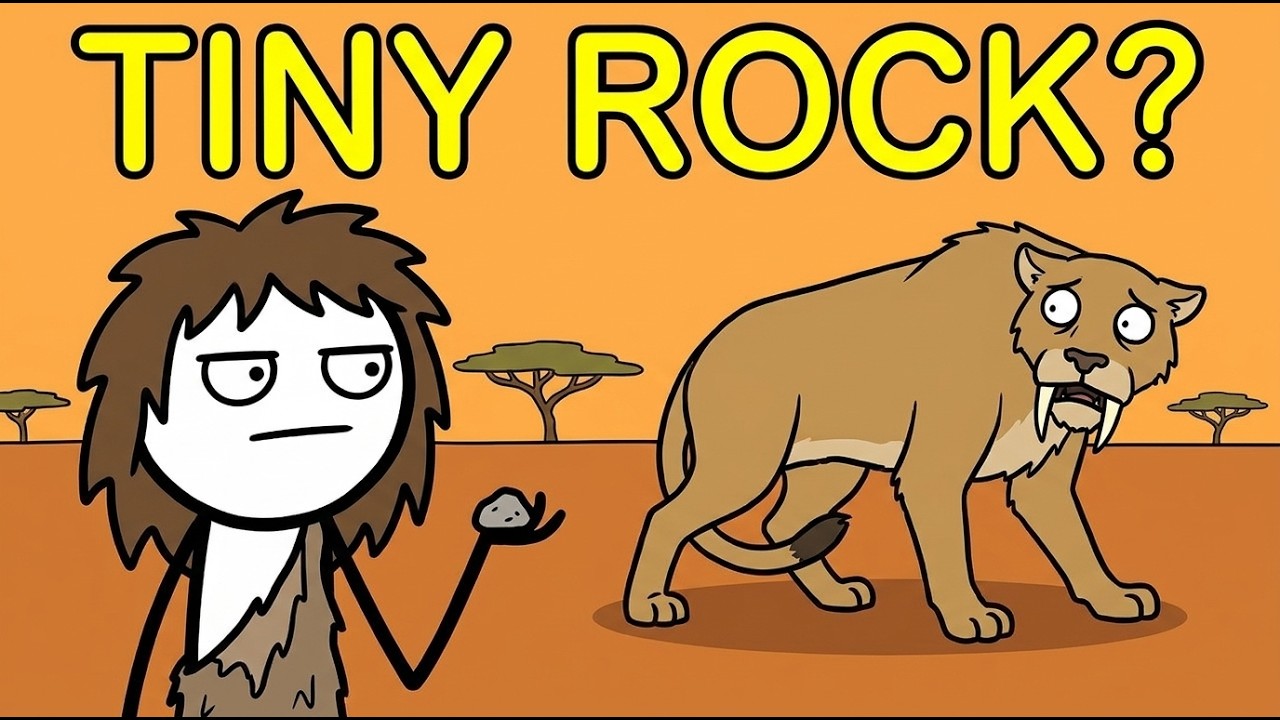
Human beings became the dominant species on a planet full of animals that are stronger, faster, and better armed than us, and one of the most consequential physical abilities in that story is something as simple as throwing. Specifically, the overhand throw of a human hunter accelerating a projectile with precise directional control may be one of the most transformative skills in evolutionary history. It allowed early hominins to kill animals far more powerful than themselves from a safe distance, reorganizing the arms race between predators and prey on this planet. What makes human throwing physically unusual is deeply anatomical.
Every other great ape can throw, and chimpanzees do throw objects with enthusiasm when agitated. But their throws are dramatically less powerful and accurate than human throws, and this difference is not primarily about intelligence or practice. Humans have a throwing arm configured differently from every other primate’s arm, with a relatively mobile shoulder joint, a waist that can rotate independently of the hips, and specific arm segment proportions that allow the elbow to extend rapidly at the right moment. Research by Neil Roach and colleagues at Harvard, published in 2013, identified the rotator cuff and the structure of the human shoulder joint as critical to throwing power.
The anatomy stores elastic energy during the cocking phase of a throw and releases it explosively during the release phase. A chimpanzee can throw at roughly 20 mph with considerable effort. A trained human baseball pitcher can throw over 100 mph. The difference is anatomy.
The shoulder anatomy associated with powerful throwing appears in the fossil record around 2 million years ago in Homo erectus specimens. This is considerably earlier than any evidence of sophisticated weapons but consistent with the period when evidence of active large game hunting first appears in the archaeological record. The timing suggests that throwing anatomy and throwing as a hunting strategy co-evolved, with better throwers surviving better and passing their anatomy to their offspring. Throwing broke the evolutionary arms race between predators and prey.
Most predators must close the distance to prey and attack with teeth, claws, or venom, which gives the prey a chance to injure the predator. This creates a co-evolutionary dynamic that keeps both parties roughly matched. Throwing changes this entirely, because a prey animal’s defensive adaptations, such as speed, horns, or hooves, are calibrated against attacks that require closeness. They are completely irrelevant against a rock or spear arriving at high velocity from 20 meters away.
This is why the archaeological and paleontological record shows a specific pattern. When anatomically modern humans or their close ancestors arrive in a new region, large animals with no prior evolutionary exposure to throwing predators tend to go extinct rapidly. Mammoths, mastodons, giant ground sloths, and other megafauna species did not go extinct primarily because they were killed in close quarters by hunters who matched them physically. They went extinct because throwing made it possible to injure and kill them from a distance where their defenses were completely irrelevant.
The social transmission of throwing skill made it even more dangerous. Unlike physical adaptations that must re-evolve through slow genetic change in every population, throwing technique is culturally transmitted and can be refined, optimized, and spread through teaching and imitation within a single generation. Tool designs such as projectile points, spear weight and balance ratios, and atlatl mechanisms were all culturally improvable. This meant the arms race between human hunters and prey happened at the speed of cultural innovation, potentially thousands of times faster than biological evolution.
Prey populations had no equivalent mechanism for rapid adaptation. Throwing was also an advantage in conflict between human groups. A group capable of accurately throwing projectiles at enemies from a distance where those enemies cannot effectively respond has an enormous tactical advantage. Anthropological research on violence in hunter-gatherer societies consistently documents ranged projectile weapons as a central component of conflict, with extensive cultural investment in developing throwing skill through practice, competition, and ritual contexts.
Accurate throwing requires a form of predictive physical computation that is itself cognitively interesting. To accurately throw at a moving target, the nervous system must solve a complex physics problem in real time, involving projectile trajectory under gravity, the timing and magnitude of release, arm mechanics, and prediction of where the target will be. This computation happens unconsciously, but it requires the same kind of predictive model-based reasoning that characterizes sophisticated cognition. Some researchers have proposed that the cognitive demands of throwing may have contributed to selection pressure for the expanded prefrontal cortex and improved predictive physical reasoning that distinguish human cognition.
Throwing technology was eventually extended into organized military contexts. The bow and arrow extended throwing through elastic energy storage in a flexible limb. The crossbow added mechanical advantage. The catapult extended the throwing principle to objects too heavy for an individual to throw.
The cannon is essentially a chemically powered projectile launcher following the same basic principle. The rifle, artillery shell, and ballistic missile all develop along a single line of technological thinking that begins with a primate picking up a rock and throwing it. The entire military history of civilization is largely a story about improving the fundamental capability that throwing established: applying lethal force at a distance with precision. Throwing also operated in combination with persistence hunting, the ability to run prey animals to exhaustion through sustained pursuit.
These two capabilities work together. Persistence hunting closes the distance to prey that has been exhausted enough to be slowed, and throwing allows killing the exhausted animal without the close-quarters risk of confronting a large, even weakened, prey animal. Together they constitute a hunting system with no evolutionary precedent and no obvious counter-strategy. The archaeological record shows that the earliest unambiguous evidence for thrown projectile weapons, specifically hafted stone points designed for spears, appears in Africa around 300,000 years ago.
Evidence for long-distance prey selection and transport also appears in this period, consistent with throwing enabling hunting strategies that close-quarters weapons could not support. Earlier sites show heavy reliance on scavenging and opportunistic killing, while later sites show patterns consistent with active pursuit hunting of large, dangerous, healthy animals. The technology changed what was huntable. The throwing advantage is not just about velocity.
Many animals can strike at high velocity, but what is unusual about human throwing is the combination of velocity with directional precision, the ability to put a projectile where you intend it to go. Research on the neural control of throwing finds that accurate throwing involves extremely precise timing of muscle activation sequences across the shoulder, elbow, and wrist, coordinated to within millisecond precision. This precision is trained across development and supported by dedicated neural circuitry that is elaborated in humans relative to other primates. A chimpanzee throwing at 20 mph with poor accuracy is a minor annoyance.
A human throwing at 60 mph with enough accuracy to hit a specific target consistently is a serious threat to animals much larger and stronger. Throwing skill develops through practice that is most effective when supported by social learning, including explicit instruction, observation of effective technique, competitive contexts, and feedback on accuracy. Social contexts for throwing practice and demonstration in many traditional societies create environments where skill improvement is rapid and better techniques spread quickly through the group. Throwing also shaped subsequent human evolution through a recursive feedback loop.
Throwing made large game hunting viable at a scale and safety level not achievable before, increasing meat intake, which contributed to nutritional support for larger brain development. Larger brains enabled better throwing through improved motor planning and physical prediction. Better throwing enabled more successful hunting, which enabled more nutritional support for larger brains. The dumb physical skill and the sophisticated cognitive capability of a larger brain reinforced each other across hundreds of thousands of years of selection.
The specific cognitive innovation that made throwing dangerous was not sophisticated reasoning about tool design. It was the discovery that you can kill something without being close to it. That single insight, paired with the anatomy to execute it effectively and the social infrastructure to transmit the skill, turned a medium-sized primate into the most consequential predator this planet has ever produced.