Commander Royce Tennant was twenty minutes into his pre-deployment brief when his eye caught on me. I was sitting in the back row by the coffee urn, wearing a flight suit with nothing sewn on it, which was deliberate. A flight suit lets you belong anywhere on a navy installation without anyone asking a single question. One with no patches lets you belong nowhere in particular, which was exactly the amount of belonging I wanted.
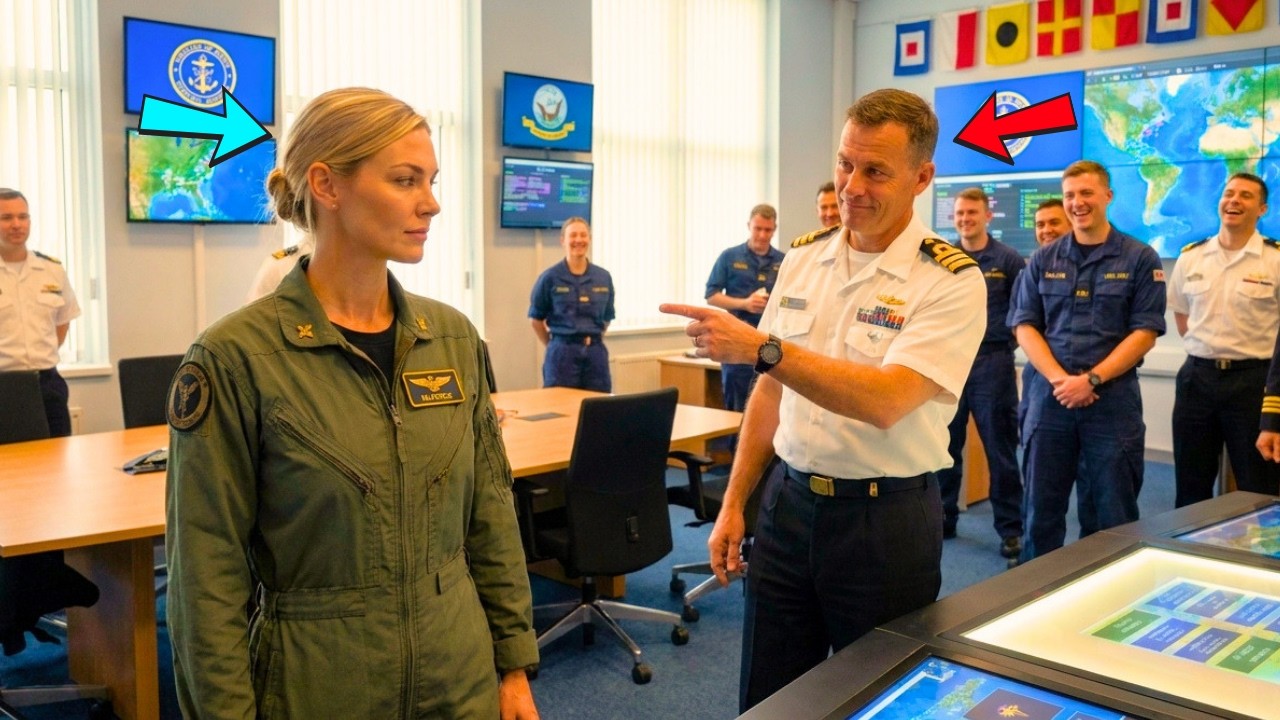
I had come in late and told myself I would observe, leave before anyone learned my name, and be gone before the part of the week with my name in it ever arrived. “We’ve got a guest in the back,” Tennant said, and the heads turned. “Don’t be shy. I’m guessing you’re with the admin shop, helping us push all this paper.
” He smiled, and the room smiled with him, ready. “Tell everyone your call sign, honey. We could use a laugh. ”
The junior officers grinned, glad for the break.
The senior ones did not. The older the man, the flatter his face went, as if some of them felt a draft come into the room that the young ones could not feel yet. “I don’t have a cute one,” I said, meaning it to close the door. Tennant was not most people.
He had a room going, and he wanted the laugh he had set up. “Come on now, everybody’s got a call sign,” he said, spreading his hands to include everyone. “Go on then. What do they call you?
”
There are moments when you can feel two roads under your feet at once. I had a dozen harmless names filed away for exactly this, soft and forgettable, the kind that makes a man nod and turn back to his slides. I had used them for years. I do not fully know why I did not use one that morning.
Maybe I was tired in a way I had not been honest with myself about. Maybe twelve years is simply the length of time a person can hold a breath, and mine had run out in that warm corner by the coffee. “Widow Seven,” I said, not loud, the way you set down something heavy you have been carrying too long. The laugh did not come.
A name like that in a room like that does the work itself. I watched it cross the rows. The junior officers looked confused first, because to them it was just two words, and then they looked at the older men, the way you check the sky by checking the faces of people who have been outside longer than you. The older men had gone still.
Not polite. Still, the way a deck goes still when the word comes down that a recovery is not going to be a recovery. Tennant’s smile held a half second past its moment, the way a glass holds its shape for an instant after it is already cracked. Somewhere in the corner, a chair creaked.
A man was getting to his feet. That is where the morning broke open. But to understand why two words emptied a brief and stood a room full of officers up out of their chairs, you have to understand who was sitting in that back chair, and you have to understand a night in January of 2014 that I had spent twelve years refusing to be in a room with. Let me tell you who I actually was first, because that is the part people get wrong.
By every measure anyone could see, I was the least remarkable officer in that building. I had a staff job, a small office with a door that closed, a coffee mug, and a calendar of meetings about manning and readiness reports. I came in early. I left without anyone noticing.
For twelve years, I had drifted through billets no one fights over, the jobs that exist so the jobs people want can function. I had cultivated a reputation as a competent woman with no edges and no story. People thought I was modest. I let them.
But modesty is a choice you make when you have something to spare. I had nothing to spare. I had a name I could not say out loud without the floor tilting. That is not modesty.
That is a person holding very still so the thing inside her does not wake up. I flew nothing. I re-qualified on nothing. I let my flight hours sit frozen at the number they had been on the eleventh of January 2014.
When a well-meaning detailer asked if I wanted to get back in the air, I told him I had found my place on the ground. I had made myself into exactly the officer the Navy needs a certain number of and never celebrates, the one who keeps the unglamorous machinery turning. I had told myself the whole time it was service. It was hiding.
The two can wear the same uniform for a very long time before anyone notices, including you. I had not meant to be on that base at all. I had been sent, on paper, to observe the brief, a courtesy assignment for the officer who will not make waves. What no one knew was that the squadron rededicating its memorial that same week was my squadron, and the wing standing up for this deployment was built on the bones of the one I had flown in.
I had spent the drive to the gate telling myself I would sit in the back and leave before anyone could ask me anything. I almost made it. To tell you the rest, I have to take you back, and I will try to do it the way it actually sits in me, which is not as a war story. In January of 2014, I was a lieutenant, thirty-one years old, and I flew the F/A-18F Super Hornet off a carrier in a part of the ocean with no land near enough to matter.
We called ourselves the Widows. It was an old squadron name, the kind of dark joke aviators give themselves so the actual dark has less room to move. I was the flight lead of a four-ship that night, and on the radio that made me Widow Seven. In my backseat, I had a weapons systems officer named Sawyer Coe.
He was twenty-four. He had been married eleven months and had a daughter at home, a girl named Nadia, who was that winter mostly a small weight and a smell. Coe used to say the backseat had the better view, the way you would thank someone. He was the kind of young man who made the people around him slightly better just by deciding to be glad.
We had flown together for the better part of a year, long enough to learn the weather of another person. I knew he got quiet about an hour before a night recovery, not from fear, but from a focus he was almost shy about, and that the quiet would break the moment we were back on deck. I knew he kept a photograph tucked where he should not have kept it, his wife and the baby, and that he had shown it to me exactly once, on a transit, holding it up over his shoulder so I could see it. I had told him it was against about four regulations, and that she was beautiful, and he had laughed and put it away.
That was the whole of the friendship, really. Hours of nothing in a small loud space, two people minding the same dark together. It does not sound like much when you say it. It is most of what I have ever loved.
It was a night recovery in weather coming down faster than the forecast had promised, and there was no divert. When people who do not fly hear there is no divert, they nod because it sounds like an inconvenience. It is not an inconvenience. It means the ship is the only dry steel in the world, and the world has gone black, and the air you are flying through has started to lie to you about which way is up.
We lost two aircraft that night. The short, cold truth is that one of my jets went into the water from spatial disorientation, the pilot believing the sea was the sky for the three seconds that mattered, and a second jet, maneuvering in the murk to hold position, came close enough to another that the only thing to do was brake hard, and the brake put it somewhere it could not recover from. Two crews, four people in a freezing sea at night, if they had gotten out at all, and at first we did not know if they had. I was Widow Seven, the flight lead, and the part of that night the citation likes is the part where I did not come home.
I had the fuel, just barely, and every instinct and every regulation pointed me at the deck, and I stayed. I orbited the place on the black water where my people had gone in, and I marked it, and I talked. That is the part no one tells. It was not heroics.
It was talking. It was keeping my voice level on the radio while I worked the rescue helo onto the survivors, while I kept one of my own pilots, a terrified young man named Brackett, from following his friends into the sea. I talked Brackett down out of the worst of it and onto a heading and toward the ship, because his voice had gone to a place I recognized. I stayed over the water until my own aircraft began to quit on me.
Fuel does what fuel does. There is no negotiating with it. The last thing I did as a pilot that night was point my dying jet away from everyone else and tell Coe to get ready. We ejected into a sea that does not bear describing, in the dark, in January.
The cold is not pain at first. The cold is a hand that takes your breath and your strength at the same time, so fast you cannot be afraid of it in any useful way. I came down under a canopy and got into my raft and found Coe. I am not going to tell you all of it.
I will tell you that his flotation had failed, and that I had him, and that I held him out of the water through the small hours of that night while the search could not find us in the dark and the weather. And that at some point in those hours he stopped being able to help me hold him, and at some later point I was holding an empty harness and did not know it, because by then the cold had taken most of me too, and I had stopped being able to tell the difference between him and the sea. They suspended the search at first light. That is procedure, and it is the correct procedure, and I have made my peace with the men who made that call, because they made it with information that said I had been in the water far too long to be a living person.
My squadron was told I was lost. They held a memorial. They printed a program with my name in it between two other names, all three in the same dignified font. Someone hung my photograph on the ready room board with a black band across the corner.
I did not know any of this for a long time after. I have pieced it together from people who were there, because I was not, in any sense that counts, present for my own rescue. A rescue swimmer named Macklin Rorke ran the numbers the same as everyone else, and the numbers said stop. He looked at the drift model in the current, and a feeling he has never been able to explain to me in words that satisfy him, and he went back to the air crew and said one more pass, and they gave it to him.
He went into that water on a line and found me nineteen hours after I went in, blue and unconscious and still holding a harness with no one in it. He did not let go of me until other hands took me. I came back from the dead in a literal administrative sense. There is a process by which a service member reported deceased is corrected to living, and it is its own small bureaucratic indignity.
I came home to my own memorial program. Someone had saved me a copy, not understanding how that would feel. I held a piece of paper with my name printed between two men who had not come back. I understood for the first time a thing I have never been able to fully un-understand since: that I had been buried and then dug up, and that the world had moved a few feet on without me and then been asked to move back.
You do not recover from reading your own name on a memorial program. You learn to carry it quietly enough that no one ever asks you about it. The Navy gave me the Distinguished Flying Cross for that night, for remaining on station over downed aircrew at the cost of my own aircraft. It is a real medal, given for real things, and I am not going to pretend it is nothing.
I put it in a drawer, and then I went looking for a job where no one would ever have a reason to read the citation. I strung those jobs together into twelve years. So when the chair creaked in that brief and a barrel-chested master chief stood up in the corner, my first thought was only that something was wrong. He was fifty-one now, with a chief’s anchors and a face that had spent thirty years in salt air.
He was looking at me the way you look at a thing you were told you would never see. “I pulled you out of the water myself,” he said. His voice was not loud either. “Nineteen hours.
I had your weight in my arms, ma’am. I never thought I would see you stand up in a room again. ”
The brief was over. Everyone in it understood that without being told.
A young officer near the front, a lieutenant named Devon Prior, said the thing the whole room was holding without meaning to say it out loud. “How is she still alive? ”
Then the room stood up. It was not a single motion.
It was one man, and then the man beside him, and then a whole row, and then the rows behind, each person rising as the thing reached them, a slow uneven swell of chairs scraping back across a linoleum floor until there was no one sitting except Commander Tennant. Then he stood too, because there was nothing else left to do. A dry, absolutely certain voice came from the side of the room. It belonged to Vice Admiral Thaddeus Orr, who had commanded the strike group the night of January eleventh, 2014, and who had signed the order that suspended the search.
“Sit down, Commander Tennant,” he said. “You have been briefing for twenty minutes in front of a legend and calling her admin. ”
He turned to the room, not to me, the way a man turns when he has decided something needs to be said in front of witnesses. “Commander Thorne held station over two crews in the water until her own aircraft quit on her.
She put a junior pilot back on the deck who would not have made it home otherwise. Then she went into the sea, and she was reported dead, and she was wrong about that, thank God. ”
Off to my right, another man was on his feet, and this one I did know, because I had heard his voice in my sleep for years. Captain Nile Brackett, forty-two now, a senior man in the wing, had been the terrified lieutenant junior grade I talked down out of a black sky.
He did not say anything clever. He said, “It’s her. It’s actually her,” his voice not quite steady. And that was somehow the thing that made it real for the rest of the room, a grown captain confirming a ghost.
The truth is, I had imagined a version of that moment over the years, idly, the way you press on a bruise. And I want to tell you what it was actually like. It was unbearable. A room full of standing officers wanted to give me something, respect, awe, apology, a story they would tell for the rest of their careers.
And I did not know how to be a person you could give something to. Every old reflex I had fired at once, and what I wanted with my whole body was to get small and get out. I started to give the speech I had given myself a thousand times. “The men who matter that night,” I said, my voice going flat and administrative, “are the ones who are not standing in this room.
Master Chief Rorke flew a pattern he wasn’t cleared for. It was my flight. There’s no version of that night where I’m the one who gets stood up for. ”
It is a good speech.
It has the shape of humility. And I watched it land on the room, and I watched the room not believe it. Not because they doubted the facts, but because they could see, the way you can sometimes see straight through a person, that I was not being humble. I was being absent.
I was using the dead to excuse myself from the obligation of being alive in front of them. Tennant came toward me through the standing officers, starting to say the thing men say, that he could not have known, that it was just a joke, that he meant nothing by it. I let him say it. I did not help him.
“You couldn’t have known,” he said. “There’s no way I could have known. ”
“No,” I agreed. “There wasn’t.
”
And I let that be all of it for the moment, because there was a man in the corner I needed to talk to more than I needed to settle anything with Commander Tennant. The brief did not resume. The admiral released the room, and the officers filed out slowly, most of them stealing a look at me, a few stopping, then thinking better of it. Rorke waited.
We ended up in a passageway outside, just the two of us, with the fluorescent hum and the gray paint. “You send me a card every December,” he said. It was not a question. “Two sentences, same two sentences, basically, for twelve years.
”
“I never knew what to write,” I said. “To the man who pulled you out of the water. ”
He said it without cruelty, turning it over the way you turn over a knot. “Ma’am, I have thought about you every day of my life since the eleventh of January, 2014.
Every day. And once a year, I get two sentences and a signature, and I have spent twelve years trying to figure out if that is because you do not think about it, or because you think about nothing else. ”
“The second one,” I said. He nodded slowly, like I had confirmed a thing he had suspected and hoped was not true.
“When I went back out that night,” he said, “I did not go back out for a body. I broke a pattern, and I went back into that water for you. For a living person I had decided without any evidence was still alive, because I could not make myself believe the water had won. And ma’am, with respect, you have spent twelve years acting like it did.
Like I pulled a dead woman out, and she has just been being polite ever since. Do not make me have done that for someone who decided to stay in the water anyway. ”
I have been told a great many things in my life by people who outranked me, and almost none of it has changed me. That changed me.
Standing in a gray passageway with a master chief who had every right to say it, I felt the thing I had been holding very still for twelve years finally move. “I thank the dead,” I said, and I was not sure I had ever said it out loud before. “Every single day. I thank them for the privilege of disappearing.
I have been using the men who did not come back as a reason not to be here. And you spent nineteen hours making sure I would be here. ” I had to stop. “One of us has been wasting it.
”
“Yes, ma’am,” Rorke said, not unkindly. “One of us has. ”
I went looking for Vice Admiral Orr after that, not to be thanked, but to ask for the one thing I had not let myself want in twelve years. He stood when I came in, which a vice admiral does not have to do for a commander.
I asked him to hear my request before he said anything kind to me. “I want to fly again,” I said. “I have been current on nothing for twelve years. I understand the re-qualification, the medical, the syllabus, all of it.
I understand I am forty-three and I have a lot of rust. I am asking anyway. ”
He was quiet for a moment. “You know I signed the suspend order.
”
“I know, sir. ”
“The numbers were right,” he said. “You were in that water for nineteen hours, and there was no model on Earth that said a living person could still be in it. I gave the order, and I was right, and I was also wrong, because you were in it, and a master chief who would not accept my correct order went and got you.
” He shook his head slowly. “The most important decision I ever made was a wrong one that a better man than me refused to obey. ”
“Sir, you don’t owe me. ”
“I am not talking about owing,” he said, looking at me directly.
“You have been carrying that night like a sentence, Commander. As if surviving was the crime, and the punishment is that you have to spend the rest of your life being small enough to deserve it. I am not going to let you carry it by disappearing into a cubicle for another twelve years. ” He put out his hand.
“Come back and fly. I will make sure the door is open. You will have to walk through it yourself, but it will be open. ”
Tenant came to me later on his own, without an audience, which told me he meant at least some of it.
He said he wanted to apologize properly, not the version from the room. “What I did was, I saw a woman I didn’t recognize, and I decided she was nobody, and I made her the morning’s joke to keep the room awake. That’s the whole of it. There’s no version where that’s all right.
”
I found that I did not hate him, and that I was also not going to make him feel better. “You didn’t insult me, Commander,” I said. “I have been insulted by experts, and I barely felt it. You insulted a name that a lot of good people died next to.
Lieutenant Sawyer Coe died next to that name. Two crews died under it. You stood in front of a room and turned it into a punchline because you needed the room awake, and you did it to a stranger you decided was beneath noticing. That is the part you should actually sit with.
Not that you happened to do it to me. That you do it at all. ”
He took it. He did not argue, and he did not collapse into apology.
It went to his chain, and it was handled the way those things are handled when no one is trying to make an example, with a formal counseling and a mark. He wrote me a letter weeks later that asked for nothing, and I read it once and filed it. We have kept our correct distance ever since. The harder conversation was with Brackett.
He found me before I left the base, and we walked, and for a while neither of us said anything. “You know what it did to us when they told us you were gone,” he finally said. “You were the flight lead. You were the one who stayed.
You talked me onto the deck. I would not have made it home that night, and we both know it. Then they told us you were lost, and I had to stand in the ready room under your picture with the black band on it, knowing I was alive because you stayed, and you were dead because you stayed. ”
He stopped walking.
“And then they found you, and it was the best day of my life. And then you disappeared anyway. ”
“I didn’t disappear. I was an hour up the coast.
”
“That’s worse,” he said, and he was right. “You were within driving distance for twelve years, and you let me keep believing the worst part of it. You let all of us keep grieving a version of you that didn’t have to exist, because the real you wouldn’t pick up the phone. ”
It had genuinely never occurred to me, in any way I had let myself feel, that there were people who had buried me and been told to unbury me and then never been allowed to actually have me back.
That my survival had been a gift I refused to finish delivering. It is the last thing I learned from that night, and it is the most expensive. “I’m sorry, Nile,” I said. “That’s not a big enough word, and it’s the one I’ve got.
”
“It’ll do,” he said. “Start picking up the phone, and it’ll do. ”
I drove home that evening with all of it loose in me, and none of it touched the actual wound. Being recognized is not the same as being whole.
I had confused the two for twelve years. The weight was never about whether I was recognized. The weight was Sawyer Coe. That night, I took the medal out of the drawer for the first time in a long time and read the citation.
It is a good citation, spare and accurate. But it does not say, because there is no language in the awards manual for it, that I held a twenty-four-year-old man out of a freezing sea until the sea took him out of my arms, and that I did not know the exact moment he left, and that I have spent twelve years unable to forgive myself for not knowing the moment, as if knowing it would have changed it. I had built a whole theology out of that drawer. As long as the medal stayed in the dark, I had reasoned, I had not really accepted it.
And if I had not accepted it, I had not been paid for him. And if I had not been paid for him, I had not betrayed him by surviving. The trouble with that theology is that it does not actually keep the dead close. It only keeps the living away.
The only thing my drawer had successfully buried was me. And I understood, sitting there with the ribbon in my hand, that I had one more thing to do. I had to go and see his family. I had been to the funeral in 2014 in a fog, barely present.
I had sent cards, the same two careful sentences, to a young widow named Annika and a daughter who could not read them. I called first. Annika answered, and there was a silence after I said my name, and then she said, “Maris Thorne,” not a question, just the name, the way you say a name you have thought about for a long time, and she told me to come. They lived in a small house in a town a few hours inland.
Annika was forty now. The woman who opened the door had a grown person’s face, lined the right amount for the years, steady. And there was a girl, twelve years old, Nadia Coe, who had been a small warm weight in her father’s stories, and who was now a kid with her father’s exact way of tilting her head when she was deciding whether to trust you. We sat in their kitchen.
On the drive, I had thought about all the careful ways I might tell them the gentle version. And I had decided, somewhere on the highway, that the gentle version was one more way of disappearing. “I need to ask you something before I say anything,” I said to Annika. “The Navy told you what happened, the letter, the casualty officer, all of it.
I can tell you the real version, the part that isn’t in the letter, the part I was there for. But it is not a gentle thing, and you have built a life, and I am not going to crack it open just because I need to confess. Do you want it? Either answer is all right.
”
Annika looked at her daughter, and something passed between them that they had clearly practiced, a family that had spent twelve years deciding together what they could carry. “For twelve years,” Annika said, “I have thought he went into that water by himself, in the dark, alone. That’s the picture I’ve had to live inside, that he was alone. If you’re telling me that’s wrong, then yes.
We want it. ”
“It’s wrong,” I said. “He was not alone. ”
And I told them.
I told them about the backseat and the better view and the way Coe talked about Nadia on long transits. I told them about the weather and the no divert and the decision to stay. I told them that we ejected together, and that I found him in the water, and that his flotation had failed, and that I had him. I said that word carefully, because it was the word that mattered.
I had him. I held him out of the water through the worst hours of that night, the two of us in the cold and the dark, and I talked to him the whole time about nothing, about everything, about a daughter at home. He was with me for a long time, longer than the cold should have allowed, because he was strong, and because he wanted to come home to them so badly that he held on past where holding on was possible. “I had him until I couldn’t,” I said.
“I’m sorry it wasn’t longer. I would give anything for it to have been longer. But he was not alone in the water. He had someone with him the whole way.
And the last thing in the world he was thinking about was the two of you. ”
Annika cried the way a person cries when something they have held in a clenched fist for twelve years is finally allowed to open. Nadia did not cry. She watched me with her father’s head tilt, taking my measure, and then she said the thing that broke me open in a way the standing room had not come close to.
“You’re the one from the metal,” she said. “Mom kept the program from your memorial before they found you. Your name’s in it between my dad’s and the other guys. Mom crossed it out in pen after.
It’s the only happy thing in the whole program, your name crossed out. ”
“Yeah,” I said. “I’m the one from the metal. ”
She asked if her father had been scared.
“He wasn’t thinking about being scared,” I said, and I believed it, and it was the truest gift I had to give her. “He was thinking about getting home to you. That’s not me being nice. That is the actual thing he talked about in the water when there was no reason left to talk.
You. ”
She nodded, a kid filing away a thing she would need for the rest of her life. Then she got up and came around the table and hugged me, fast and fierce, the way her father did everything. And I held a twelve-year-old in a kitchen and let myself, for the first time, be a person someone could give something to.
Before I left their town, I went to the squadron memorial. Three names had gone up on it in 2014 after that night. Mine had been one of them. When they found me, they had taken my name off.
There is a faint difference in the stone where it was, if you know to look, a place where the letters were and then were ground away, so that for twelve years I have been a smooth patch on a wall between two men who stayed carved. I stood in front of Sawyer Coe’s name, which is carved and will stay carved, and I said it out loud in daylight, with people walking past on the path behind me who did not know what I was doing. “Sawyer Coe. ” Just his name in the sun, where anyone could hear.
And I looked at the smooth patch beside it where mine had been, and I understood something I had been refusing to understand for twelve years. They had cut my name off that wall because I was alive. That was not a theft. That was the whole point.
For twelve years I had been quietly carving it back on myself, living like a name that belonged on a memorial, treating my own survival as an administrative error that decency required me to keep correcting. Standing there in the daylight, I finally let it stay off. I am not on that wall. And the not being on it is not a debt.
It is a gift that a master chief gave me in nineteen hours of freezing water. You do not honor a gift like that by living as though you had refused it. I got my airplane back. It was not quick, and it was not easy, and I did not deserve it to be.
There was a medical I had to pass, and a re-qualification syllabus built for people half my age, and a great deal of rust. The door was open the way the admiral had promised, and walking through it was the hardest sustained thing I have done since the water. But there is a flight suit that fits me again now, and it has patches on it, and my name is on one of them. Above my left chest, there are wings of gold that I earned twice, once at twenty-five and once at forty-four.
The first time I came up the ladder and settled into the seat and the canopy came down and the world got quiet in the particular way it only gets quiet in a cockpit, I sat there for a moment before I started the checklist, and I let myself be exactly where I was, which was alive, in an airplane, on a deck, in the world, finished with being dead. I fly with a call sign now. The same one. Widow Seven.
I thought about asking for a new one when I came back. I decided not to. The name means two things now. It means the men who did not come home, and it always will.
And it also means that I came home, that a master chief would not believe the water had won, and went back out, and was right. The name holds both of those now, the loss and the survival, the way I have finally learned to hold both. When a young officer asks me what it means, I tell them the whole thing, because the whole thing is the point. So to you, if you came home from something you were not supposed to come home from, if you survived the crash, or the diagnosis, or the deployment, or the year that should have ended you, and the people next to you did not, and you have spent every day since paying for your survival by living as small as you can manage, treating the fact that you are still here as a debt you can never pay down, an embarrassment you carry quietly so as not to insult the dead, I know that life.
I lived it for twelve years in a series of small offices with the door closed. I want to tell you what a master chief told me in a gray passageway. He did not pull you out of the water so that you could stay in it. Whoever went back out and would not believe you were gone, a person, a doctor, a stranger, your own stubborn body that refused to quit, they did not do that so you could spend the rest of your life being a smooth patch on a wall.
The ones who did not come home are not honored by you disappearing slowly where no one can follow. They are honored by you living, all the way, out loud, in daylight, letting people see you and letting people give you things and saying the names of the lost in the sunshine instead of carving your own beside them in the dark. Stand up. Let them see you.
You are allowed to be the one who lived. I fly now. I say his name in daylight. And when someone asks me my call sign, I tell them, and I let it mean both things at once, the leaving and the coming home, and I do not flinch from either.
And that, after twelve years in the water, is what being alive turned out to be.