Jacqueline Bisset, the 80-year-old actress whose career has spanned six decades, has ignited a firestorm of controversy with remarks dismissing the #MeToo movement as something she finds herself “very unsympathetic” toward, comments that have landed with explosive force in an industry still grappling with its reckoning.
In an interview published this week, the “Bullitt” and “The Deep” star suggested that women bear a share of responsibility for sexual misconduct in Hollywood, arguing that “how you dress and what your subtext is” are critical factors that should not be “played with.” She added that women need to learn the word “no.”
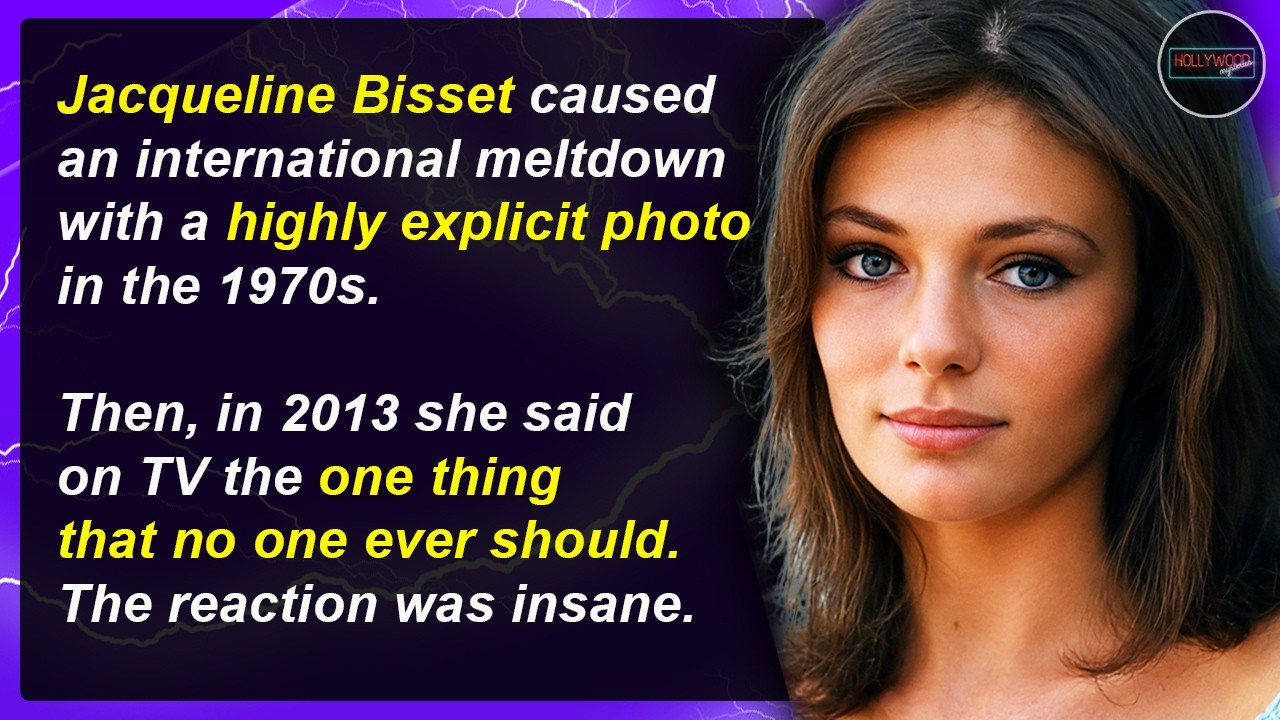 The statements are particularly jarring given Bisset’s own history. She is the godmother of Angelina Jolie, one of the most prominent accusers of disgraced producer Harvey Weinstein. Bisset herself spent decades fighting against the exploitation of her image, most notably the unauthorized underwater photograph from the 1977 hit “The Deep” that made her a global sensation against her will.
That photograph, which showed her in a sheer white t-shirt 90 feet beneath the surface of the British Virgin Islands, was published without her consent in Playboy and Penthouse. She attempted to secure an injunction to stop its distribution, but the image was so valuable to Columbia Pictures that it became the centerpiece of a year-long publicity campaign. The studio’s own internal marketing documents reportedly classified the target demographic as “lusty men.”
“I tried to get an injunction on them,” Bisset said at the time, but the legal effort failed. The image spawned a decade of wet t-shirt contests across the country, organized by the film’s soundtrack label, and followed her for half a century. She has said repeatedly that people would not look her in the eye, only at her chest, and called the experience “rather boring.”
In her recent remarks, Bisset defended her generation’s approach to workplace harassment, claiming she handled unwanted advances by going “very cold towards them and freeze them out.” She insisted nothing ever happened to her because she “simply decided that nothing would” and that she never traded anything for a job.
Critics have been quick to point out the apparent contradiction: a woman whose most famous image was stolen from her, who could not stop its commercial exploitation, now suggesting that women control their own objectification through their behavior and presentation. The distinction between refusing a proposition and being unable to refuse one appears lost in her formulation.
Bisset’s career has been defined by such paradoxes. Born Winifred Jacqueline Fraser Bisset in Weybridge, Surrey in 1944, she rose to fame in the late 1960s with roles in “Two for the Road” and “Bullitt.” She was nearly killed filming “The Deep” when her air supply failed at depth, an accident the producers wrote into the script after realizing the footage was too dramatic to waste.
She has never married and has no children, having spent much of her adult life caring for her mother, who was diagnosed with multiple sclerosis when Bisset was 15. The caregiving lasted nearly 40 years, through paralysis, blindness, and dementia. She has described the experience as “a hell of a journey.”
Her comments on #MeToo come at a delicate moment for the industry, which has spent the years since Weinstein’s downfall in 2017 wrestling with questions of power, consent, and accountability. Bisset’s insistence that women must learn to say no has been met with fierce backlash from those who argue that the problem has never been women’s inability to refuse, but the consequences of refusal in an industry where one person holds all the cards.
She has also been criticized for ignoring the vast difference between her own position and that of less privileged women. Bisset was a contract player at 20th Century Fox by her mid-20s, a woman of formidable beauty and presence who could afford to freeze out unwanted advances. Many women in the industry, particularly those without her status, did not have that luxury.
In a 2018 interview, she expressed similar views, suggesting that the movement had gone too far. Her latest remarks double down on that position, and she has shown no sign of softening them in the face of criticism.
The irony is inescapable. The woman who spent decades being asked to sign copies of a photograph she never approved, who watched as her near-drowning was turned into marketing material, who was anointed “the most beautiful film actress of all time” by Newsweek while being denied control over her own image, now tells women that their subtext is something to be managed.
She has said she hates looking back, and her refusal to engage with the implications of her own history is consistent with that. But the past has a way of catching up, and for a woman who has spent 50 years asking the world to look her in the eye, these remarks ensure that the world is looking now, and what it sees is deeply complicated.
Bisset has always been a study in contradictions: the ballet dancer rejected for being too tall, the actress who produced her own film but kept her name off the credits to avoid seeming egotistical, the woman who nearly drowned on camera and then never put her head underwater again. Her Golden Globes speech in 2014, in which she appeared disoriented and was accused of being drunk, ended with the observation that “if you want to look good, you have to forgive everybody. It’s the best beauty treatment.”
That sentiment, forgiveness as the ultimate cosmetic, seems far from her current stance. Whether she will walk back her comments or double down remains to be seen. At 80, she has earned the right to speak her mind, but in an era where the industry is still fighting for its soul, her words carry weight she may not have anticipated.