The rhythmic pulse of a smartphone alarm is a sound that has governed human existence for generations, a daily call to arms in the endless war against the clock. But for 99% of our species’ history, that sound did not exist, nor did the concept of the “workday” it initiates. A growing body of archaeological and anthropological evidence is challenging the foundational myth of modern civilization, suggesting that the hunter-gatherer existence was not a brutal, desperate struggle for survival, but a life of remarkable leisure, rich social connection, and profound artistic expression that we have since traded away for the security of the 9-to-5.
The modern human spends approximately 90,000 hours of their life working, a staggering figure that equates to roughly one-third of their waking existence dedicated to employment, wages, and the demands of a boss. Yet, for the overwhelming majority of human history, the concept of a “job” was entirely alien. There was no employment, no salary, no career ladder to climb, and no performance review.
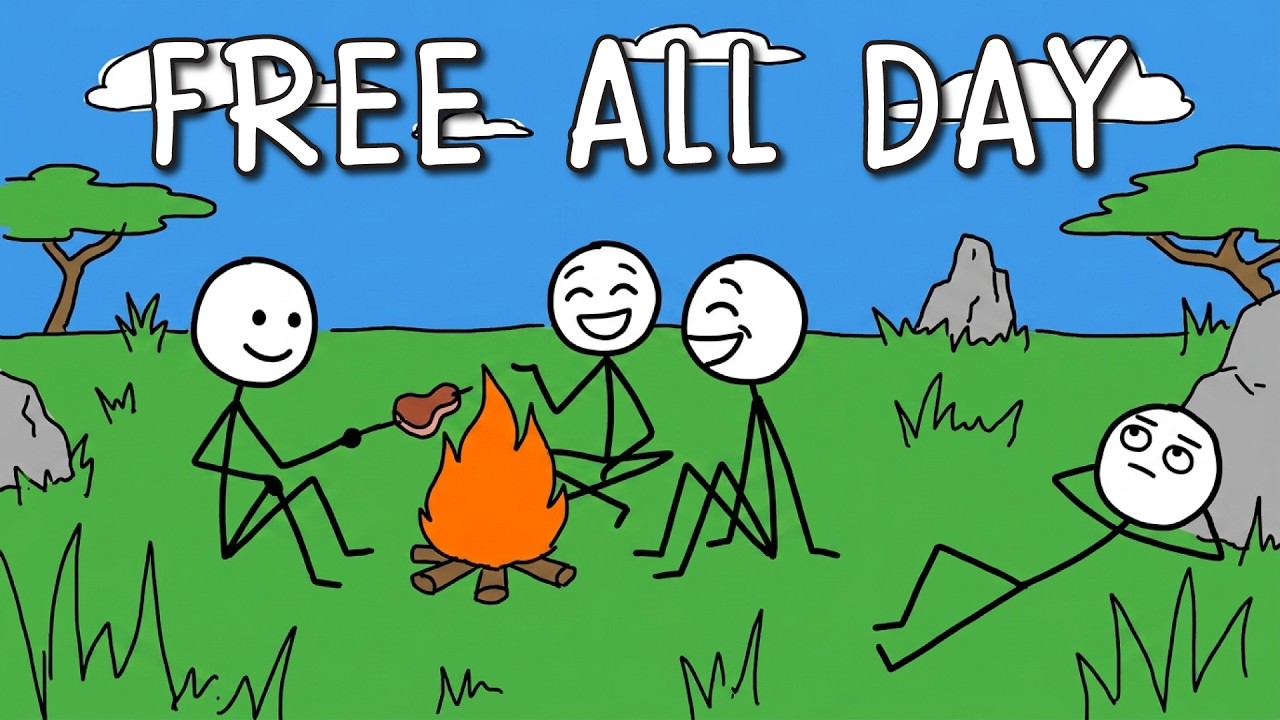 The question that haunts the modern worker—”What should I do today?” —was not a source of anxiety for our ancestors but a genuine, open-ended inquiry into a day filled with possibility, not obligation.
This radical re-evaluation of prehistoric life is not based on idle speculation but on rigorous, decades-long scientific study. In 1963, archaeologist Richard Lee conducted a landmark study among the Dobe Ju/’hoansi people of Botswana, one of the last groups living a lifestyle that closely mirrors pre-agricultural human existence. His findings were nothing short of revolutionary.
Lee tracked the daily activities of adults and discovered that they spent an average of just 2. 5 days per week acquiring food, totaling roughly 17 hours. The remaining time was theirs to do with as they pleased, a level of leisure that would be the envy of any modern professional.
This pattern is not an anomaly isolated to one region. Anthropologists have observed the same phenomenon across the globe, from the Hadza in Tanzania to the Aché in Paraguay and the Martu in Australia. Despite completely different environments and continents, the result is consistently the same: approximately 15 to 20 hours per week dedicated to survival activities.
For context, the average modern worker puts in double that amount of time before they even begin to consider their personal lives. The question then becomes, if we work so much more, what exactly are we working for?
Skeptics might argue that these are modern populations, influenced by the world around them, and cannot accurately represent the lives of ancient humans. However, the most compelling evidence comes not from living cultures but from the silent testimony of ancient bones. When archaeologists compare the skeletons of hunter-gatherers to those of early agricultural populations, the difference is stark and undeniable.
The farmers were shorter, their bones riddled with signs of nutritional deficiency, and their teeth were decayed from grain-heavy diets. They suffered from arthritis in their spines, a direct result of repetitive, back-breaking labor, and they died younger.
In contrast, the skeletons of ancient hunter-gatherers tell a different story. They were taller, stronger, and had healthier teeth and less joint damage. Their bones are a clear biological record that they were engaging in less repetitive physical labor, not more.
The shift to agriculture, often hailed as the great leap forward for humanity, was, according to the skeletal evidence, a catastrophic decline in physical health and quality of life. It was a trap from which there was no escape, as populations grew too large to ever return to a foraging lifestyle.
Perhaps the most fascinating evidence against the “brutish, short life” narrative comes from a discovery that should not exist if survival were a constant, all-consuming struggle: art. In 1994, explorers stumbled upon the Chauvet Cave in southern France, a time capsule containing paintings created roughly 30,000 years ago. These were not crude stick figures but sophisticated depictions of horses, lions, and rhinoceroses rendered with perspective, shading, and a sense of movement that rivals modern artistry.
Creating such work required immense skill, careful planning, and, most importantly, a significant investment of time that had no direct survival benefit.
 This pattern of creative expression is found across the globe. In Blombos Cave in South Africa, archaeologists unearthed 100,000-year-old perforated shell beads, tiny holes drilled through seashells clearly intended to be strung as jewelry. The nearest coastline was 20 kilometers away, meaning someone walked a 40-kilometer round trip just to collect shells, then spent hours meticulously drilling holes with stone tools, all for the sake of personal adornment.
In 2008, a 40,000-year-old flute carved from a vulture bone was found in Germany, with five perfectly spaced finger holes, demonstrating a sophisticated understanding of music and pitch.
These are not isolated finds. Archaeological sites from 100,000 years ago onward are filled with evidence of decorative objects, carefully crafted tools far more elaborate than necessary for survival, and items that required hours of focused work with no immediate practical benefit. This is what people did when they weren’t securing food.
They created. They decorated. They made things beautiful.
They engaged in activities that gave their lives meaning and pleasure, not just sustenance. This was not a luxury reserved for a privileged few; it was a fundamental part of the human experience.
So, what did a typical day actually look like for our ancestors? The reconstruction from anthropological data paints a picture that is both idyllic and profoundly human. You wake up around dawn, not to an alarm, but because your body is rested.
The fire from the previous night is still smoldering, and someone adds wood. You eat leftover meat or fish from yesterday’s hunt, perhaps supplemented by nuts or berries gathered the day before. Breakfast is a social 𝒶𝒻𝒻𝒶𝒾𝓇, filled with talk and loose plans for the day, not because you have to, but because that is what humans do.
Around mid-morning, a small group might leave to hunt or gather, but here is the crucial point: you do not go every day. If the hunt was successful two days ago and food is stored, you might not leave camp at all. You might spend the morning working on tools, sharpening a spear, weaving a basket, or scraping an animal hide to make it soft and usable.
This is not “work” in the modern sense. There is no clock, no supervisor, and no wage. You do it because competence matters, because being skilled earns respect, and because making things well is a fundamental part of being human.
When hunting does occur, it is not the frantic chase often depicted in movies. Humans are persistence hunters, uniquely adapted to track animals at a steady jog for hours until the prey overheats and collapses. We are the only species that can do this effectively because we can sweat and regulate our body temperature while running.
 The hunt might take three to six hours, including travel, after which the animal is carried back and butchered, and everyone eats. By early afternoon, the productive part of the day is essentially over, and what follows is what modern people find hardest to understand: nothing, and everything.
People rest. They sit in the shade and talk. They play with children and groom each other, picking through hair to reinforce social bonds.
They make jewelry from shells, beads, or animal teeth. They carve designs into bones or stones. They nap.
Anthropologist James Suzman documented that among the Ju/’hoansi, adults spend roughly six hours per day in what he called “social time.” This is not working or sleeping, but simply being with other people, talking, laughing, and telling jokes. In a world without money, police, or written contracts, survival depends entirely on the strength of your relationships.
If people do not like you, they do not have to share food when you are hungry. Therefore, you invest an enormous amount of time in nurturing those bonds, not because it is “productive” in an economic sense, but because it is how humans stay human. This social investment is not a distraction from life; it is the very fabric of life itself.
As the sun sets, a remarkable transformation occurs. In 2014, anthropologist Polly Wiessner analyzed hundreds of hours of conversation recordings from the Ju/’hoansi and found a clear pattern. During the day, conversations were practical, focused on animal tracks, plant harvests, and complaints about sharing.
But at night, around the fire, 81% of conversations shifted to stories. Myths about the creation of the world, tales of ancestors who performed impossible feats, jokes that made everyone laugh, and adventures from distant lands. Wiessner argued that this is where human culture was actually born.
Gods, spirits, the past, and the future are concepts that can only be contemplated when your stomach is full and you are safe. This nightly storytelling was not a form of entertainment; it was the mechanism by which knowledge, values, and identity were transmitted across generations.
Furthermore, the sleep patterns of our ancestors were radically different from our own. Historical records from medieval Europe and sleep studies from the 1990s confirm that before the advent of artificial light, humans slept in two distinct phases. They would have a “first sleep” for about four hours, then wake for a period of one to two hours in complete darkness, a time often used for reflection, prayer, or even visiting neighbors, before having a “second sleep” for another four hours.
This biphasic sleep pattern was the norm, and our modern insistence on a single, uninterrupted eight-hour block is a relatively recent invention.
 A full day for an ancient human, therefore, looked something like this: four to six hours securing food or making tools, six hours in social interaction, storytelling, grooming, and playing, eight hours of sleep in two separate phases, and the rest of the time resting, sitting, watching clouds, and doing nothing in particular. They existed without needing to justify their existence through productivity. They woke up every morning already free, already enough, and at peace with nothing to prove to anyone.
They did not need to become successful; they were already living the life that modern people work their entire existence to retire into.
Then, approximately 10,000 years ago, everything changed. In the Fertile Crescent, humans began planting seeds and domesticating animals, a shift known as the Agricultural Revolution. This was not a conscious choice for a better life but a gradual, almost accidental trap.
Once farming begins, it can support a larger population. A larger population requires more food, which requires more farming. Within a few generations, populations exploded, and there was no going back.
There were simply too many mouths to feed to ever survive by hunting and gathering again. Humanity was locked into a new system.
Farming demanded far more labor than foraging ever did. Plowing, planting, weeding, harvesting, storing, and defending crops from animals and raiders became the new reality. The skeletal evidence is unambiguous: early farmers worked harder, ate worse, and died younger than the hunter-gatherers who came before them.
But the population kept growing, and with larger populations came specialization. Tool makers, potters, weavers, and inventors emerged, followed by soldiers, priests, and administrators. Eventually, this led to the concept of jobs and employment, the idea that your time belonged to someone else in exchange for resources.
By the time humanity built its first cities, the original human lifestyle was gone, replaced by schedules, obligations, and the need to work most of your waking hours just to survive within the very system we created. Today, we spend 90,000 hours working, we sleep in one block and call waking up at 2:00 a. m.
insomnia, and we spend our lives chasing an illusion of greatness defined by standards society invented. We make art only if we can find time after our jobs, while our ancestors made art because they had time, and because that is what humans do.
We are not a different species, but we live so differently from how humans lived for 99% of our existence that we might as well be. We traded freedom for food security, leisure for population growth, and time for productivity. The question that now haunts us is not just what we gave up, but whether we even realize it was there.
The evidence from our own bones and the art on cave walls suggests that the life we are working so hard to achieve, a life of leisure, connection, and meaning, is not a future aspiration but a distant memory we have forgotten. The alarm clock is ringing, but perhaps it is time to ask ourselves if we are waking up to a life we actually want, or just the one we have been conditioned to accept.