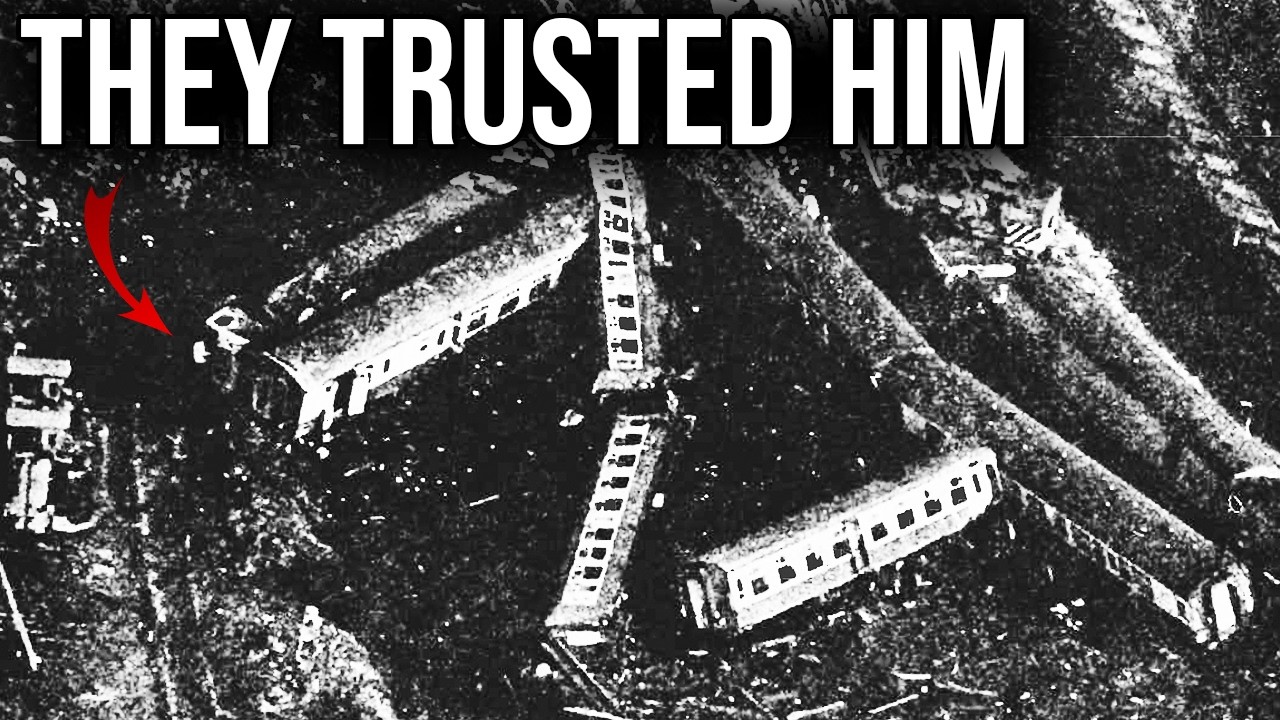
The silence of the evening was shattered by the sound of twisting, buckling metal and the screams of hundreds of passengers. It was just after 9:30 PM on the 11th of June, 1972, when a packed excursion train, carrying over 400 people back to London from a day at the seaside, tore through the Eltham Well Hall curve at more than three times the permitted speed. The locomotive and the first four carriages derailed in a catastrophic heap of steel, leaving six people dead and more than 120 seriously injured.
Within hours, investigators would begin to piece together a chain of events that pointed to a single, horrifying cause: the driver, Robert Wilsdon, was blind drunk.
 The disaster unfolded with terrifying speed. The train, a Class 47 diesel-electric locomotive hauling ten modern steel coaches, had been running late from Margate, but the driver had been making up time. As the train approached the sharp bend at Eltham Well Hall, a curve with a radius of just 12 chains and a strict 20 mph speed limit, witnesses on the platform at nearby Welling station saw it approaching at an alarming velocity.
The guard, Atterbury, sensing the impending catastrophe, made two light applications of the guard’s brake in a desperate attempt to alert the driver, but it was too late. The train, traveling at an estimated 65 mph, entered the curve and physics took over.
The leading wheels of the locomotive mounted the rails, which buckled under the immense lateral force. The 100-ton locomotive rolled onto its left side, sliding across a coal yard before coming to rest just 135 yards from the point of derailment, perilously close to an electrical substation. The first four coaches, their couplings parted by the violent forces, jackknifed and zigzagged into a grotesque N-shape across the tracks.
The remaining six coaches stayed largely upright, a stark contrast to the wreckage at the front. Inside the leading carriages, the scene was one of utter devastation, with collapsed compartments, buckled roofs, and passengers trapped in darkness beneath twisted steel and shattered luggage racks.
The first police officer arrived within five minutes, and the first ambulance within seven, but the rescue operation was hampered by the arrival of hundreds of sightseers. The official report into the disaster would later record the inspector’s disgust at the conduct of those who crowded to the site, hampering the relief work. Forty of the 126 people taken to hospital were detained with serious injuries.
Three passengers died at the scene, with two more succumbing to their injuries in the months that followed. The fact that the death toll was not significantly higher was attributed to the relative strength of the modern steel coaches, a grim silver lining when compared to the wooden carriages of earlier decades.
The subsequent inquiry, a painstaking and exhaustive process, left no stone unturned. Investigators interviewed railway staff, friends, family, and publicans. They measured every mark on the rails, tested the locomotive and carriages, and examined the track.
 The track itself was found to be sound, having been inspected just two days prior. The locomotive and carriages were in perfect working order, with no mechanical defects or brake failures. Visibility was good, and signals were functioning correctly.
With every mechanical and environmental explanation ruled out, the investigation turned its full attention to the man in the cab, 33-year-old Robert Wilsdon, a driver with almost 20 years of experience based at Hither Green.
The reconstruction of Wilsdon’s final day painted a damning picture of a man who had made a series of reckless decisions. On that Sunday morning, Wilsdon had visited the Cherry Orchard Inn in Rainham with his brothers, where he consumed two pints of light and bitter and half a pint of light ale. His brothers insisted he had drunk no more, but the timeline of his actions suggests otherwise.
At 3:22 PM, Wilsdon signed on for duty, but he did so by telephone from his home, a practice that was apparently common at the time. He claimed he was traveling directly to Ramsgate, but in reality, he spent another two hours in Rainham before being driven to the station at 5:15 PM. This allowed him to claim extra pay while avoiding any face-to-face supervision that might have detected his condition.
The first concrete evidence of Wilsdon’s inebriation came when he finally met his second man, 18-year-old P. E. Stokes, at Ramsgate Depot at around 6:25 PM.
Stokes, who had signed on punctually and traveled to meet his driver, later recalled that Wilsdon smelled strongly of alcohol. When Stokes remarked on it, Wilsdon admitted to having had some beer at dinner time and then drinking sherry. Despite this, the pair proceeded to the Railway Staff Association Club at 7:05 PM, where they both consumed three pints of light and bitter, with Wilsdon potentially adding another half pint of light ale.
 The pattern was clear: Wilsdon was a seasoned drinker, capable of masking his intoxication, but he was steadily and deliberately impairing his ability to operate a train carrying hundreds of passengers.
The train departed Margate at 8:13 PM, eight minutes late, after the crew had been found absent and the cab was discovered to contain two bottles of beer. Wilsdon was heard to remark that he would make up time on the route back, and he did, running at high speed. However, the journey was punctuated by unscheduled stops, including one at Rainham, where Wilsdon, who lived locally, got out to use a telephone.
He called the signalman, asking about the position of the first excursion train, and became agitated when he learned it was ahead of him. He was overheard calling the other driver a “slow bastard.” By the time the train passed through Bexleyheath at 9:31 PM, it was seven minutes behind schedule, but the crew had been complying with speed restrictions up to that point.
As the train approached Eltham Well Hall, the gradient began to pull it downhill. Wilsdon had switched the engine off and was coasting, a common practice for drivers on this stretch. But he failed to apply the brakes for the sharp curve ahead.
The pathologist’s report into Wilsdon’s death revealed a blood alcohol concentration of 278 milligrams per 100 milliliters of blood, roughly the equivalent of eight and a half pints of beer. Critically, the report noted that his body was still absorbing alcohol at the time of his death, indicating he had been drinking either during or very shortly before the crash. The wreckage of the cab contained smashed glass, believed to be from the two beer bottles seen at Margate, and it was theorized that Wilsdon may have obtained another bottle of alcohol and consumed it on the train, throwing the empty bottle from the window.
The inquiry’s conclusions were unequivocal and damning. The sole cause of the accident was driver Wilsdon’s grossly impaired ability to drive safely due to the considerable quantity of alcohol he had consumed both before and after booking on duty. The report stated that Wilsdon had been drinking before leaving Margate and again in his cab during the journey.
 Second man Stokes, who was severely injured, was criticized for drinking while on duty in direct disobedience of British Railways rules, but the report was clear that Wilsdon was the ringleader and that the young Stokes, unfamiliar with the route and the driver’s condition, could not have realized the danger. The report concluded, “Driver Wilsdon alone was to blame for this accident.”
The aftermath of the Eltham Well Hall disaster left a community in mourning and a railway network grappling with the uncomfortable truth that human failure, fueled by alcohol, had caused an entirely avoidable tragedy. The report recommended that the practice of signing on for duty by telephone, which had allowed Wilsdon to avoid detection, should be banned, though it was acknowledged that this was impractical for some drivers living far from their depots. The report also found that the existing rules around drinking were sensible and sufficient, and that random breath testing was unjustified.
However, the specter of Wilsdon’s actions would linger, a stark reminder of the devastating consequences of a single individual’s irresponsibility.
Robert Wilsdon lost his life in the crash he caused, never having to face the survivors or the families of the five other victims. His actions that day, a series of choices made over the course of a Sunday afternoon and evening, had irreparably changed the lives of hundreds of people. The disaster at Eltham Well Hall stands as a grim testament to the fragility of human judgment and the immense responsibility that comes with operating public transport.
There is no memorial at the site today, the original station having been closed and moved, but the memory of that night, and the lessons learned, remain etched into the history of Britain’s railways.