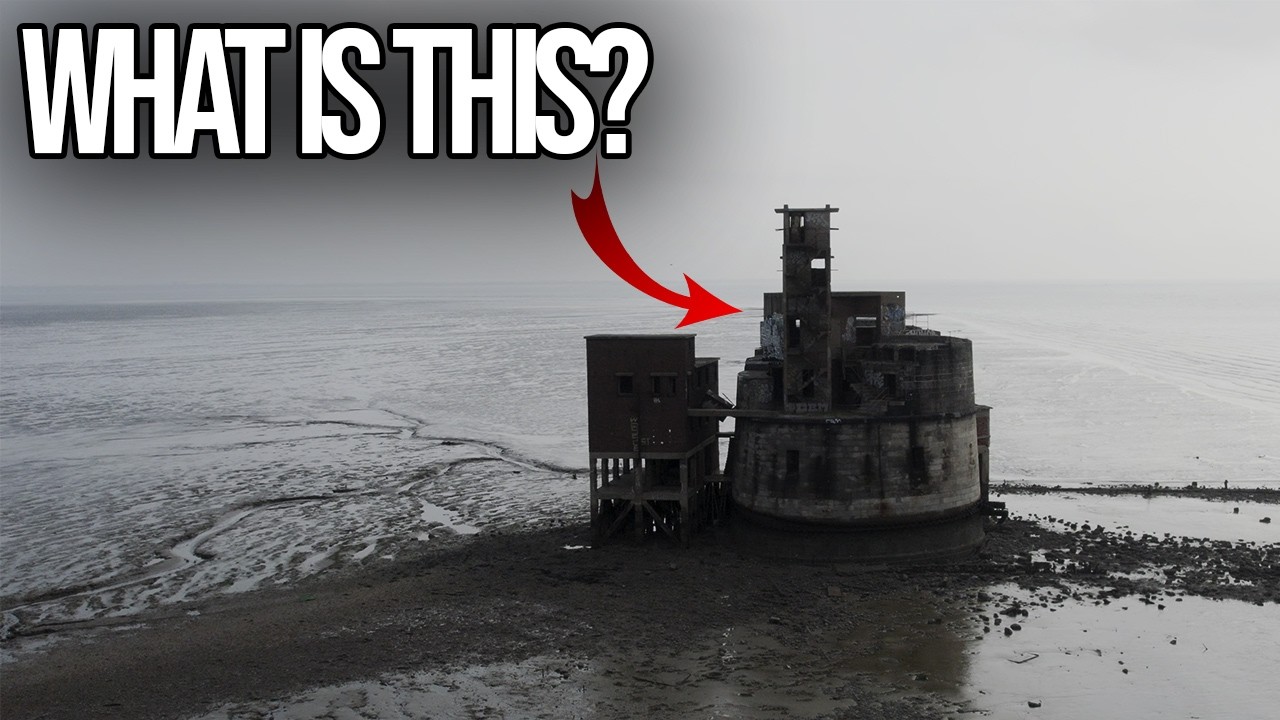
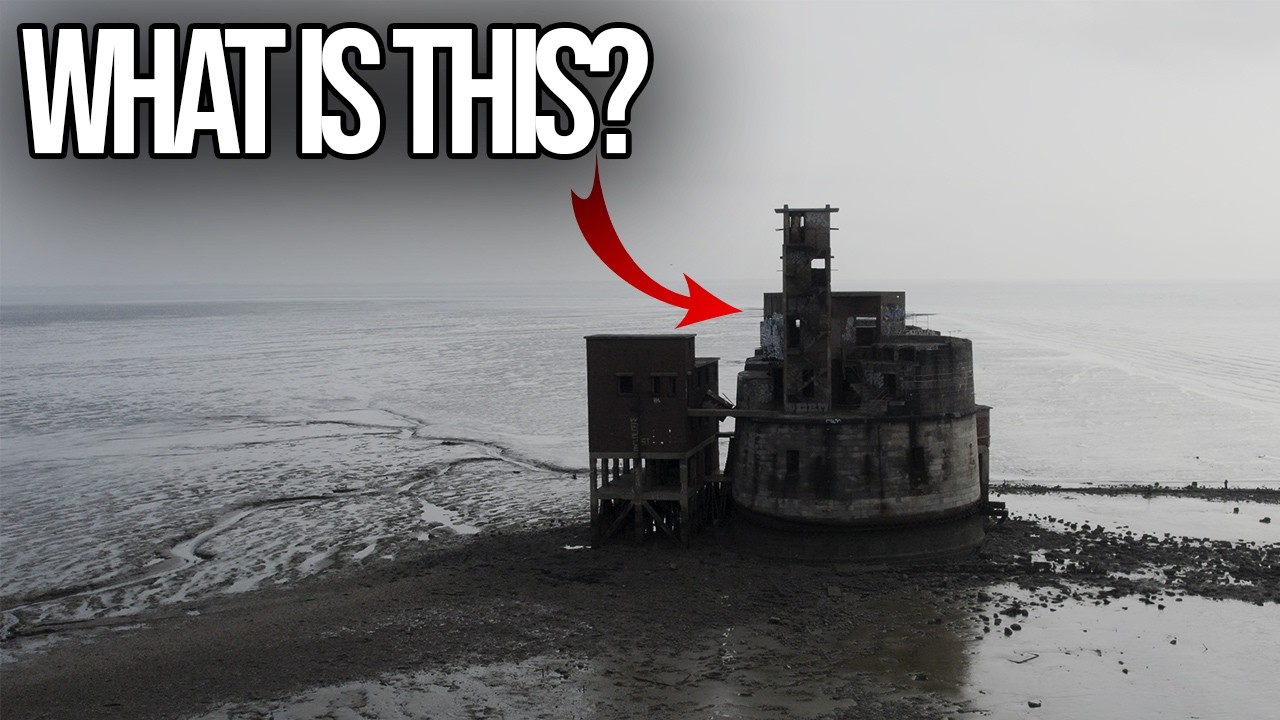
A solitary, rusting fortress rises from the sands of the Thames Estuary off the Kent coast, a haunting silhouette that has become one of Britain’s most enigmatic abandoned structures. Grain Battery Tower, the last of its kind ever built in the United Kingdom, now stands forgotten approximately 500 meters offshore, accessible only when the tide retreats far enough to expose a crumbling causeway.
The tower’s story began in the 1850s when Britain grew increasingly anxious about French naval ambitions across the Channel. The threat was not abstract. The Thames Estuary represented one of the nation’s most critical trade arteries, and the dockyards at Sheerness and Chatham, along with the victualling yards at Deptford, the Woolwich Arsenal, and numerous shipbuilding facilities and magazines, were considered dangerously vulnerable to attack.
Construction on Grain Tower commenced in 1848, but the exposed location in the middle of the estuary created immediate problems. Workers battled relentless wind, harsh winter conditions, and the constant challenge of building on a sandbank surrounded by water. The original builders eventually paused construction, and it took Lincolnshire firm Kirk and Perry another two years to complete the project after a five-year delay.
When the tower was finally handed over to the Ordnance authorities at the end of 1855, it had already exceeded its budget significantly. Originally projected to cost around £10,000, the final bill reached £16,798, a sum equivalent to nearly £3 million in today’s currency. For a structure of such unusual design and strategic ambition, some historians argue it was still a relative bargain.
The tower was designed along the lines of the Martello towers that dotted the British and Irish coastlines earlier in the century. These were thick-walled circular fortresses with flat roofs capable of mounting a single piece of artillery. Grain Tower followed this tradition but was purpose-built for its offshore position, making it the final example of this type of defensive architecture ever constructed in Britain.
Once operational, the tower was armed with three smoothbore 68-pounder guns mounted on its roof. The weaponry was formidable for its era, but the tower’s operational life as a gun platform proved tragically short. Almost immediately after completion, a new generation of rifled muzzle-loading guns rendered the smoothbore armament obsolete, and the tower was never upgraded to match the advancing technology.

By the end of the 1850s, the government recommended that all existing forts either be rebuilt or substantially upgraded. Grain Tower was included in these recommendations, but as so often happened with Victorian defense spending, the cost of modernization proved prohibitive. Instead, authorities chose to build a new fort on land and improve the existing battery at Garrison Point on Sheppey.
The tower did receive some newer rifled muzzle-loading guns, but these were removed in the early 1900s when the structure was converted into a communications tower. The changing nature of naval warfare, with threats shifting from large wooden warships to smaller, faster torpedo boats, demanded yet another transformation. A concrete structure was added on top and equipped with two quick-firing guns.
During the First World War, the tower served a dual purpose. It retained its defensive armament while also functioning as one end of a boom defense stretching across the Medway. An iron chain, still visible at the base of the structure today, would have been stretched from the tower all the way to Sheerness, preventing enemy vessels from penetrating the estuary.
The Second World War brought further modifications. A twin six-pounder quick-firing gun was installed, requiring a much larger and thicker concrete emplacement on the roof. A taller tower was added for directing the gun’s fire, and a utilitarian square barrack block was attached to the rear of the structure, giving it the somewhat ungainly appearance it retains today.
After the Second World War, the tower’s military career came to an end. It was decommissioned in 1956, and since then it has been left to the elements. The structure is now technically a Grade II listed building, recognizing its historical significance, but its deteriorated condition has made it increasingly difficult to protect or repurpose.

Access to the tower is officially prohibited, though that has not stopped curious explorers and urban adventurers from making the treacherous journey across the tidal causeway. Photographs taken inside the structure reveal a haunting interior of rusted metal, crumbling concrete, and the inevitable graffiti left by visitors. The images circulate online, adding to the tower’s mystique as a destination for those drawn to abandoned places.
The tower’s recent history has been marked by a series of failed attempts to find a new purpose. It was purchased from the Crown in 2005, and by 2010 it was back on the market with a guide price of around £500,000. The previous owner, Simon Kalper, reportedly found that it simply did not work well as a home, a conclusion that many observers might have reached without the experiment.
In 2014, the tower sold again, this time for £400,000. By 2023, it was listed once more, but with a guide price of just £150,000. The declining valuations tell a story of a structure that captures the imagination but defies practical use.
In its current state, it is unlikely to attract anyone seeking a conventional residential property or a viable commercial venture.
The tower’s isolation is both its curse and its strange appeal. Standing on its sandbank, surrounded by the shifting waters of the Thames Estuary, it has become a monument to a bygone era of coastal defense. Its silhouette against the dawn sky, as seen by early-morning visitors and drone operators, evokes comparisons to fictional villainous lairs, though its reality is far more mundane and melancholy.
For local historians, Grain Tower represents a fascinating footnote in Britain’s military past. It was built to counter a threat that never materialized, armed with weapons that became obsolete before they could be used in anger, and modified repeatedly to meet dangers that evolved faster than the structure could adapt. Its story is one of strategic foresight undermined by technological change and fiscal restraint.

The tower also serves as a reminder of the broader network of coastal defenses that once ringed Britain. The Martello towers, the Palmerston Forts, and the various batteries and emplacements scattered along the coastline were all part of a massive investment in national security. Many have since been demolished, converted into homes, or, like Grain Tower, left to decay in exposed and inaccessible locations.
Conservationists face significant challenges in preserving the structure. Its offshore position makes maintenance expensive and logistically difficult. The causeway is only passable at low tide, limiting access for workers and equipment.
The corrosive salt air and constant exposure to wind and water have taken a heavy toll on the fabric of the building, and any restoration effort would require substantial investment.
Despite these obstacles, the tower continues to attract attention. Drone footage and photographs shared online have introduced it to new audiences, and its peculiar appearance has made it a subject of fascination for those interested in abandoned architecture and military history. The graffiti inside, while vandalism, has become part of the tower’s evolving story, a layer of contemporary human presence on a structure designed for a very different purpose.
The tower’s future remains uncertain. Its listing status offers some protection, but without a viable plan for its restoration or reuse, it seems destined to continue its slow decline. The declining sale prices suggest that the market sees little potential in the structure, and the costs of making it safe and accessible are likely to deter all but the most dedicated preservationists.
For now, Grain Battery Tower stands as it has for over a century and a half, a lonely sentinel on the sands. It watches the ships pass through the estuary, the tides rise and fall, and the seasons change. It is a relic of a time when Britain feared invasion and built fortresses in the sea to guard against it.
Today, it is a monument to abandonment, a strange and beautiful ruin that continues to capture the imagination of all who see it.