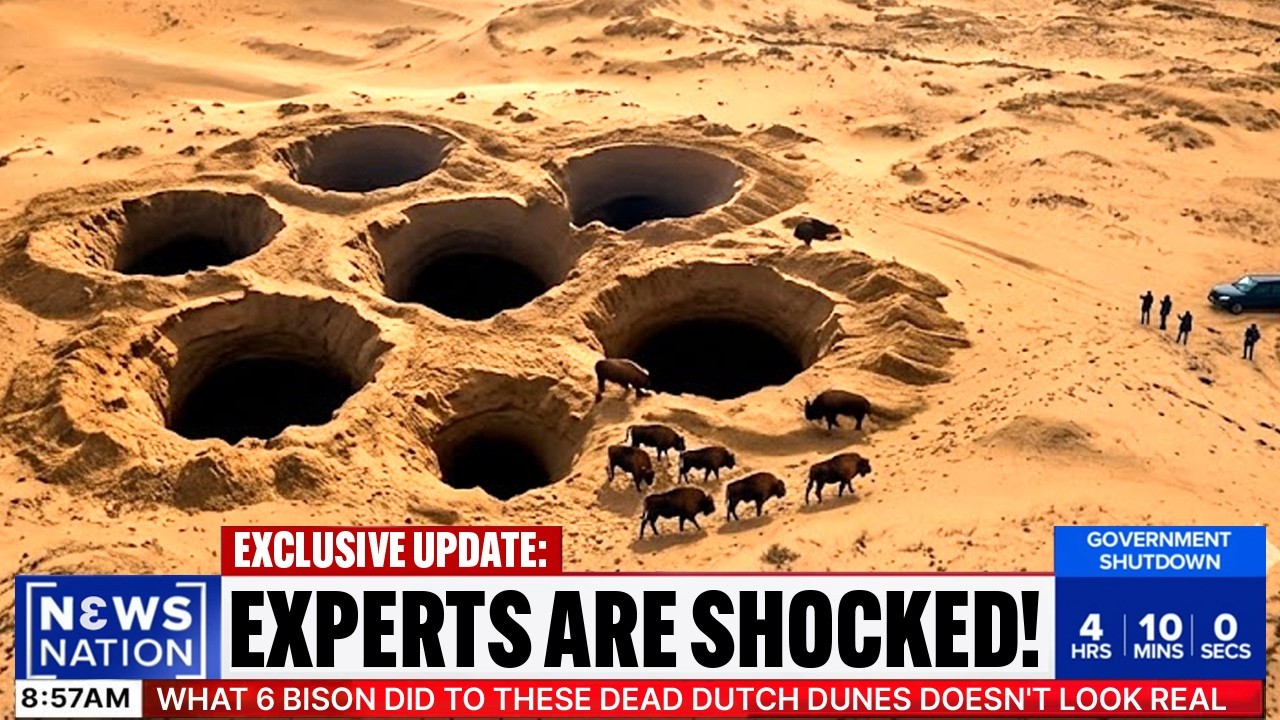
In a stunning ecological breakthrough, six European bison introduced to a dying Dutch dune landscape in 2007 have transformed it beyond recognition, defying established scientific consensus by thriving in an open coastal habitat and reviving a critical ecosystem essential for biodiversity and a major water supply.
The Kronflock reserve on the Dutch coast was once a collapsing gray dune system, a unique habitat rapidly losing its defining open sandy patches and species due to invasive plants, nitrogen pollution, and a catastrophic decline in rabbit populations.
Gray dunes, covered with lichens and mosses, require nutrient-poor, unstable ground with open sand to sustain rare specialized flora and fauna. Over decades, nitrogen deposition and the loss of rabbits—nature’s grazers and ground breakers—allowed dense vegetation, including invasive trees, to choke the dunes.
Conservation efforts by local water utility PWN, which manages the dunes as key natural water filters for 1.7 million people, initially tried grazing with horses and cattle. These grazers trimmed vegetation but failed to restore the bare ground critical for dune health and water filtration.
Ivonne Kemp and colleagues challenged the prevailing view that European bison are solely forest dwellers. In a bold experiment, six bison from forest habitats were released into a fenced portion of the reserve with no supplementary winter feeding, a test to see if they could survive and impact the landscape.
Contrary to expectations, all six bison thrived through multiple winters without hay, subsisting on roots, bark, and dune vegetation. This survival marked the first recorded case of free-ranging European bison living on open coastal dunes, challenging textbook assumptions.
More importantly, the bison fundamentally altered the dune landscape. Their heavy bodies created “wallows”—bare sand depressions—thousands of which were mapped and studied. These open patches allowed sand lizards to lay eggs and rare plants like the seaside pansy to germinate, restoring critical biodiversity.
The bison also attacked invasive shrubs, ring-barking trees such as creeping willow and American cherry, killing unwanted plants while leaving standing dead wood that supports beetles and promotes ecological diversity—effects impossible to replicate with mechanical clearing.
Additionally, the bison’s thick, seed-laden coats distributed plant species across the reserve, linking fragmented habitats by transporting new vegetation to reopened patches. This seed dispersal enhanced plant diversity and habitat connectivity, further rejuvenating the ecosystem.
A groundbreaking 2018 peer-reviewed study compared areas grazed by bison, cattle, and ungrazed zones. Only in bison-grazed areas did woody plant encroachment significantly decrease and open dune vegetation stabilize, proving that bison actively halt degradation better than other large grazers.
The herd expanded steadily; thirty-three calves were born within the first decade. By 2023, the population stabilized around 22 animals, with surplus bison distributed across Europe to aid other conservation projects, marking a direct lineage and expanding the species beyond traditional forest refuges.
The implications ripple beyond biodiversity. The dunes act as a natural filtration system, purifying water flowing to nearly two million residents. Open dune maintenance through bison grazing appears to indirectly preserve water quality by preventing dense vegetation that impedes filtration, a critical but still inferred benefit.
While bison’s survival in this habitat defies old assumptions that confined them to forests, the project’s careful scientific monitoring and published vegetation analyses provide compelling evidence of their unique ecological role on open dunes—both preserving habitat and supporting clean water.
Skepticism initially greeted the project, but documented behavior, ecological responses, and rigorous data have rewritten understanding of European bison biology and conservation potential, opening the door to rewilding large grazers in landscapes they once roamed freely.
This case exemplifies the power of innovative, interdisciplinary conservation blending biology, hydrology, and community stewardship under public scrutiny in densely populated Europe—offering a model for saving endangered habitats worldwide through bold rewilding.
The breakthrough at Kronflock is a vivid reminder of how deeply entrenched scientific narratives can be upended by careful observation and experimentation, stressing the need to reassess conservation strategies in a changing world with open minds and evidence-based approaches.
The transformation achieved by merely six bison reshaping hundreds of hectares of failing dune habitat within less than two decades stands as one of the most remarkable ecological recoveries in recent memory, with far-reaching benefits for biodiversity and human water security.
As this story unfolds, it demands urgent attention from conservationists, policymakers, and scientists alike, urging them to reconsider the role of mega-herbivores in ecosystem restoration and the complex interdependencies between wildlife and human survival.
In sum, the bison project turned a presumed ecological dead zone into a living, resilient landscape, proving nature’s capacity for recovery when ancient species are reintroduced with scientific rigor and respect for local environmental dynamics.
The unexpected alignment of water supply protection and biodiversity gain underlines how interconnected natural systems are and how conservation efforts can yield multiple societal benefits—even when initially conceived for a single purpose.
This empirical example holds profound lessons for future rewilding initiatives globally, highlighting the necessity of scaled, controlled experiments in testing long-held ecological beliefs and adjusting management to match realities on the ground.
The success of the Kronflock project illustrates the potential of large herbivores to generate ecological disturbances essential for habitat diversity, promising a new chapter in conservation biology that emphasizes restoring natural processes over maintaining static preserves.
Moving forward, researchers must deepen understanding of bison behavior in various open landscapes, refine measurement of their impact on water quality, and balance human coexistence with species once marginalized to fringe habitats.
The dramatic reversal from decline to flourishing habitat achieved here challenges conservation orthodoxy and invites fresh debate on how humans manage and repair natural landscapes under increasing environmental stress.
As old dogmas fall, the surprising story of six bison reviving the Dutch dunes stands as urgent proof that trusting nature’s own architects can yield extraordinary results that transcend expectations and redefine ecological possibilities.
Stakeholders worldwide should watch Kronflock closely as a beacon of hope and scientific insight, emphasizing patient, evidence-driven restoration over quick fixes, and preserving the complex integrity of both biodiversity and essential ecosystem services.
In the face of accelerating habitat loss and climate threats, this breakthrough urges immediate replication and adaptation of similar projects where large native herbivores can reinvigorate ecosystems faced with subtle but deadly impoverishment.
The bison’s comeback confirms that even heavily human-altered landscapes can recover with thoughtful, innovative interventions, restoring functions that benefit wildlife and human populations alike, a crucial lesson for global conservation efforts.
Experts agree more monitoring and cross-site comparisons are essential, but the Dutch attempt sets a high bar for success, offering a replicable model of how introducing the right species under careful management can reverse ecosystem collapse.
As public awareness grows, this story may influence policy and funding priorities, shifting focus toward dynamic landscape management using native megafauna rather than relying solely on mechanical or chemical control methods.
The Kronflock reserve’s remarkable ecological renaissance epitomizes the essence of rewilding: leveraging natural behaviors and species interactions to regenerate landscapes once thought lost, shaping resilient futures for nature and people.
The creeping green of decline has been rolled back by the powerful, everyday behaviors of a small group of bison, their wallows, grazing, and seed dispersal knitting together a battered ecosystem into a mosaic of life once again.
This real-world experiment with big grazers challenges assumptions about species’ ecological niches, illustrating how historical human impact can obscure understanding of wildlife’s true habitat flexibility and conservation potential.
Beyond restoration, the project enhances scientific knowledge on European bison ecology in open habitats, guiding reintroduction strategies and improving long-term management to balance animal welfare with habitat needs.
The unexpected synergy between biodiversity revival and water purification underscores how ecosystem health directly connects to human well-being, reinforcing the imperative to sustain natural habitats amid growing anthropogenic pressures.
Despite lingering uncertainties, the data solidly demonstrate that bison reintroduction at Kronflock is more than symbolic; it is a landmark achievement redefining ecological restoration and expanding possibilities for large mammal conservation in Europe.
Each bison’s presence reshaped the reserve’s ecosystem structure, creating habitats in miniature and preserving a dynamic mosaic that supports rare species, a feat unattainable with conventional conservation tools alone.
As this pioneering effort matures, ongoing research and adaptive management will be critical to optimize outcomes and possibly scale up and export the model, ensuring these living landscapes can endure and thrive for generations.
The tale of these six extraordinary bison and their role as living ecosystem engineers offers a powerful narrative of hope, science, and nature’s resilience, inspiring new approaches to global biodiversity conservation.
In a world scrambling to counter biodiversity loss, the Kronflock project highlights that solutions may come from unexpected sources—species with ancient ties to the land reclaiming their roles and revitalizing ecosystems in profound, measurable ways.
This landmark case challenges conservationists to rethink entrenched assumptions and embrace bold, evidence-based experimentation integrating wildlife’s natural functions into habitat recovery policies.
The Dutch bison experiment is a vital reminder that adaptive, science-driven conservation can uncover remarkable pathways to heal and sustain the natural landscapes critical to both wildlife and human societies today.