Maeve’s hand was in mine, and my other hand clutched a migraine kit, when the receptionist stopped me at the elevator bank of Voss and Associates. I’d been to that office a hundred times over the past six years. I knew the slow elevator on the left, the cedar diffuser in the hallway, the security guard who always smiled at my daughter. But this receptionist, a young woman I’d never seen before, looked at me with something that wasn’t rudeness.
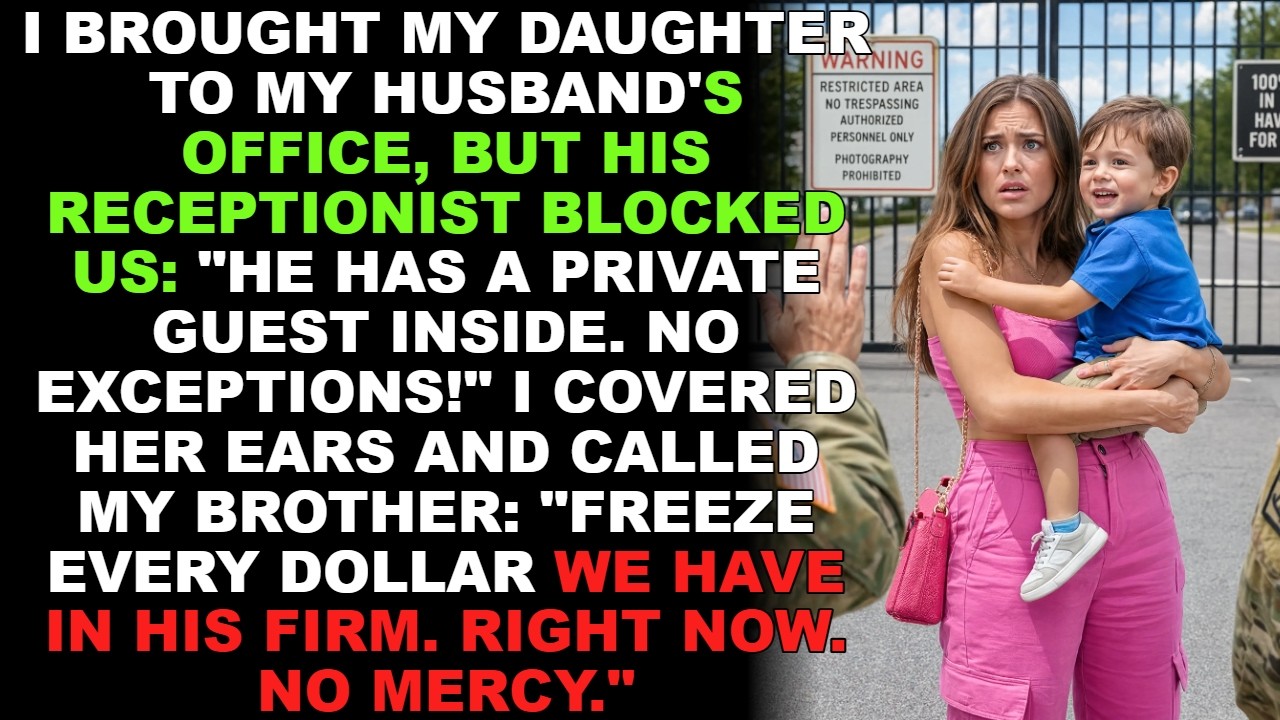
It was closer to discomfort. “I’m here to see my husband, Declan Voss. I’m Margot Voss. ” I smiled and held up the bag.
“I just need two minutes. I’m dropping off his medication. ”
She picked up her desk phone, murmured a few words, listened, then hung up. “Mrs.
Voss,” she said carefully, “Mr. Voss has asked that he not be disturbed this afternoon. He has a private meeting. ”
“I’m not a client.
I’m his wife. He has a migraine. I’m bringing him his prescription. ”
Her jaw tightened.
She was choosing her words the way you choose footing on ice. “He has a guest,” she said finally. “A personal guest. He was very specific about the instructions.
”
The lobby was kept at a precise 68 degrees. I know because Declan complained about it constantly. But my hands went cold anyway. I looked down at Maeve.
She was staring up at me with her big dark eyes, her little hands warm and soft inside mine. She understood nothing. She understood everything. I knelt down, set the bag on the marble floor, and pressed both palms over her ears.
“Baby,” I said, keeping my voice steady, “Mama needs to make one quick call. Don’t move from this spot, okay? ”
She nodded solemnly and hugged her stuffed rabbit tighter. I stood back up, one hand still covering her ears, and dialed my brother Graham with the other.
He picked up on the first ring. “Hey, you. ”
“Graham. ” My voice was quieter than I expected.
“I’m standing in the lobby of Voss and Associates. I came to bring Declan his migraine medication. The receptionist just told me he has a personal guest and has given instructions not to be disturbed. ”
My older brother had built Caldwell Capital from a two-person boutique into a two-billion-dollar investment firm.
He never raised his voice in a business meeting because he didn’t need to. The quieter my brother got, the more dangerous he was. He was very quiet right now. “Who’s with him?
” he asked. “I don’t know yet. ”
“Are you okay? ”
“I will be.
” I looked down at Maeve, who was watching me with that too-serious expression five-year-olds get when they sense something is wrong but can’t name it. “I’m going to take Maeve home. I’ll call you from the car. ”
“I’ll be at my desk.
”
I picked up the bag from the floor and looked at the lemon chicken soup I’d spent forty-five minutes reheating that morning, transferring it carefully into the container so it wouldn’t spill. I set it on the reception desk. “Could you please let Mr. Voss know,” I said pleasantly, “that his wife came by?
”
The receptionist nodded. She looked like she wanted to disappear. In the car, I buckled Maeve into her seat. She watched me with those quiet eyes.
“Mommy, is Daddy busy? ”
“Very busy, sweetheart. ”
“Did we forget to bring him the soup? ”
“We left it for him.
”
She thought about this. Then she said, in the small, careful voice that children use when they’re testing whether a thing is really true, “Is Daddy going to come home for dinner? ”
I started the engine. “Mommy will make your favorite tonight,” I said.
“Mac and cheese with the bread crumbs on top. ”
“Okay,” Maeve said. She held her rabbit up to the window and didn’t ask about Daddy again. I called Declan from the car once.
He didn’t answer. I didn’t call again. Instead, I called my brother Forrest. He was thirty-eight, three years younger than Graham, and he’d spent the last decade as a federal prosecutor.
He had a particular skill set that had nothing to do with the courtroom, and everything to do with what happened before anyone ever set foot in one. “Portia Langham,” I said when he picked up. “She came back to the city about four months ago. She was abroad for eight years, London mostly, then Singapore.
She and Declan dated in college. I need everything. ”
“How long do you need it in? ”
“As soon as you can.
”
“Give me twenty-four hours. ”
Portia Langham. I’d heard her name exactly three times in my six years of marriage. Once from Declan’s mother, who mentioned her with a particular wistfulness I’d chosen not to examine.
Once from an old college friend of Declan’s who’d had too much wine at a dinner party and said, “Oh, we all thought it would be Portia,” then gone very quiet. And once from Declan himself, two years into our marriage, when I’d woken at 3:00 in the morning to find him talking in his sleep. Just her name, once. Quietly.
I told myself it meant nothing. I told myself I was being irrational. I understood now that I had always known what it meant. That night I put Maeve to bed.
She’d eaten her mac and cheese, taken her bath, asked me to read Goodnight Moon twice, and fallen asleep mid-sentence about something her friend at school had said. I stood in the doorway of her room for a long time watching her breathe. Then I went to my husband’s home office and went through his files. I found it in the bottom drawer of his desk, a manila envelope, unsealed.
Inside was a life insurance policy. Policy holder: Declan Voss. Insured: Portia Langham. Relationship to insured: friend.
Coverage amount: $1. 5 million. Date of issue: six months ago. He had a five-year-old daughter.
He had a wife. And the person he’d named to receive $1. 5 million when he died was a woman listed only as a friend. I read it three times.
I photographed every page. Then I went to the kitchen, sat at the table, and called my sister Cordelia. Cordelia was the youngest of my siblings, thirty-one, a corporate attorney at one of the three firms in the city that the others genuinely feared. She didn’t do anything slowly.
“I need you to pull everything,” I said when she answered. “Every dollar Caldwell Capital has in Voss and Associates. Every contract, every line of credit, every partnership agreement. I want a full inventory of our family’s financial exposure to Declan’s firm.
”
Silence. “Margo, what happened? ”
“Tomorrow I’ll explain everything. Tonight I just need you to start.
”
“Okay,” she said. “It’s done. I’ll have a preliminary list by morning. ” Then she said, more quietly, “Are you all right?
”
“I’m deciding. ”
She understood that. The women in our family always understood that. Forrest’s email arrived the next afternoon.
The subject line was just my name. I opened it at the kitchen table while Maeve was at kindergarten. Twelve pages, small font. Portia Langham, thirty-three, graduated from Whitmore University the same year as Declan.
Spent three years at a consulting firm in New York, then relocated to London, then Singapore. In both cities she’d worked for the same parent company, Meridian Group, a financial consulting firm with offices in seven countries. I kept reading. Meridian Group appeared four times in the document.
The fourth time it was in connection with a vendor contract—thirty pages of fine print that had been awarded by Voss and Associates to a Meridian subsidiary six months ago. The contract was worth $15 million. The standard competitive bidding process had been bypassed. A single managing partner had signed the approval.
Declan’s signature was on the contract. I stared at that page until the letters stopped making sense. Then I called Forrest. “The Meridian contract,” I said.
“Is it what I think it is? ”
“Potentially worse,” he said. “The subsidiary Meridian set up for this contract was incorporated four months before Portia returned to the US. Our people are looking at the corporate filings.
There are financial flows that shouldn’t be there. ”
“What kind of flows? ”
“The kind the SEC investigates. There may also be an issue with client data.
We’re still tracing it. ”
I pressed my fingers to the table to feel something solid. “Forrest, is this big enough to bring in outside help? ”
“I already made some calls this morning.
I wanted to wait until I talked to you, but if you give me the word…”
“Give me until tomorrow,” I said. “There’s something I need to do first. ”
Declan came home at 9:00 that night. He looked tired.
He looked guilty. He also looked like a man who had decided that if he acted normally enough, the house might stay standing. “Hey,” he said, setting his briefcase down in the hallway. “Sorry it’s late, big day.
”
“I came to bring you your medication this afternoon,” I said. I was at the kitchen island, both hands wrapped around a mug. My voice was conversational. “And your soup.
You said you had a migraine. ”
Something shifted in his face. “The receptionist told me you had a personal guest,” I continued. “That you’d left specific instructions not to be disturbed.
”
“Margo. ”
“I brought Maeve. ” I watched his face when I said her name. “She was wearing her yellow dress.
She wanted to see your office. ”
He put his hands in his pockets. “I can explain. ”
“Good.
Start with how many times you’ve seen Portia since she moved back. ”
He went still. “How many times, Declan? ”
“It’s not—” He stopped, started again.
“She’s connected to a client relationship. It’s professional. ”
“The Meridian contract. ”
His face changed.
“Yes,” I said. “I know about that, too. ”
I picked up my mug and walked toward the hallway. “The guest room is made up.
I’d prefer you use it tonight. ”
“Margo, if you would just listen. ”
“I’ve been listening for six years,” I said. “I listened when your mother mentioned her name at our rehearsal dinner.
I listened when your friend at the Keesons’ dinner party said ‘we all thought it would be Portia. ’ I even listened once at 3:00 in the morning when you said her name in your sleep. ” I stopped at the foot of the stairs. “I just kept telling myself I was being irrational.
”
Declan didn’t say anything. There was nothing to say. “Good night,” I said. By morning, I’d made three calls.
The first was to Graham. I told him everything—the insurance policy, the Meridian contract, Portia’s connection to it. He was quiet for a long time. Then: “I’m going to contact the firm’s board today.
Caldwell Capital holds 9% of Voss and Associates’ operating fund. I’ll be freezing our position this morning and requesting a full audit of the Meridian contract approval. ”
“I know what that will do to the firm’s expansion plans,” I said. “I know you know,” Graham said.
“Are you sure? ”
“He brought Maeve to that building,” I said. “She stood in the lobby in her yellow dress, and I had to put my hands over her ears and kneel on a marble floor. Yes, I’m sure.
”
The second call was to Forrest. I gave him the word. The third call was to Cordelia. “Get me the best family law attorney in the city,” I said, “and start the paperwork.
”
Two days later, Cordelia called back. “Her name is Rebecca Slater. Twenty-two years of practice. She doesn’t lose.
” Cordelia paused. “Margo, there’s more from Forrest’s team. ”
“Tell me. ”
“Portia’s firm—the Meridian subsidiary—was used to route client investment data out of Voss and Associates.
The data went to a competitor firm overseas. Meridian had the access because of the contract Declan signed. Forrest says the SEC and the FBI’s financial crimes unit are both looking at it now. ”
I sat down.
“Declan didn’t know,” I said. It wasn’t a question. I’d been turning this over for days. “Probably not,” Cordelia said.
“But he signed the contract without proper due diligence. He gave her the access. Whether he knew what she was doing with it is something the investigators will have to establish. ”
“He trusted her,” I said.
“He did. ” And there it was. He’d trusted her. He’d let her back into his life and into his firm and into a $15 million contract because she’d looked at him the way she used to look at him in college, and he hadn’t asked enough questions.
But before any of that—before the SEC, before the audit, before the attorneys—he had blocked his own wife from the elevator bank of his building. He had told a receptionist to keep his wife out. He had stood there with a personal guest while our daughter was downstairs in a yellow dress holding a stuffed rabbit. That’s the thing people don’t understand about moments like this.
The betrayal isn’t just the big thing. It’s the accumulation of all the small things. The name whispered in his sleep, the wistful look his mother got, the friend at the dinner party who went quiet. Until one afternoon it collapses into a single point, and you’re kneeling on marble, pressing your palms over your child’s ears, making a call.
That same evening, Maeve sat at the kitchen table with her crayons and drew a family portrait. I found it folded on my pillow when I went to bed. Three figures drawn in careful crayon lines: one tall, one medium, one small. She’d labeled them in her careful kindergartner handwriting: “Mama, Maeve, dog.
”
We didn’t even have a dog. I held the paper for a long time, folded it back up, and put it in my nightstand drawer. The annual gala for Voss and Associates was held on a Thursday evening at the Whitmore Hotel downtown. Three hundred guests, black tie, a silent auction, and a keynote from the managing partners about the firm’s record-breaking year.
I’d attended every one of these galas for six years. I knew every face in that room. I wore the midnight blue silk gown my sister had given me the Christmas after Maeve was born. Cordelia had said at the time, “Wear this when you need to remind yourself who you are.
” I’d found no occasion for it until now. Declan was at the front of the room when I walked in. He saw me from across the room, and his face went through four expressions in under a second: surprise, relief, weariness, then a careful smile, like a man hoping the ground underneath him is more solid than it feels. I smiled back.
I found a seat near the aisle. The evening moved the way these things always moved: cocktails, dinner, polite applause, a video reel of the firm’s achievements, then the keynote. Declan took the podium. He was good at this.
He’d always been good at this. The measured voice, the easy confidence, the way he made a room feel like he was speaking to each person individually. “This has been a transformative year for Voss and Associates,” he said. “We’ve expanded into three new markets, exceeded our revenue projections for the second year running, and broken ground on what I believe will be our most significant strategic partnership in the firm’s history.
” He paused, looked toward the right side of the room. “Much of that is due to the work of an exceptional consultant who came back to the city after nearly a decade abroad. Portia Langham brought relationships and resources to this firm that genuinely changed our trajectory. I want to recognize her publicly tonight.
”
Applause. I stood up. I didn’t rush. My heels were low and steady on the parquet floor, and I walked down the center aisle the way you walk when you have decided exactly what you are doing and why.
People began to turn. A murmur went through the room, low at first, then building. Declan saw me when I was halfway to the stage. I watched his expression change.
I stepped up to the podium. He didn’t move. He was frozen in the specific way that people freeze when they realize that every exit has already been covered. “Excuse me,” I said into the microphone.
My voice came out even and clear. “My name is Margot Voss. I’m Declan’s wife. ”
The room went very quiet.
“I’m sorry to interrupt. I was not sorry at all, but my husband has just asked you to applaud someone I think you should know a little more about before you do. ”
I took out my phone. “Six months ago, Declan signed a $15 million vendor contract with a subsidiary of Meridian Group.
Portia Langham is Meridian’s point of contact on that contract. The contract was approved without a competitive bidding process. ” I looked out at the room. “The SEC and the FBI’s financial crimes unit opened a preliminary investigation into that contract two days ago.
The allegation is that the Meridian subsidiary used the access granted by that contract to route client investment data to a competitor firm overseas. ”
The room erupted. I let it settle for a moment, then continued. “I also want to share something personal.
” I turned slightly toward Declan. He was gripping the edge of the podium, his knuckles white. “Four days ago, I came to this firm with my five-year-old daughter to bring my husband his migraine medication. I was stopped in the lobby and told that my husband had left instructions: no interruptions.
He had a personal guest. ” Silence. “My daughter was with me. Five years old, holding a stuffed rabbit, standing in the lobby of a building her father works in sixteen hours a day.
And I had to kneel on the floor and put my hands over her ears before I made my next phone call. ”
A woman near the front inhaled audibly. “I also found at home, in my husband’s desk, a life insurance policy. A million and a half in coverage.
” I looked out at the room. “The named beneficiary is Portia Langham. His wife and his daughter are not named anywhere on that document. ”
Declan said my name.
His voice cracked on it. I reached up and removed my wedding ring. The room watched in complete silence. I placed it on the podium in front of the microphone.
The sound it made was very small. The microphone made it enormous. “Declan,” I said, “Caldwell Capital has been your firm’s anchor investor for four years. $30 million, and every connection that came with it.
We did that because you were family. ” I picked up my clutch. “You are no longer family. ”
I turned and walked back down the aisle.
Three hundred people watched me go, and not one of them made a sound. Portia was arrested the following Tuesday. FBI agents went to her office on the 22nd floor of the Meridian building at 8:30 in the morning. The forensic accounting had turned up transfers: $200,000 to an overseas account tied to the competing firm, and a separate $80,000 to a personal account of hers.
The client data breach was confirmed. She was facing federal charges for securities fraud and the unauthorized transfer of proprietary financial data. Forrest called me after it was done. He said she’d been calm at first, then not calm.
He said she told the agents that Declan had known nothing about it. That she’d chosen him specifically because of the access the contract would give her. That she’d come back to this city and found the man who still had feelings for her from twenty years ago, and she’d used those feelings precisely and without hesitation. She’d identified him like a door she’d already had the key to.
She just needed the right moment to use it. Declan had been suspended pending the firm’s internal review. He hadn’t contested the divorce papers when Rebecca delivered them. What typically takes four months had taken Rebecca Slater six weeks.
I received full custody of Maeve. Declan’s access to her would be evaluated by the family court after the conclusion of his firm’s disciplinary process. Two months later, I was in Rebecca Slater’s office signing the final documents when she set one last page in front of me. “This is the name change,” she said.
“Effective as of today. ”
I looked at the line. Maeve Caldwell. I thought about the lobby, the yellow dress, the stuffed rabbit, her voice in the car asking if Daddy would be home for dinner.
I signed. On the drive home, I called Forrest. “It’s done,” I said. “I know.
Rebecca texted Graham. ” A pause. “How do you feel? ”
I thought about it honestly.
“Like something that was out of alignment for a long time just got put back,” I said. “That’s about right,” he said. Thanksgiving at my mother’s house smelled of sage stuffing, wood smoke, and the particular warmth of too many people in a kitchen that was never quite big enough. Graham was there with his family.
Forrest came. Cordelia had brought two bottles of wine that were unreasonably good for a Thursday afternoon, which was exactly like her. Maeve had found the old tin box of my childhood toys in the hall closet and spent most of the afternoon working through it with the focused intensity she brought to all important projects. After dinner, I sat in the wingback chair by the fireplace.
Graham came and sat across from me with his coffee and didn’t say anything for a while. “She’s doing okay,” I said, nodding toward Maeve. “She’s got your stubbornness,” he said. “She’ll be fine.
”
My phone buzzed on the side table—a notification from the Caldwell Capital investment account. Graham had added me to it officially three weeks ago, restoring the shares that had always technically been mine but that I’d left untouched for years. I set the phone back down without checking the amount. “Graham,” I said, “do you remember what Dad always said about the family?
”
He thought about it. “That we look after our own. And if someone can’t look after themselves, then we do it for them. ” He smiled slightly.
“Until they can. ”
Across the room, Maeve looked up from the tin box, found me with her eyes, and held up a small ceramic bluebird she’d discovered inside it. “Mama, look. ”
“I see it, baby.
”
She turned it over in her hands very carefully. Then she set it on the coffee table where she could keep an eye on it and went back to the rest of the box. I thought about the night I’d found the insurance policy, the cold feeling in my hands, the strange clarity that had come after, like a window being opened in a room that had been sealed for years. I thought about Declan saying “I can explain” and how I’d already known by that point that he couldn’t.
I thought about the gala, the midnight blue gown, the way the ring had sounded against the podium in that enormous room full of silence. I didn’t feel triumphant about any of it. Triumph would have required something to celebrate. What I felt was more like what you feel when a wound finally closes.
Not good, exactly, but real, solid, the kind of feeling that doesn’t go anywhere. Outside the Caldwell house, November had turned the maple tree in the front yard the color of embers. My grandmother had planted it the year she moved in. It had been there for sixty years, through everything the family had been through.
Its roots going down into the earth so deep that no one had ever measured them. Maeve looked up from the tin box again. She held out the bluebird toward me, offering to let me hold it. I reached across and took it from her.
Small and smooth and ceramic cold, warming immediately in my palm. She was a Caldwell now. And the roots went down a long way.