In 1983, a record-breaking 105 million viewers tuned in to watch the legendary finale of MASH, an emotional television landmark filled with tearful goodbyes. Yet, buried within those heartbreaking final moments was a glaring, embarrassing detail hiding in plain sight—a mistake so out of place that it completely broke the reality of the show’s 1950s Korean War setting. . The worldwide success of MASH looked almost effortless.
Week after week, millions laughed at the witty banter, mourned the heartbreaking losses, and watched a fictional army hospital become one of television’s most beloved families. Yet, long before the record-breaking finale, the series had already been shaped by a remarkable chain of real-life experiences, unexpected casting choices, and last-minute decisions that could have sent it down a completely different path. . The story actually began in 1968 when surgeon H.
Richard Hornberger decided to turn his experiences during the Korean War into a novel. Writing under the pen name Richard Hooker, he teamed up with writer W. C. Heinz to create MASH, a novel about three army doctors drawing heavily from Hornberger’s time serving with the 8055th Mobile Army Surgical Hospital.
The book struck a chord with readers, offering a rare blend of battlefield tragedy and razor-sharp humor. Just 2 years later, acclaimed director Robert Altman adapted it into the hit film MASH, creating the fictional 4077th unit by simply cutting the original hospital number in half. By 1972, the story found new life once again as a television series that would ultimately run for an incredible 11 seasons. Part of what made the show feel so authentic is that several of its biggest stars had actually worn military uniforms long before stepping onto the set.
Alan Alda, who became inseparable from the role of Hawkeye Pierce, spent 6 months serving in the US Army Reserve in Korea. Jamie Farr, the man behind the unforgettable Corporal Klinger, enlisted in the Army and was stationed in Japan before joining Red Skelton’s USO tour through Korea. Wayne Rogers, who played Trapper John, had previously served in the US Navy as a ship navigator, while Mike Farrell, television’s B. J..
Hunnicutt, served in the US Marine Corps. Their first-hand military experience added a layer of realism that audiences may never have consciously noticed but certainly felt. The casting process, however, nearly changed the entire identity of the series. Before becoming the lovable Lieutenant Colonel Henry Blake, McLean Stevenson originally auditioned for Hawkeye Pierce.
Producers instead convinced him to take the commanding officer role, a decision proved to be one of the show’s smartest moves. Another major twist came when comedian Robert Klein was offered the role of Trapper John McIntyre but turned it down. Although many assumed he later regretted passing on one of television’s biggest hits, Klein has always insisted that he never looked back with regret. Even behind the scenes, MASH came together under surprising circumstances.
Veteran screenwriter Larry Gelbart had grown tired of Hollywood and moved to London, but the chance to adapt Robert Altman’s film pulled him back. Working at an astonishing pace, he wrote the pilot in just two days, earning $25,000 for the script. . Meanwhile, one character who was never expected to stick around ended up becoming one of the show’s greatest icons.
Corporal Klinger was originally written for a single episode and was initially conceived as a gay character. That idea was eventually abandoned, transforming Klinger into the cross-dressing soldier desperately trying to convince the army he was mentally unfit for service. Inspired in part by comedian Lenny Bruce’s claim that he received a Navy discharge after declaring he had homosexual tendencies, the revised character became one of MASH’s most memorable and beloved creations, proving that some of television’s biggest successes begin as complete accidents. The hidden conflicts that made MASH even better.
If there was one battle the cast and creators of MASH never expected to fight, it wasn’t against television ratings or demanding production schedules. It was against the very network bringing the show into American homes. Time and again creative decisions collided with executive demands, forcing the people behind the series to defend the realism that made MASH so special. Incredibly, some of those behind the scenes disputes ended up shaping the show just as much as anything that happened on screen.
One of the biggest disagreements centered around something viewers heard every single week. Series creator Larry Gelbart and executive producer Gene Reynolds strongly opposed the use of a canned laugh track, believing it undermined the emotional balance of the series. To them, MASH wasn’t a traditional sitcom. It blended comedy with the harsh realities of war, and artificial laughter often felt completely out of place.
CBS, however, insisted that audiences expected laughs in a 30-minute comedy and refused to remove them entirely. After lengthy discussions, Gelbart and Reynolds won one important compromise. The network agreed that there would be no laughter during scenes inside the operating room, allowing those moments to retain the gravity they deserved. As the years went on, the laugh track became noticeably quieter, and in the United Kingdom, the BBC went a step further by airing the series without it altogether.
The network also drew the line at stories it feared would make the American military look bad. One proposed episode focused on soldiers deliberately standing outside in freezing temperatures until they became sick enough to be sent home. While the storyline was inspired by a tactic reportedly used by real troops during the Korean War, CBS considered it too unpatriotic and refused to let it air. The rejection frustrated the writers, who believed the series worked best when it reflected the complicated realities of war rather than presenting an idealized version of military life.
The writers eventually found a clever way to settle another ongoing problem, this time much closer to home. Cast members frequently approached them with detailed notes and complaints about their scripts, forcing constant revisions. After growing tired of the endless feedback, writer Ken Levine anda his fellow writers decided to make a point without saying a word. On two separate occasions, they wrote scenes requiring the actors to wear heavy winter parkas while filming on the Malibu Ranch set in temperatures reaching between 90 and 100°.
The uncomfortable experience delivered the message loud and clear. Before long, the steady stream of nitpicking script notes came to an abrupt end. One of the show’s biggest cast shake-ups came because of an oversight that seems almost impossible to imagine today. Wayne Rogers, who played Trapper John McIntyre, decided to leave after the third season as he became increasingly unhappy with his role.
Producers threatened him with a breach of contract lawsuit only to discover they had a major problem. Rogers had never actually signed a contract in the first place. He had refused the standard television agreement because he objected to its outdated morals clause, and without his signature, the studio had no legal way to force him to stay. Although he admitted he missed the cast, especially his close friendship with Alan Alda, Rogers always maintained that leaving the series was a decision he never regretted.
Nine Alda was the only actor who was aware of Henry Blake’s fate until moments before shooting the final scene in Abyssinia, Henry, the shocking death that changed MASH forever. Few television moments have stunned audiences quite like the death of Lieutenant Colonel Henry Blake. Even decades later, fans still remember exactly how it felt to hear Radar O’Reilly quietly walk into the operating room and deliver the heartbreaking news. But what made that unforgettable scene even more powerful was the extraordinary effort the creators took to ensure nobody, not even most of the cast, knew it was coming.
The secrecy surrounding the episode became almost as legendary as the moment itself, proving that sometimes the greatest surprises happened behind the camera long before they reached the screen. When McLean Stevenson decided to leave MASH after the third season, series creators Larry Gelbart and Gene Reynolds saw an opportunity to make a much bigger statement. Rather than simply writing Henry Blake off the show with a transfer or honorable discharge, they wanted to remind viewers that war rarely offered happy endings. To drive home what they believed was the tragic wastefulness of war, they made the bold decision to have Henry die after his plane was shot down on the journey home.
Keeping that secret became a production all on its own. Gelbart deliberately distributed the script without its final page, allowing everyone to believe they were filming an ordinary farewell. After the scheduled scenes had been completed and just minutes before the cast was set to begin the season wrap party, he handed each actor the missing final page. It revealed the now famous ending in which Radar enters the operating room and quietly announces that Henry’s aircraft had gone down over the Sea of Japan and that there were no survivors.
The cast was left speechless. Larry Linville, who played Frank Burns, immediately called the twist "fucking brilliant", recognizing just how daring the ending was. Gary Burghoff had a very different reaction. Turning to Stevenson, he jokingly called him a son of a because he was convinced the emotional scene would earn him an Emmy Award.
Ironically, it never did. The powerful sequence itself was filmed in just two takes, making its raw emotion feel even more authentic. Viewers at home were equally stunned. According to Gelbart and Reynolds, more than 1,000 angry letters poured in from fans devastated by Henry’s shocking death.
CBS was reportedly so unhappy with the backlash that at least one rerun removed the heartbreaking final scene altogether. As the series continued into its later seasons, the writers found themselves facing a much lighter challenge. After introducing so many wounded soldiers over the years, they gradually began running out of believable character names. Their solution was surprisingly creative.
During season six, several Marine patients were named after members of the 1977 California Angels infield. A season later, injured soldiers borrowed the names of players from the 1978 Los Angeles Dodgers. Ken Levine even slipped in a personal reference during Goodbye, Radar by naming Radar’s new girlfriend, Patty Haven, after one of his former girlfriends, adding another hidden inside joke for himself. Perhaps the most remarkable statistic of all is that MASH ended up lasting far longer than than the conflict it portrayed.
The Korean War lasted just 3 years, 1 month, and 2 days. Yet, the television series spent an incredible 11 seasons following the lives of the doctors and nurses stationed at the 4077th. Somehow, a story built around one of history’s shortest modern wars became one of television’s longest-lasting and most beloved dramas, leaving behind a legacy that still resonates decades after the final salute. By the time MASH reached its final episode, it was no longer just another television series.
It had become a cultural phenomenon that millions of viewers simply couldn’t imagine saying goodbye to. The emotional farewell marked the end of an era, but the numbers it produced were almost as unbelievable as the story itself. Even after the final salute, the show’s influence refused to fade, spawning new series, preserving cherished props, and leaving behind real-world reminders that its legacy was far from over. When Goodbye, Farewell, and Amen aired on Monday, February 28th, 1983, it became one of the biggest television events in American history.
An astonishing 77% of everyone watching television that night had tuned in to see the doctors and nurses of the 4077th say their final goodbyes. That translated to roughly 121. 6 million viewers, a figure that remained unmatched by a scripted television finale for decades. The show’s incredible popularity was reflected in its advertising prices as well.
When MASH premieredin 1972, a 30-second commercial cost advertisers around $30,000. By the time the finale arrived 11 years later, that same commercial slot had skyrocketed to an incredible $450,000, highlighting just how valuable every second of airtime had become. The success of the series also inspired several attempts to continue the story after the original ended. The most successful was Trapper John, M.
D. , which ran from 1979 until 1986 and followed Trapper John McIntyre years later as chief of surgery in San Francisco, although Wayne Rogers did not reprise the role. Another continuation, AfterMASH, reunited Colonel Potter, Father Mulcahy, and Corporal Klinger as they adjusted to civilian life while working at a veterans hospital in Missouri. Despite bringing back familiar faces, the series struggled against tough competition from the A-Team and was canceled during its second season.
Perhaps the strangest spin-off was Walter, which focused on Walter "Radar" O’Reilly after he lost both his family farm and his marriage before becoming a police officer in St. Louis. The story even included Radar attempting suicide, a surprisingly dark direction for such a beloved character. The pilot failed to attract enough interest to become a full series and aired only once on CBS, reaching viewers in the Eastern and Central time zones before quietly disappearing into television history.
Even decades after the cameras stopped rolling, pieces of MASH continued finding their way back to the people who loved them. Gary Burghoff revealed that Radar’s famous teddy bear had been missing for nearly 30 years before unexpectedly resurfacing at an auction in 2005. A medical student purchased the treasured prop for $11,500, then immediately sold it back to Burghoff, allowing one of the show’s most recognizable keepsakes to return to its original owner. One final surprise came from the series’ second-to-last episode, As Time Goes By, in which the characters buried a time capsule beneath the Fox Ranch.
Just 2 months later, the property was sold, and construction crews quickly uncovered the buried capsule. A worker contacted Alan Alda to ask what should be done with the unexpected discovery. Alda simply told him to keep it, later joking that the man seemed far less impressed by the find than any lifelong MASH fan would have been. For more than a decade, MASH managed to do something almost no television series had accomplished before.
It could make audiences laugh 1 minute and leave them in tears the next, blending comedy and heartbreak so effortlessly that viewers forgot they were watching actors on a soundstage. By the time the series reached its final chapter, millions weren’t simply tuning in to watch another episode. They were saying goodbye to a family they had welcomed into their homes for 11 years. Yet, hidden beneath one of television’s most celebrated farewells was a surprisingly obvious mistake that shattered the illusion of the Korean War era.
It appeared in plain sight during the emotional closing moments, but with so many viewers focused on saying goodbye, almost nobody noticed it. Based on Richard Hooker’s 1968 novel and Robert Altman’s acclaimed 1970 film adaptation, MASH premiered on September 17th, 1972. Set during the Korean War, the series followed the doctors, nurses, and support staff stationed at the fictional 4077th Mobile Army Surgical Hospital as they struggled to save lives under impossible conditions. Led by Alan Alda’s quick-witted Captain Benjamin Franklin Hawkeye Pierce and Loretta Swit’s unforgettable Major Margaret Houlihan, the series became famous for balancing razor-sharp humor with the brutal emotional realities of war.
Although its first season struggled in the ratings, it steadily grew into one of television’s biggest successes, spending much of its run among America’s 10 most-watched programs. Unlike many beloved series that slowly faded because of declining ratings or behind-the-scenes turmoil, MASH ended on its own terms. After 11 successful seasons, the cast and creative team felt they had told the story they wanted to tell. Rather than risk watchingthe quality decline, they chose to finish while the show was still at its peak.
That decision gave audiences one final chapter that would become one of the most celebrated television events ever broadcast. On February 28th, 1983, CBS aired the two-and-a-half hour finale, "Goodbye, Farewell, and Amen. " Directed and co-written by Alan Alda himself, the episode attracted roughly 125 million viewers, making it the most-watched primetime television finale in history. Streets reportedly emptiedas families gathered around their televisions to witness the end of an era.
And for years afterward, the finale remained the benchmark against which every other television farewell would be measured. The story itself was every bit as emotional as fans had hoped. With the Korean War finally coming to an end, the members of the 4077th began preparing for the difficult transition back to civilian life. But returning home wasn’t as simple as boarding a plane.
Years of constant trauma had left invisible scars that many of them struggled to confront. No character embodied that emotional burden more than Hawkeye. Throughout the finale, he suffers a psychological breakdown and begins treatment with psychiatrist Dr. Sidney Freedman.
At first, Hawkeye recalls an incident involving a frightened woman who accidentally smothered her noisy chicken while hiding from enemy soldiers. As Dr. Freeman patiently guides him through the memory, Hawkeye finally realizes he had been protecting himself from an even more horrifying truth. There had never been a chicken.
The woman had suffocated her crying baby to keep everyone on the bus from being discovered. The revelation remains one of the most devastating moments ever shown on network television and marked a turning point in Hawkeye’s long journey toward healing. Around him, the other members of the 4077th quietly prepared for lives that would never be the same. Charles Winchester attempted to share his love of classical music with a group of Chinese musicians, only to learn that most of them were later killed before the ceasefire took effect.
Margaret Houlihan accepted a new administrative role in the army while struggling with the reality of leaving behind the people who had become her second family. Colonel Potter took one last ride on his beloved horse Sophie before receiving an emotional farewell from Hawkeye and B. J… Hunnicutt.
Meanwhile, Klinger discovered a new purpose after falling in love with refugee Soon-Li Han, choosing to remain in Korea and help her search for her missing parents instead of immediately returning to America. The finale reached its emotional peak when B. J… departed by helicopter while Hawkeye watched from below.
As the aircraft lifted into the sky, Hawkeye looked down to see one final message carved into the earth. Using carefully arranged white stones, B. J… had spelled out a single word, "Goodbye.
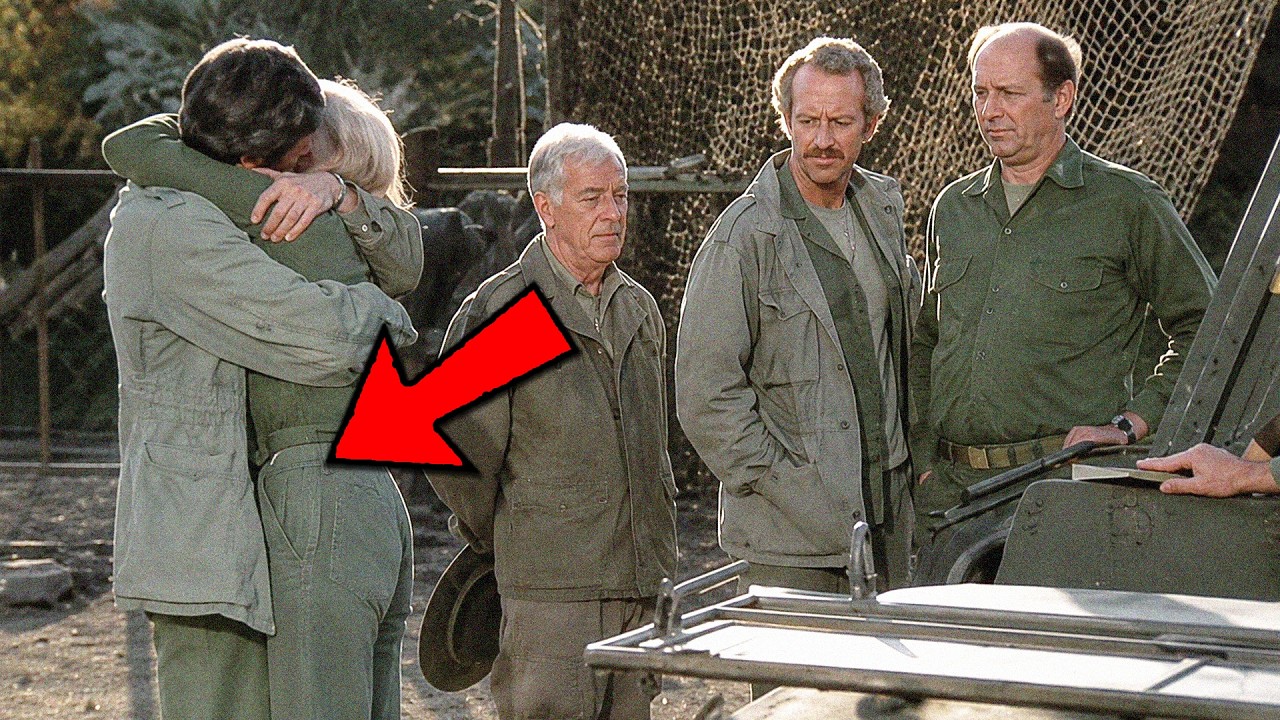
" It was a simple gesture, yet it perfectly captured the bond the two friends had built through years of war, sacrifice, and survival. For countless viewers, it was impossible not to cry. But while audiences were focused on that unforgettable farewell, something else appeared in the backgroundthat absolutely did not belong in 1953 Korea. During the helicopter sequence, sharp-eyed viewers later noticed modern paved roads and contemporary vehicles visible beyond the filming location.
Instead of preserving the illusion that the characters were still in a war-torn Korean landscape, the background briefly revealed unmistakable signs of 1980s Southern California surrounding the Fox Ranch where the series was filmed. The production team had become so focused on capturing the emotional weight of Hawkeye and B. J… ‘s goodbye that this glaring continuity mistake slipped through editing completely.
It’s the kind of error that instantly breaks the historical setting once you spot it. After spending 11 seasons carefully transporting audiences to the Korean War, the finale accidentally reminded everyone that they were really looking at a television set in California decades later. Ironically, that mistake has done little to tarnish the episode’s extraordinary reputation. If anything, it highlights just how emotionally invested viewers were.
More than 100 million people watchedthe finale, yet almost nobody was paying attention to the scenery because every eye was fixed on Hawkeye, B. J… , and the heartbreaking end of their journey. The emotions were simply too powerful for a few misplaced details in the background to matter.
Today, with the passing of Loretta Swit in 2025, Alan Alda remains the only principal cast member to appear in both the pilot and the finale who is still alive. Their final performance together continues to stand as one of television’s greatest achievements. And whilethe modern roads and vehicles remain a fascinating production slip for eagle-eyed fans, they ultimately serve as a reminder that even the most legendary finales are created by human hands. Some mistakes become footnotes in history, but the story, the friendships, and the unforgettable goodbye are what audiences remember most.
When MASH signed off in 1983, it wasn’t just the end of one of television’s greatest series. It was the moment millions of viewers had to say goodbye to characters who had become part of their own families. For 11 unforgettable seasons, the doctors, nurses, and staff of the 4077th shared laughter, heartbreak, and sacrifice, creating a bond with audiences that few shows have ever matched. But, once the cameras stopped rolling, the actors behind those iconic roles embarked on remarkably different journeys.
Some reached even greater heights, others quietly stepped away from Hollywood, anda a few, sadly, are no longer with us. No one became more closely associated with MASH than Alan Alda, whose portrayal of Captain Benjamin Franklin Hawkeye Pierce earned him six Emmy Awards and six Golden Globes during the show’s run. Rather than fading after the finale, Alda continued building an impressive career, appearing on ER, The West Wing, Ray Donovan, and The Big C. His performance as presidential candidate Senator Arnold Vinick on The West Wing earned him his only Emmy outside of MASH.
In 2015, Alda revealed he had been diagnosed with Parkinson’s disease,but he refused to let it define his life. Through boxing, tai chi, anda relentless sense of curiosity, he has continued to stay activeand engaged. Following Loretta Swit’s passing in 2025, Alda became the only principal cast member still living who appeared in both the pilot and the series finale. Gary Burghoff became a fan favoriteas the innocent and lovable Radar O’Reilly, making historyas the only actor to play the same character in both the original film and the television series.
His performance earned six Emmy nominations before finally winning in 1977. After leaving MASH, Burghoff made regular appearanceson popular game shows while living a quieter life away from major Hollywood productions. One of the sweetest stories from his later years came in 2005 when Radar’s famous teddy bear unexpectedly resurfaced at an auction. A medical student purchased the cherished prop for $11,500 before selling it back to Burghoff, reuniting the actor with one of television’s most recognizable keepsakes.
Loretta Swit transformed Major Margaret "Hot Lips" Houlihan from a stern, one-dimensional head nurse into one of television’s most respected female characters. Alongside Alan Alda, she remained withthe series from its first episode to its last, collecting two Emmy Awards along the way. Away from acting, Swit became a passionate advocate for animal rightsand hosted Those Incredible Animals. Her final television appearance came in 2008, and she passed away on May 30th, 2025 at the age of 87, markingthe end of an extraordinary career.
Jamie Farr’s unforgettable portrayal of Corporal Maxwell Klinger turned what was originally intended as a one-time guest role into one of the show’s greatest success stories. Ironically, Farr was the only principal cast member who had actually served in Korea, even wearing his real military dog tags throughout the series. After MASH, he enjoyed success on Broadwayin Guys and Dolls, continued acting in television, and remained happily married to his wife, Joy Ann Richards, whom he wedin 1963 Together, they raised two children. Mike Farrell joined the castduring season 4 as Captain B.
J… Hunnicutt after Wayne Rogers departed the series. He quickly became one of the show’s emotional anchorsand even wrote and directed several episodes. Following MASH, Farrell appeared in series including Providence, Desperate Housewives, Law & Order: SVU, and Supernatural, while also becoming an outspoken political activistand author.
In 2022, he reunited with Alan Alda to celebrate the show’s 50th anniversary, delighting long-time fans. Several beloved cast members sadly are no longer with us. Larry Linville, remembered for playing the pompous Frank Burns, chose not to renew his contractafter five seasonsbecause he believed the character had run its course. He continued acting until his death from pneumonia in 2000.
Wayne Rogers left the seriesafter season 3, later reinventing himself as a successful investorand financial commentator before passing away in 2015 from complications of pneumonia. William Christopher, who lovingly portrayed Father Mulcahyafter taking over the role from the pilot actor, continued acting in television before dying from non-small cell lung canceron New Year’s Evein 2016. More than four decades after the final episode aired, the cast of MASH remains inseparable from one of television’s greatest achievements. Though many have passed onand others have stepped away from the spotlight, their performances continue to introduce new generations to the humanity, humor, and heartbreak that made the 4077th impossible to forget.
.