More than 105 million viewers tuned in for the final episode of MASH, a record-breaking television event that ended one of America’s most beloved series. For 11 seasons, the show had blended sharp humor with the brutal realities of the Korean War. Yet buried in the emotional closing moments was a visible mistake that broke the show’s 1950s setting entirely. The error appeared during the farewell sequence between Hawkeye Pierce and B.
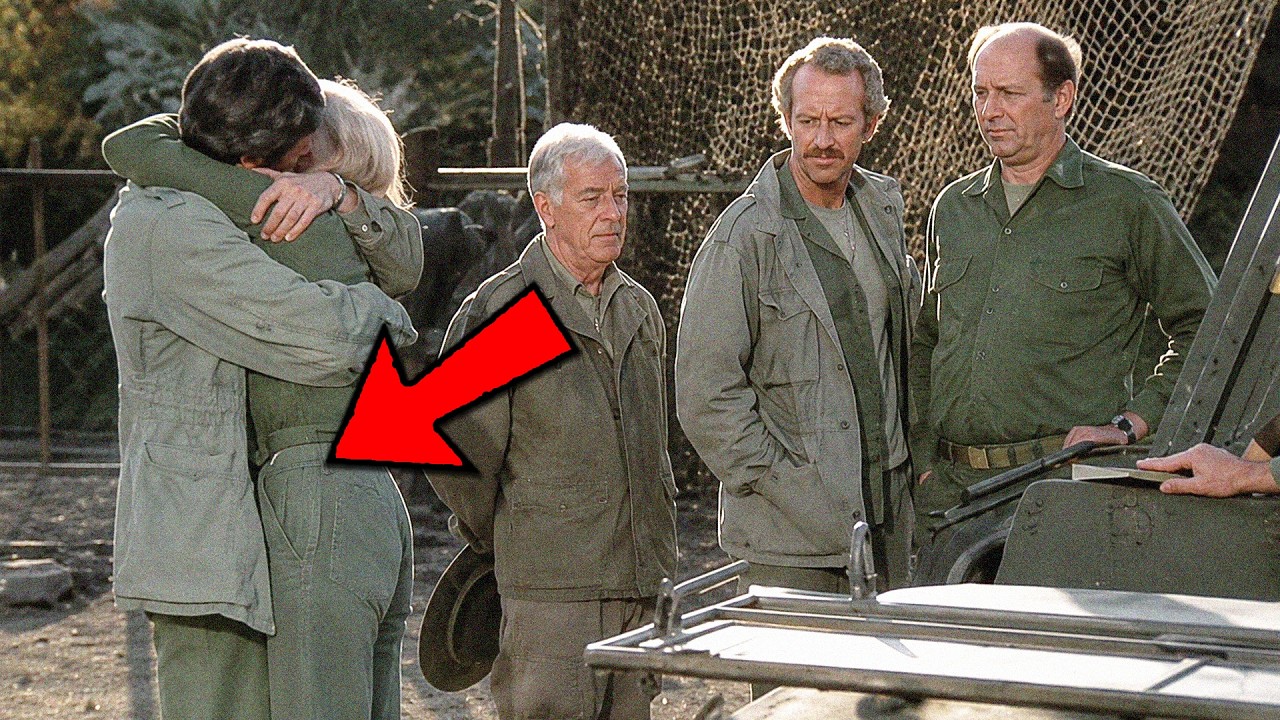
J. Hunnicutt. In the background, sharp-eyed viewers later noticed modern paved roads and contemporary vehicles that clearly belonged to 1980s Southern California, not war-torn Korea. The production team was so focused on capturing the emotional weight of the scene that the continuity slip aired unnoticed.
The series began with surgeon H. Richard Hornberger, who wrote the novel MASH under the pen name Richard Hooker, drawing on his own Korean War service with the 8055th Mobile Army Surgical Hospital. Director Robert Altman adapted the book into a hit 1970 film and created the fictional 4077th by halving the real hospital’s number. Two years later, the television series premiered on September 17, 1972.
Casting decisions shaped the show in unexpected ways. McLean Stevenson originally auditioned for Hawkeye Pierce before producers convinced him to take the role of Lieutenant Colonel Henry Blake. Comedian Robert Klein was offered the part of Trapper John McIntyre but turned it down, a decision he has always insisted he does not regret. Corporal Klinger was originally written for a single episode and was initially conceived as a gay character.
That idea was abandoned, and the character became a cross-dressing soldier trying to convince the army he was mentally unfit for service. The revised character, inspired in part by comedian Lenny Bruce’s claim about his own Navy discharge, became one of the show’s most memorable creations. Several cast members had real military experience. Alan Alda spent six months in the US Army Reserve in Korea.
Jamie Farr, who played Klinger, enlisted in the Army and was stationed in Japan before joining a USO tour through Korea. Wayne Rogers had served in the Navy, and Mike Farrell served in the Marine Corps. The creative team also clashed with CBS over the laugh track. Producers Larry Gelbart and Gene Reynolds opposed canned laughter, believing it undermined the show’s emotional balance.
The network insisted on keeping it, but the producers won one important compromise: there would be no laughter during operating room scenes. CBS also blocked a proposed episode about soldiers intentionally standing in freezing temperatures to become sick enough to be sent home. The storyline was based on a tactic reportedly used by real troops, but the network considered it too unpatriotic to air. Wayne Rogers left the series after the third season because he was unhappy with his role.
Producers threatened him with a breach of contract lawsuit, only to discover he had never actually signed a contract. He had refused the standard television agreement over its morals clause, leaving the studio with no legal way to force him to stay. Henry Blake’s death in the episode “Abyssinia, Henry” remains one of television’s most shocking moments. When McLean Stevenson decided to leave the show, the producers chose to have Blake’s plane shot down on his way home.
Gelbart distributed the script without its final page, and only minutes before the cast was set to begin the season wrap party did he hand each actor the missing page revealing the death. The cast reacted strongly. Larry Linville called the twist brilliant, while Gary Burghoff jokingly called Stevenson a son of a gun because he believed the emotional scene would win an Emmy. It never did.
More than 1,000 angry letters poured in from devastated fans, and CBS was reportedly so unhappy with the backlash that at least one rerun removed the final scene entirely. The show’s popularity translated into enormous commercial value. A 30-second ad during the premiere in 1972 cost around $30,000. By the time the finale aired, the same slot cost $450,000.
After the series ended, several spin-offs were attempted. Trapper John, M. D. ran from 1979 to 1986, though Wayne Rogers did not reprise his role.
AfterMASH reunited Colonel Potter, Father Mulcahy, and Corporal Klinger but was canceled during its second season. A pilot called Walter focused on Radar O’Reilly after he lost his farm and marriage and became a police officer; it aired only once. The finale itself, “Goodbye, Farewell, and Amen,” aired on February 28, 1983. Directed and co-written by Alan Alda, it drew roughly 121 to 125 million viewers, making it the most-watched primetime television finale in history.
An estimated 77 percent of everyone watching television that night tuned in. In the episode, Hawkeye suffers a psychological breakdown and works through a memory with psychiatrist Sidney Freedman. He initially recalls a frightened woman smothering a noisy chicken to avoid detection by enemy soldiers, but he eventually realizes there had never been a chicken. The woman had suffocated her crying baby to keep everyone on the bus from being discovered.
It remains one of the most devastating moments in network television history. Other characters faced their own farewells. Charles Winchester’s attempt to share classical music with Chinese musicians ended in tragedy when most of them were killed before the ceasefire. Margaret Houlihan accepted a new army role while leaving behind the people who had become her family.
Colonel Potter took one last ride on his horse Sophie. Klinger fell in love with refugee Soon-Li Han and chose to stay in Korea to help her search for her missing parents. B. J.
Hunnicutt’s departure came by helicopter, and as Hawkeye watched from below, he saw a message spelled out in white stones on the ground: “Goodbye. ” The moment captured the bond the two friends had built through years of war and survival, and it reduced countless viewers to tears. The background error involving the modern roads and vehicles has done little to damage the episode’s legacy. If anything, it highlights how emotionally invested audiences were.
More than 100 million people watched, but almost nobody was looking at the scenery. Following the passing of Loretta Swit in 2025, Alan Alda is the only principal cast member still living who appeared in both the pilot and the finale. Alda, who earned six Emmys and six Golden Globes for playing Hawkeye, went on to appear in The West Wing, ER, and other series. He revealed in 2015 that he had been diagnosed with Parkinson’s disease but has continued to stay active.
Gary Burghoff, who played Radar and appeared in both the film and the series, won an Emmy in 1977. His famous teddy bear was missing for nearly 30 years before resurfacing at an auction in 2005, where a medical student bought it for $11,500 and then sold it back to him. Loretta Swit transformed Margaret “Hot Lips” Houlihan into one of television’s most respected female characters and became a passionate animal rights advocate. She passed away on May 30, 2025, at the age of 87.
Jamie Farr, the only principal cast member who had actually served in Korea, wore his real military dog tags during the series. He went on to appear on Broadway in Guys and Dolls and remained married to his wife, Joy Ann Richards, whom he wed in 1963. Mike Farrell joined in season four as B. J.
Hunnicutt and became an outspoken political activist and author. Several beloved cast members have died, including Larry Linville in 2000, Wayne Rogers in 2015, and William Christopher in 2016. MASH lasted 11 seasons, far longer than the conflict it portrayed. The Korean War lasted 3 years, 1 month, and 2 days.
Despite that, a story set during one of history’s shortest modern wars became one of television’s longest-lasting and most beloved dramas. The continuity slip from the finale remains a fascinating production footnote. It serves as a reminder that even the most legendary television moments are created by human hands, and that some mistakes become part of history without ever diminishing what audiences remember most.


