Ancient humans were far better at treating wounds than most people assume, and new evidence continues to show that sophisticated medical knowledge existed tens of thousands of years before modern medicine formalized it. Without antibiotics, sterile tools, or any understanding of germs, our ancestors developed treatments that genuinely worked, and some of those treatments are still used in medicine today. The greatest threat from an ancient wound was rarely the injury itself. It was infection, sepsis, and gangrene that followed days or weeks later.
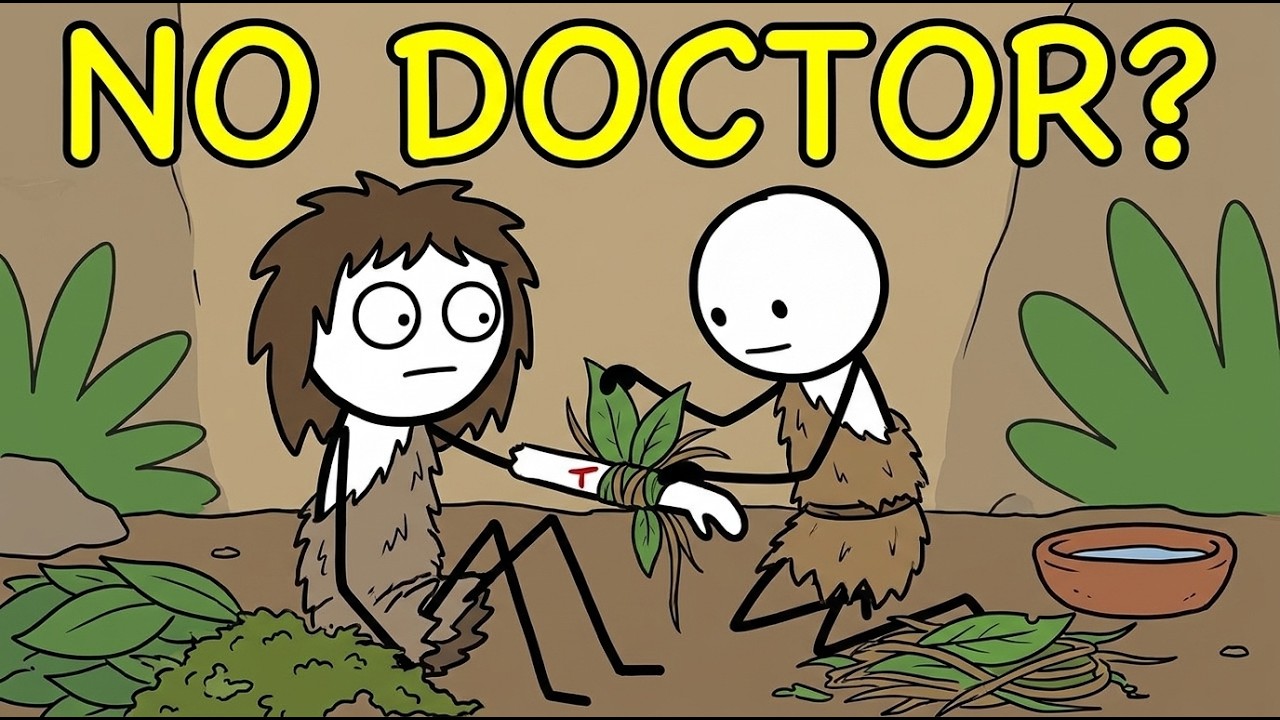
A person could survive a lion attack and still die from bacteria that entered the wound during healing. Ancient healers could see that some wounds healed cleanly while others turned fatal, and over thousands of generations they built a practical pharmacopoeia through careful observation of results. Plants were humanity’s first pharmacy, and evidence suggests medicinal plant use predates our own species. At Shanidar Cave in Iraq, pollen analysis from a burial dating back roughly 60,000 years revealed clusters of flowering plants, including yarrow, groundsel, and ephedra, all of which have documented medicinal properties.
Yarrow, in particular, has genuine antimicrobial properties and was used as a wound-healing agent across dozens of cultures. Whether Neanderthals placed those plants deliberately remains debated, but the pattern is not ignored by researchers. Modern observations of chimpanzees strengthen the case that medicinal plant use is older than humanity. Chimpanzees infected with intestinal parasites seek out and consume Vernonia amygdalina, a plant with no nutritional value but documented antiparasitic properties.
They do not eat it normally, only when sick. Chimps have also been observed applying chewed plant material to wounds and swallowing whole leaves to mechanically dislodge parasites. This suggests the instinct to use the environment as a medicine cabinet predates anatomically modern humans. Ethnobotanical studies of contemporary hunter-gatherer groups reveal extraordinarily detailed pharmacological knowledge applied to specific wound types.
Bark preparations containing salicylates, the active compounds in aspirin, were used to reduce fever and inflammation. Mold was applied to wounds in multiple cultures across multiple continents, thousands of years before Alexander Fleming noticed penicillin-producing mold in 1928. These practitioners did not know why such treatments worked, but they observed that they did. Stopping bleeding was an immediate priority, and ancient people proved remarkably resourceful.
Spider webs appear in wound treatment traditions across multiple ancient cultures. Spider silk is naturally rich in vitamin K, which plays a direct role in blood clotting, and it also has documented antimicrobial properties. Packing a wound with it provided both physical pressure and genuine biochemical assistance with coagulation, even though the people using it had no understanding of why it worked. Yarrow was applied topically to bleeding wounds in traditions ranging from ancient Greece to Native American medicine.
Its scientific name, Achillea millefolium, references the legend that Achilles used it to treat his soldiers’ wounds at Troy. The legend exists because the plant works. Plantain leaves, mosses, and various tree bark preparations also appear across ancient wound treatment traditions, and many have since been confirmed to have genuine hemostatic or antimicrobial properties. Honey is one of the most remarkable entries in the ancient medical record.
It appears in Egyptian medical papyri from 3,000 years ago as a wound dressing, in Ayurvedic texts from India, in Greek medical writing, and independently in wound treatment traditions on multiple continents. Honey creates a hyperosmotic environment that draws water out of bacterial cells, produces hydrogen peroxide as a byproduct of enzymatic activity, and maintains a moist wound environment that promotes healing. Modern medicine has rediscovered medical-grade honey as a legitimate treatment, a validation of what ancient practitioners arrived at through pure empirical observation. The oldest currently accepted evidence of surgical amputation comes from a skeleton found in a cave on the Indonesian island of Borneo, dating to at least 31,000 years ago.
The left lower leg had been cleanly amputated, not torn off or broken, but surgically removed. The bone shows clear evidence of healing afterward, meaning the person survived the surgery and lived for years after it while being cared for by their community. Researchers concluded the cut was performed with a sharp stone tool by someone with knowledge of anatomy, including where to cut to avoid immediately fatal blood loss. Trepanation, the drilling or scraping of holes in the skull, is the most widespread documented ancient surgical procedure.
Evidence has been found on every inhabited continent, with the oldest examples dating back over 7,000 years. Healed bone around the openings shows that patients survived frequently, with survival rates at some ancient sites estimated at over 50 percent. Some trepanations appear to have been performed on individuals with severe head trauma, making the procedure an attempt to relieve pressure from skull fractures or intracranial bleeding, a treatment still performed today. Others may have had ritual or spiritual purposes.
The medical and the ritual were rarely cleanly separated in ancient medicine. Ancient wound treatment was specialized knowledge held by specific individuals and transmitted carefully across generations. Every documented hunter-gatherer society has healers who carry detailed knowledge that ordinary group members do not have. This means ancient medicine had a form of medical education: structured transmission of knowledge from practitioner to apprentice, generation after generation.
The earliest written medical texts read not as new knowledge being invented but as codifications of existing practice. The Edwin Smith Papyrus from ancient Egypt, dating to around 1600 BCE but believed to be based on much older sources, describes 48 surgical cases in clinical detail. It includes case-by-case examination, diagnosis, assessment of treatability, treatment protocols, and follow-up observations. It is structured like a medical textbook because that is essentially what it is.
Ancient practitioners also understood something that took modern medicine embarrassingly long to formalize: keeping wounds clean. Wound irrigation appears in ancient medical traditions across cultures using water, wine, vinegar, and urine. Wine contains alcohol, and vinegar is acidic; both create environments hostile to bacterial growth. Fresh urine is sterile and has been used in emergency wound irrigation even in modern contexts.
Ancient practitioners did not know why these substances helped, but they observed that wounds treated with them did better. The concept of wound covering was also understood and practiced. Leaves, animal skins, plant fiber bandages, and resin-coated wrappings were used to protect injuries from further contamination. The Edwin Smith Papyrus describes wound dressings with remarkable specificity, and Egyptian mummies have been found with evidence of linen bandages on healed wounds.
Ancient practitioners lacked mechanism but not observation: they could see what happened, just not why. Cauterization, burning tissue with fire or hot metal to stop bleeding and prevent infection, worked but also destroyed tissue, delayed healing, and caused massive trauma. Ancient surgeons used it because the alternative of uncontrolled bleeding was worse, not because it was ideal. Pain management was also part of the ancient medical toolkit.
Willow bark, containing salicin which the body converts to salicylic acid, the precursor to aspirin, was used in ancient Egypt, Greece, China, and among indigenous peoples of the Americas. The same compound was discovered independently on opposite sides of the planet. Mandrake root, which contains scopolamine and other alkaloids with genuine sedative and analgesic effects, was used in ancient Mediterranean surgical contexts. Opium appears in the medical records of ancient Sumeria, Egypt, and Greece.
Cannabis appears in ancient Chinese medical texts as an anesthetic for surgical procedures. These were deliberate pharmacological interventions identified through observation and applied with intent. Ancient wound treatment was an empirical system in the most fundamental sense. Observations were made, results were noted, effective treatments were retained and transmitted, and ineffective ones were sometimes dropped when practitioners noticed they did not work.
What the system lacked was not intelligence or attention but germ theory and microscopy. Ancient practitioners were fighting bacteria without knowing bacteria existed, and they were winning often enough to keep the species alive. The social dimension of healing was equally important. The Neanderthal with the withered arm and the Borneo amputee survived because their groups fed them, protected them, and kept them alive through extended recovery.
The healer’s technical intervention and the group’s social support were both part of the treatment. Modern medicine now knows that social support improves measurable clinical outcomes; ancient medicine embedded that truth structurally. The story of ancient wound treatment is not a story about primitive people fumbling toward modern medicine. It is a story about human intelligence producing a working, transmissible, genuinely effective body of medical knowledge without the conceptual tools that would have made everything faster and clearer.
They found honey without knowing about hydrogen peroxide. They found willow bark without knowing about salicylates. They performed skull surgery without knowing about intracranial pressure. They got the right answers without the right explanations because they paid close enough attention to outcomes over long enough time periods.
Modern medicine did not replace ancient wound treatment. It explained it. The honey is still used. The willow bark became aspirin.
The trepanation became neurosurgery. The careful observation of which treatments produced which outcomes became clinical trials. The tools changed, but the impulse never did: someone is hurt, figure out what helps, remember it, and teach it to the next person.