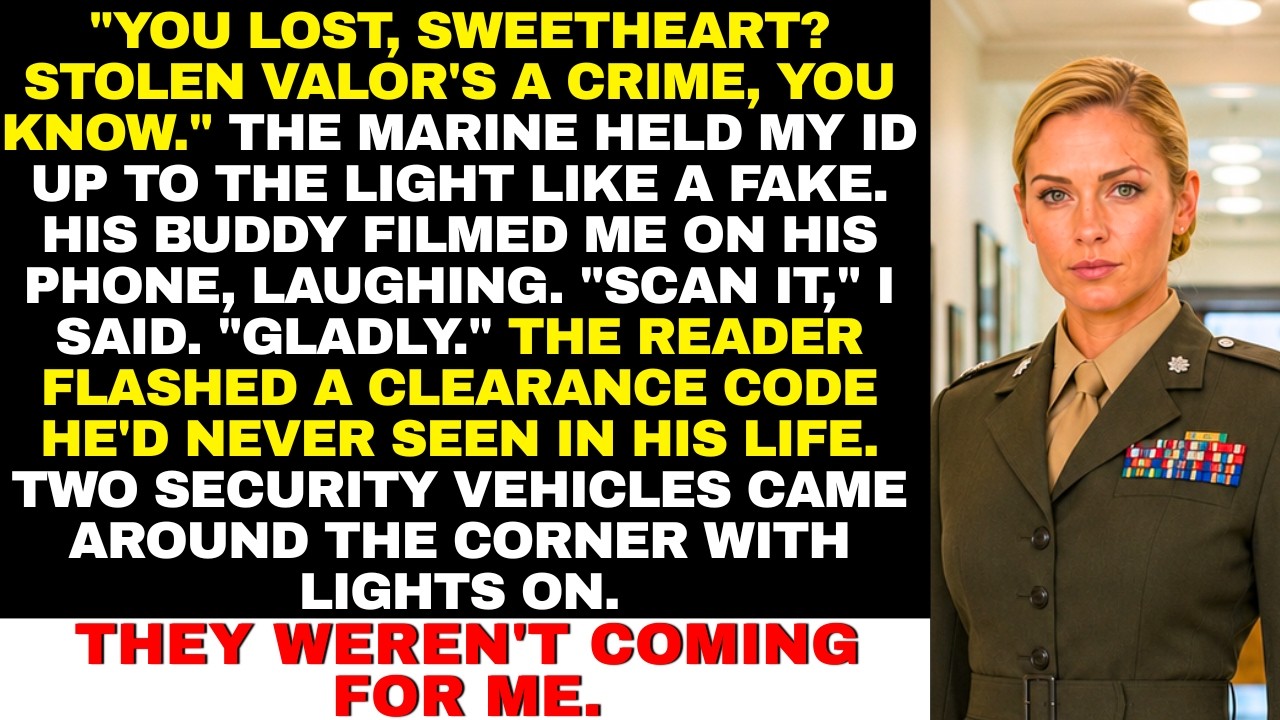
The corporal had my identification card for less than ten seconds before he decided what I was. I watched him decide. It happened in his shoulders first. He had taken the card the way gate sentries take a thousand cards a day, two fingers, eyes already moving to the next vehicle in line, and then something on it caught him, and his shoulders changed, and he brought the card up and tilted it against the morning light.
Like a man checking a bill he already knew was counterfeit. It was a few minutes before nine on a Friday in June. I was sitting in the visitor lane of the main gate in a rented gray sedan with the windows down because the booth speaker was broken. I had a printed invitation on the passenger seat with my brother’s name on it.
I was wearing a blue dress I had ironed the night before in a motel room and flat shoes because the ceremony would be on a parade deck and heels sink into the seams between the concrete slabs. The corporal’s name tape said Pruitt. He was twenty-two, maybe twenty-three, with a sunburn line across the back of his neck and the particular confidence of a young man who has been given a little bit of authority and a slow morning. Behind him, leaning in the doorway of the booth, a lance corporal was grinning at something on his phone.
His tape said Boggs. Corporal Pruitt tilted my card one more time and then he looked at me and he smiled. You lost, sweetheart? I have been asked versions of that question my whole life.
In classrooms, in briefing rooms, in a tent in a country I’m not allowed to name, by men of every rank and a few women, too. There is a correct answer to it, and the correct answer is nothing. So I said nothing. I kept both hands on the wheel where he could see them.
This says Department of Defense, he said, turning the card so I could see my own face as if the problem were mine. But it’s not a CAC like any CAC I’ve ever issued a pass off of. The category’s wrong. The color band’s wrong.
He looked over his shoulder at the lance corporal, who pushed himself off the doorway and came over with the phone still in his hand. Boggs, you ever seen one of these? Boggs looked. Boggs shrugged.
Boggs did not put the phone away. I noticed the camera lens was facing me and that he held the phone at the slightly wrong angle a person holds a phone when they want you to think they are just holding it. Ma’am, where’d you get this card? Pruitt asked.
The ma’am had air quotes around it. He had raised his voice a little, enough to carry to the cars behind me, and I understood that I had become the morning’s entertainment. It was issued to me, I said. Issued to you?
He laughed, not unkindly, which somehow made it worse. Okay, you know what stolen valor is? Stolen valor’s a crime, you know. People buy these online.
We had a guy last month with a whole fake Bronze Star certificate in his glove box. He tapped my card against his knuckles. You don’t have a sticker. You’re not in the visitor system.
The name on this invitation doesn’t match the name on the card because the invitation says Captain Kessler, and unless you’re Captain Kessler, sweetheart, somebody’s lost. Captain Kessler is my brother, I said. It is his change of command. I am on the family list.
There’s no family list at my gate. There’s the system, and you’re not in it. He was wrong about that. I was in a system.
I was in a system he did not have a terminal for, and there was no way on earth to tell him so, and that is the exact shape of the corner my life had been built in for eleven years. I looked straight ahead through the windshield at the painted sign welcoming me to a base my father had walked onto in 1978 as a private. And I breathed the way I had been taught to breathe a long time ago. Low and slow and boring.
A horn sounded somewhere behind me. Pruitt stepped back and waved the next car into the other lane with my card still in his hand. A little flourish, a magician mid-trick. Boggs had given up pretending.
The phone was up at chest height now, level and steady, and he was laughing at whatever his screen showed him, which was me. Tell you what, Pruitt said, coming back to my window. You can turn this thing around, head back to the visitor center, and they can sort you out. Or you can keep telling me this card’s real, and I can have you detained and let PMO sort you out.
Those are the options, sweetheart. There is a third option, I said. Yeah? What’s that?
Scan it. He looked at me for a second. Something about the way I said it irritated him. I had not raised my voice.
I think that was the problem. People who are bluffing raise their voices, and I had not. And somewhere under the sunburn and the boredom, a small alarm was trying to ring, and he did not like the sound of it. Gladly, he said.
He walked to the booth with my card. He said something to Boggs I could not hear, and Boggs laughed and turned the phone to follow him. Getting all of it, the whole show, the corporal swaggering to the scanner to put the fake lady out of her misery. Pruitt swiped the card with a snap of his wrist, theatrical, and turned back toward my car with his mouth already open to deliver the punchline.
The scanner gave a tone I knew and he did not. It was not the flat error buzz the machine gives a bad card. It was three short tones, ascending, and then the screen locked, and whatever it showed him, it was not the word fake. From where I sat, I could see only the change in his posture.
The same shoulders that had decided what I was ninety seconds earlier deciding something very different now. All at once, with interest. Inside the booth, a telephone began to ring. A landline, old and loud.
Boggs lowered the phone. What’s it say? he asked. His voice had gotten younger.
Pruitt did not answer him. Pruitt was reading the screen a second time. I watched the color leave his face in the orderly way color leaves a face, forehead first, then the cheeks, then the mouth, until the sunburn on his neck looked painted on. The telephone kept ringing.
Neither of them moved to answer it. Somewhere beyond the gate I heard engines. Two military police vehicles came around the curve of the access road with their light bars on and no sirens, moving fast and then very deliberately not fast, the way professionals arrive. They split as they reached the gate, one stopping ahead of my car at an angle, one sliding in behind the booth.
Doors opened. A sergeant stepped out of the lead vehicle, took off his sunglasses, and looked at the whole scene once, the way you read a room you have already been briefed on. Boggs put his phone behind his back, which is the universal posture of a man who has just realized the phone is evidence. Pruitt stood holding my identification card in both hands now, carefully, the way you hold something that has started ticking, and he looked at the military police sergeant, and he managed to say, Sergeant, I was just—
The sergeant walked past him.
He came to my window and he stood at a respectful distance, and the morning got very quiet. They had not come for me. I should tell you who was sitting in that rented sedan, but the truth is that for eleven years there had been two answers to that question, and only one of them had ever been allowed out of the building. The answer the world got was this.
Audrey Kessler, Lieutenant Colonel, United States Marine Corps. Commissioned in 2005 out of a state school nobody brags about. A tour as an intelligence officer, a second tour, and then a long gray smear of assignments with names like joint staff liaison and plans and integration and special project cell, the kind of billets that make other Marines’ eyes slide off your record like rain off glass. No command, no combat action ribbon anyone could explain.
A career that looked from the outside like a slow leak. My own family had stopped asking around 2016. There is a specific kindness people extend to a relative they have decided is unremarkable. A gentleness around the topic of your work, the way you would steer conversation around a divorce.
My brother got the questions at family dinners. I got asked about my flight. The answer the world did not get was shorter. I worked in a building with no sign on it, on a program with no name, and the thinner my record looked, the better I had done my job.
I had spent the night before the ceremony in a motel eleven minutes from the gate. The kind with a metal railing along the second floor and an iron that has to be checked out from the front desk. I ironed the blue dress on a towel on the bed. In the closet hung a garment bag I had brought out of habit more than intention.
And inside the garment bag was my service alpha uniform. The green coat with the silver oak leaves on the shoulders and rows of ribbons I had been authorized to wear and rarely had anywhere to wear them. I did not plan to open the bag. You do not wear oak leaves to your little brother’s day.
You sit in the family row in a blue dress and you clap, and afterward when his Marines ask who you are, you say, I’m his sister. And you let the conversation go wherever conversations go when people decide you are nobody. I had gotten good at that. There was a text on my phone from a week earlier.
It was from Ethan, sent to the family group chat. Ceremony details, parking instructions, the time, the building. Below it, our aunt had replied with three flag emojis. I had typed and deleted four different replies before sending the one word, There.
He had not texted me directly. I want to be fair to my brother because this story is hard on him, and he is not a villain in it. He had not texted me directly in a long time, and if you had asked him why, he would have had to think about it, and the honest answer underneath the other answers would have been that I made him feel strange. That something about my life did not add up, and families can forgive almost anything except a sum that will not resolve.
That night, in the motel mirror, I practiced saying, I’m so proud of you. I said it three times. It kept coming out with a flinch in the middle, and I worked on it the way I have worked on everything in my life, with repetition until the flinch was gone and the sentence sat level. I am telling you this so you understand what I brought to the gate the next morning.
Not a chip on my shoulder. The opposite. A woman in a blue dress doing her level best to be exactly as small as everyone needed her to be. One more day for love.
The corporal could not have known any of that. I want to be fair to him, too. That is going to matter later. My father made sergeant major the year I started college.
If you do not know the Marine Corps, I will tell you what that sentence means. It means he had spent twenty-three years earning a thing that cannot be bought, faked, or inherited. The highest rank an enlisted Marine can hold, and he wore it the way mountains wear weather. Roy Kessler.
Everyone on three bases knew him by his first name, and nobody used it. When he walked into a chow hall, the noise changed. I grew up watching rooms organize themselves around my father, and I will not pretend that is not part of why I raised my hand at eighteen and took a naval ROTC scholarship to a school he had never heard of. He was proud of me then.
I want that on the record. When I commissioned in 2005, he stood behind me in his dress blues, sergeant major chevrons on his sleeves, and pinned the gold bars on my shoulders with hands that shook a little, and he told the photographer to take it again because he had blinked. My brother Ethan was fifteen then, sunburned, bored, already taller than me. Eight years later Ethan enlisted on his eighteenth birthday, and my father drove him to the recruiter himself, and that photograph did not need to be taken twice.
The trouble started slowly, the way erosion starts. My first tours made sense to him. Intelligence officer, deployments, the work you could put in a sentence. Then 2012 came, and the sentence stopped working.
I went to a joint assignment I could not describe in a place I could not name. And when I came home for Christmas, my father asked what I was working on, and I gave him the cover answer, coordination and planning and liaison work. And I watched something in his face politely close. He never pushed.
That was the worst of it. A father who pushes is a father who still believes there is something to find. Mine just adjusted quietly, the way he adjusted to anything, and the family scoreboard adjusted with him. Thanksgiving 2016, my parents’ kitchen, the good tablecloth, twelve people.
Ethan had just been selected for the enlisted commissioning program, the hard road, the Marines’ road, a mustang like a story in a magazine. My father stood up with a glass of sweet tea and toasted him until my mother cried. And then, because he was a kind man and he could feel the imbalance in the room, he turned to me and he raised the glass a second time and he said, And to Audra. Not everybody’s built for the hard road, kiddo.
Staff work matters, too. He meant it gently. Every person at that table heard it gently. I raised my glass and drank to my own dismissal, and I’m going to tell you something now that I have never said out loud.
Thirteen months before that toast, I had been read into a program whose existence is itself classified. Eight months before that toast, I had spent four days awake running an operation that I will spend the rest of my life not describing. At the end of which, eleven Americans came home who were not coming home any other way. There’s a citation about it in a safe in a building with no sign.
It has my name on it. Fewer than forty living people have read it. Not everybody’s built for the hard road, kiddo. I raised my glass.
I drank. I asked my mother if she needed help with the pies. You build a life out of moments like that. One on top of another until the silence is a structure.
In 2019, my father got the diagnosis, and it went the way it goes, fast and then slow and then fast. Near the end, in the hospice, in the smallest voice I ever heard him use, he asked me whether I ever regretted settling. That was his word, settling. I had options in that room.
People think classified means you cannot say anything. But there are things you can say. You can say, Dad, there’s more to it than I can tell you. You can say, Dad, trust me.
Just once. I had rehearsed versions of it on the drive over. All those years of discipline straining against one dying man’s incorrect arithmetic. And I looked at him, at the yellow in his eyes and the fear he was working so hard to keep off his face, and I understood that what he needed in that room was not the truth about me.
What he needed was to believe the world was simple, that the hard road was the road he and Ethan had walked, that his sacrifices and his son’s sacrifices sat at the top of the only ledger there was. The truth would not have lifted him. It would only have handed a dying man a mystery, and a regret, and a closed door he had been knocking on for years without knowing it. So I said, No, Dad.
I’m happy. I’ve had a good career. I let my father die thinking less of me. It was the kindest thing I have ever done, and it cost the most.
And I would do it again. After the funeral, the family redistributed itself the way families do around a missing center. Ethan became the keeper of the legacy. He commissioned, made captain, collected our father’s friends, had every promotion like inherited furniture.
And the story of me hardened into its final shape. At a barbecue in his backyard in 2024, I stood holding a paper plate while he introduced me to the wives of his Marines. And he put his hand on my shoulder, warm, easy, fond. And he said, This is my sister, Audra.
She does admin stuff for the Corps. Admin stuff. Not cruel. Worse than cruel.
Settled. A fact so established it had stopped being interesting. On the wall inside his house, there was a photograph arrangement, my father in dress blues, Ethan in dress blues, and between them a picture of me at somebody’s graduation in a cardigan. That is the wall I drove past the gate to go clap in front of.
Everything that happened afterward happened to it. The military police sergeant at my window said, Ma’am, are you injured? Do you need anything? I said I was fine.
He nodded once and turned around, and what happened next happened the way weather happens, around me and to other people. He relieved Corporal Pruitt of his post, not loudly. He stepped close and said words I mostly could not hear, and I watched the corporal hand over my identification card with both hands like surrendering a weapon, and then stand there opening and closing his mouth while a second military policeman walked Lance Corporal Boggs to the booth wall and held out an evidence bag, and Boggs looked at the bag and looked at his phone and put the phone in the bag with the exact expression of a man lowering his own career into a small plastic coffin. A staff car arrived four minutes later.
The woman who got out wore the rank of major and the expression of someone whose morning had detonated. She introduced herself as Major Elise Tanaka, provost marshal. She had my card in her hand. She had clearly read the screen in the booth herself, because she held the card out to me with a precise, careful courtesy that I recognized because people in my world use it on each other all day.
Ma’am, on behalf of the Provost Marshal’s office, I apologize, she said. The flag on your category requires us to respond to any detention or escalation involving your credentials. We will drive you wherever you need to go on this installation at your convenience. That’s not necessary, Major.
It’s required, ma’am. She said it, and then lower, human for a second. I’m sorry. He’s a kid.
It’s not an excuse, but he’s a kid. I looked past her at Pruitt, who was standing where the sergeant had parked him. Ramrod straight, staring at nothing. The sunburn the only color left on him.
He had heard the word ma’am leave the major’s mouth in my direction four times in one minute, and every one of them had landed on him like weather on a bad roof. Here’s what the flag was in the only terms I can use. The billet I held came with credible, specific concerns attached to it. And so my identification carried a protective category, and any scan of that category anywhere in the world rang a telephone somewhere, and the people whose job it was to answer the telephone did not have a sense of humor.
That is all, and it is enough. And Corporal Pruitt’s scanner had just taught him more about my career in one tone than my family had learned in eleven years. At the Provost Marshal’s office, I drank bad coffee and gave a five-minute statement that said almost nothing because almost nothing was what I was allowed to say. Major Tanaka took it herself.
At the end, she clicked her pen and looked at the wall for a moment. Ma’am, you should know before you hear it somewhere else, she said. The lance corporal was recording. He sent a portion of the video to a group chat before we secured the phone.
We’re working on it, but you know how that goes. How long is the portion? About fifteen seconds. The accusation, the— she consulted her own memory and chose accuracy over comfort.
The stolen valor portion. Fifteen seconds. The accusation, but not the scanner. The charge, but not the verdict.
Of course, the clip that travels is never the whole arc, only the wound. Where did it go? A barracks chat, and from there we believe two more. And one of them— here she paused for the first time — appears to include members of Kilo Company.
Your brother’s new command, ma’am. I’m sorry. The timing is unfortunate. I want to teach you a phrase from my world.
Unfortunate timing means the worst possible thing at the worst possible moment, spoken by professionals. The ceremony was at ten hundred. They drove me to the parade deck despite my objections. A marked vehicle with a silent light bar, which meant I arrived at my little brother’s change of command the way a problem arrives.
I slipped into the family row late between my mother and my aunt, and I felt the rows behind us shift, that soft tidal motion of attention. Phones angled with the casual wrongness I had already seen once that morning, and a whisper moving along the bleachers at the speed of a struck match. That’s her, the gate lady. Stolen valor.
My mother squeezed my hand and asked if I had gotten lost coming in because the gate, she heard, had some kind of incident this morning. Something like that, I said. Out on the deck, the company stood in formation, and the colors moved, and the band played, and Captain Ethan Kessler took command of a rifle company with our father’s posture and our father’s jaw. And it was beautiful, and I clapped at all the right times with my eyes stinging, and he was perfect, and he did not look at me once.
Not once. A man at the center of two hundred people can always find his family in the stands. It is the one piece of fieldcraft every Marine is born with. He found our mother.
He found our aunt. The ceremony ended in sunlight and applause, and the whisper kept moving through it, patient, unkillable, the way I knew it would move through every chat and every smoke pit and every duty hut on that base by nightfall. He never looked at me, and the clip had beaten me to my own brother, and the day I had ironed a dress for was on fire in a way that, for once in my professional life, I had not seen coming. The reception was in the base club, a long room with pushed-back partitions and a sheet cake with the company crest printed on it in food coloring.
I stood near a window with a plastic cup of lemonade and watched my brother work the room the way our father used to. A hand on every shoulder, a name for every spouse. And I watched the room work around me. A polite vacancy about six feet across that traveled wherever I traveled.
He came over at last between handshakes, smiling for the room with his jaw set for me. He steered us toward the window with a hand that did not quite touch my back, and he kept his voice at reception pitch, warm and low and furious. Whatever that was at the gate, he said, it followed me into my own ceremony. My ceremony, Audra.
I’ve got staff NCOs I haven’t met yet asking my gunny about my sister the stolen valor lady. My first day of command. That’s the first thing my Marines know about me. Ethan.
Why is it always weird with you? He said it tiredly, which hurt more than heat would have. Every time, there’s always some— I don’t know— some fog around you. Something nobody can ask about.
You couldn’t just be normal for one day? Sit in the stands, eat the cake, be my sister. One day. I had a sentence ready.
It was the sentence I had practiced in the mirror. I am so proud of you. I had sanded the flinch out of it and everything. What I said was, The cake looks good.
He looked at me for a long moment, and in his face I saw the thing that frightened me more than the clip, more than the whisper, which was relief. The incident had not contradicted his story of me. It had confirmed it. The sister who does not add up had publicly failed to add up in front of his whole command, and the math of his entire childhood had balanced.
He shook his head, the smallest motion, and went back to his Marines. My mother drove home with my aunt. I went back to the motel, and the day got worse with the efficiency I associate with operations that have begun to fail in a coordinated way. At seventeen forty, my program security officer called.
News travels fast in a small world, and a protective flag trip travels faster. He was a calm man whose entire job was making sure people like me stayed boring, and he laid the policy out like silverware. There would be an inquiry, almost certainly non-judicial punishment proceedings for the corporal, possibly more for the lance corporal. I would be contacted for a statement.
I would decline. I would not appear, not in person, not in writing, not in uniform, and most certainly not in any proceeding with a transcript. The program does not exist in a hearing room, he said. You know this.
The flag response is already more exposure than we budget for a year. We need this to be a story about a rude kid and a glitchy scanner, and then we need it to be no story at all. And the corporal? What about him?
Without context, the command is going to weigh everything on him. The accusation, the escalation, my detention, the flag response, the viral clip. He’ll carry all of it. There was a pause on the line, not a cruel one.
He had been doing this longer than me. Colonel, he said, everyone in this lash-up gives up something. You gave up being known. The kid at the gate is going to give up a clean record.
The program keeps people breathing. I am sorry about the kid, and I need your silence, and you know the order those come in. Everyone wanted my silence. That is what I wrote in the motel notepad that evening, an old habit structuring the problem.
My security officer wanted it for the program. My brother wanted it because my silence was the version of me he knew how to live with. Even the system wanted it in its way, because the system had a clean, simple story already loaded. Rude corporal, innocent civilian.
And my silence would let the story run. At twenty thirty, Major Tanaka called my cell, apologizing for the hour. Procedure required her to inform me of the proceeding schedule as the affected party. And then, carefully, in the tone of a person walking to the edge of what her lane allowed, she told me the rest.
The corporal’s twenty-two, ma’am. He’s got a spotless record up to today, a fiancé in town, and a staff sergeant who says he’s the best gate NCO he’s got. Just young and mouthy. The command climate right now, after the clip with the visibility—
She let the sentence finish itself.
The lance corporal’s looking at worse, and he’s earned his share. The filming alone. But Pruitt— ma’am, the way it’s loading up, Pruitt’s going to wear the whole morning. Reduction, maybe processing out.
For being rude to the wrong person, fundamentally. And the thing is, nobody in that room is going to know she was the wrong person, or why. So it’ll just look like the sky fell on him at random. That’s bad for him, and it’s bad for every Marine at every gate who hears about it.
Because the lesson they’ll take is that scanning a weird card summons a career-ending lightning bolt. And the actual lesson, the one we need— check the card, trust the system, skip the cruelty— that lesson dies in the dark. She stopped, conscious of having said more than her lane allowed. Thank you, Major, I said.
That was a clear picture. After she hung up, I sat on the end of the motel bed and watched the clip. It had reached the wider internet by then, the way water reaches a basement. Fifteen seconds, the corporal’s voice, tinny and bright.
You lost, sweetheart. Stolen valor’s a crime, you know. My own face through the windshield, perfectly calm, and I understood for the first time how that calm read to strangers. It read as caught.
The comments said what comments say. Somebody had found my name. Somebody else had found my thin gray public record, the staff tours, the nothing, and posted it as proof. Look at this career.
Twenty years of admin. And she’s got some special card? Fake as it gets. My record, my beautiful boring record, eleven years of deliberate gray, working exactly as designed in exactly the wrong direction.
I turned the phone face down. In the closet, the garment bag hung where I’d left it. And I looked at it the way you look at a phone that has not rung yet. I have made decisions under mortar fire, in moving vehicles, on encrypted calls with four time zones arguing in my ear.
The decision I am about to describe I made at zero two hundred in a motel room with a towel still spread on the bed from the ironing, and it was the slowest one of my life. The garment bag was open. I had opened it around midnight, not to dress, just to look. The service alpha coat, green wool, silver oak leaves, and the ribbons, four rows.
There are exactly two contexts in which I had worn that coat in the last five years, and both of them were funerals. Here’s what the coat meant hanging in a motel closet in a base town at zero two hundred. It meant a door I was allowed to open a crack, at a price. I want to be precise about the price because stories like mine usually lie right here.
The price was not death, and it was not prison. The price was the billet. If I stood up in a hearing room as myself, even a closed room, even redacted, I became a person who had been seen. Seen people cost more to protect.
Programs do not fire you for being seen. They just rotate you somewhere visible with a nice title. And the work you were put on this earth to do goes on without you, behind a door that no longer has your code on it. I had watched it happen to better officers than me.
My security officer had not been making a threat. He had been reading me the actuarial table. Against that, on the other side of the notepad, I wrote the assets. A twenty-two-year-old corporal who had been cruel for ninety seconds and was about to be destroyed.
Not for the cruelty, but for the ninety percent of his conduct that had been correct. Check the anomaly. Doubt the card. Refuse the pass.
We pay gate sentries to be suspicious, and the suspicion had worked, and the machine that was about to crush him could not tell the difference between his suspicion, which we want, and his cruelty, which we do not. Because the only witness who could draw that line was under orders to stay home. And under the assets, lower on the page, in smaller handwriting, I wrote the other thing, the thing that was mine. Eleven years of silence had kept a lot of people alive.
I believed that. I believe it now. But somewhere in the middle of those years, the silence had stopped being only operational. It had crept home.
It had sat at the Thanksgiving table. It had stood in a hospice room and let a dying man keep his simple arithmetic. It had become not just what I did, but what I was. The woman shaped exactly like the hole in every room, and I had told myself that was the mission.
And at zero two hundred in that motel, with my father’s base eleven minutes away, I made myself ask the question I’d been outrunning for years. Is the silence still the mission? Or is it just the habit? Because a corporal was about to be fed to it either way.
At zero two thirty, I called my security officer’s duty line, and I did not ask permission, because I had spent eleven years learning exactly how his world worked, and you do not ask that world for permission. You bring it a plan. A closed hearing. Limited disclosure.
Name, rank, service. No billet, no program. A one-page summary redacted by his office of nothing but what was needed. The existence of a protective category and the reason a scan trips a response.
And a separate letter, under separate cover, from a releasing authority senior enough that nobody in any hearing room would ask a single follow-up question. I even told him who. Major General Warren Holt had been trying to find a way to thank me for nine years. His office would draft the letter in an afternoon.
You’ve thought about this, my security officer said. All night. It’ll cost you the billet. Maybe not this year, but it goes in the calculus.
I know the calculus, I said. I helped write it. He was quiet for a moment. Approved in part, he said at last, which in our world is a yes wearing a seatbelt.
One appearance, one page. The general’s office sends the letter direct. And Audra— he said, and the first name startled me. Eleven years, and he had never used it.
For what it’s worth, the habit was never just yours. We grow it in people like a crop. Go fix your gate. At zero three hundred, I set up the motel ironing board, and I steamed the service alpha coat seam by seam, unhurried, the way my father taught me to prep anything that matters.
And outside the window, the base town slept, and the creases came out one at a time like old arguments, and I was not tired at all. The hearing was held nine days later in a battalion conference room with the blinds drawn, a closed proceeding, attendance controlled by a list that Major Tanaka had personally walked to the battalion commander. I know what the room expected because Tanaka told me afterward. They expected no victim at all.
The affected party had declined to make a statement. That was the word that had gone around. The proceeding had arranged itself as a simple machine. The clip, the witness statements from the cars behind me, the flag response logs with the classified portions blacked out like piano keys.
Corporal Dustin Pruitt, standing at the long table’s end in his service uniform, ready to be processed by a morning he still did not understand. I arrived at nine fifty-eight. I want to describe the next thirty seconds carefully, not because I am proud of them, but because I owe you the truth about what they felt like. I walked in wearing service alphas.
Green coat, silver oak leaves, four rows of ribbons, and on the top row, decorations that exist in a strange daylight, real, listed in my record, wearable, and utterly unexplainable. Awards whose citations live in safes. A sergeant major can read ribbons the way you read a sentence. So can a battalion commander.
I watched the presiding officer’s eyes go to the top row and stop and read it twice, the way Pruitt had read his scanner. The room stood. That is custom, an officer entering, nothing more. But there is standing, and there is standing, and the room came up out of its chairs with the particular suddenness of people recalibrating in real time.
And at the end of the table, Corporal Pruitt turned and saw me, and I watched him recognize my face out of the context it had been filed under— the lost lady, the fake, the sweetheart— and the recognition went through him like current. He did not gasp. To his credit, forever, he did not gasp. He locked up to attention so hard I heard his heels meet.
The presiding officer said, Ma’am, the proceeding was informed you had declined to appear. I reconsidered, I said. With command’s permission, I have a statement and two documents. The documents went down the table.
The first was the one-page summary, redacted to gray lace, that established only this: that my credentials were genuine, that they carried a protective category attached to assignments I had held, that the category exists for reasons of personal security, that any scan of it generates a mandatory response, that nothing about the response was the corporal’s doing, and that nothing about the category will be further described in this or any proceeding. The second document was a letter. The presiding officer opened it, read the letterhead, and sat up by a degree I could measure. The instruction on the cover sheet asked that it be read aloud.
He read it aloud. From the office of Major General Warren Holt, United States Marine Corps, to the presiding officer. Sir, I am informed that a proceeding before you concerns the conduct of a sentry toward an officer whose identity I am in a position to confirm, and whose service I am in a rare position to describe. In March of 2017, the officer before you planned and directed the recovery of eleven Americans, myself among them, from a circumstance I am not permitted to name, in a place I am not permitted to name, by methods I am not permitted to name.
I am permitted to say this. I have worn this uniform for thirty-four years, and I have never owed more to a single officer’s competence, and I have spent nine years wishing I could thank her somewhere louder than a vault. I did not expect a corporal at a gate to give me the opportunity. I ask the proceeding to weigh her words as it would weigh mine.
Signed, Holt. The room was very quiet. There is a kind of quiet I have only ever heard around classified subjects. A quiet with pressure behind it.
Every person present privately revising a story they had walked in certain of. Pruitt stood inside that quiet like a man standing in surf, getting hit by it in waves. The clip. The gutter accusation.
Sweetheart. I watched the words come back to him one at a time, each one arriving with its new price tag. And this is the part of the story where I’m supposed to have enjoyed it, and I want to tell you the truth. There was a taste of it, two seconds of something hot and sweet at the back of the throat.
Eleven years of rooms like Thanksgiving paying out all at once through one pale corporal. It lasted two seconds. Then it curdled, the way it always curdles if there’s anything left of you, because he was twenty-two and he was somebody’s fiancé, and he was standing where the silence I had grown for eleven years had finally collapsed on a person, and the person was not even the right one. The presiding officer asked for my statement.
Three minutes, no notes. I had structured it at zero two hundred days before, and I delivered it the way I deliver assessments, conclusions first. Sir, I am here to ask for leniency for Corporal Pruitt, and I want to be precise about why. On the morning in question, the corporal did most of his job correctly.
He encountered a credential he had never seen. He doubted it. He declined to wave it through. We pay him for that doubt, sir.
We post him at that gate precisely so that a card that does not look right does not get in on charm. The day a sentry stops doubting strange cards because the last strange card turned out to outrank him, this base is less safe. And whatever this proceeding decides will be taught at every gate in the Marine Corps within a month. I would ask it to teach doubt and verification.
The corporal ran the card. That is the system working. What the system does not require, sir, is the rest of it. The performance for the line of cars.
The accusation of a crime by name, at volume. The word sweetheart twice. A United States Marine does not need cruelty to do his job at a gate, and the difference between suspicion and contempt is the entire difference, and he is young enough to learn it permanently if this proceeding lets him stay in the Marine Corps long enough to learn it. The corporal was rude to a stranger.
He was not wrong to doubt the card. The doubt is the system working. The cruelty is the only thing I ask you to fix. That is my whole statement, sir.
The presiding officer looked at Pruitt for a long moment and asked him if he had anything to say to the affected party. Corporal Pruitt turned to me. His mouth opened, and I watched him reach for it. Ma’am, I am sorry, ma’am.
I did not know. Every sentence he started collapsed under the weight of what the room now knew. And the silence stretched five seconds, eight, until it was its own event. He could not manage a sentence.
So he did the only thing his body had left. He came to attention and saluted me. Indoors, uncovered, wrong by every custom in the book, and the most correct thing I have ever seen a Marine do. He held it too long, the way you hold onto a railing, and his hand was shaking at the fingertips, and I stood and returned it, and the proceeding was, for all purposes that ever mattered to me, over.
The official outcomes, since you will want them. Corporal Pruitt received non-judicial punishment, restriction, and extra duty, with reduction in rank suspended, held over his head and never executed, contingent on completing remedial training that Major Tanaka built personally— a gate procedures package that, I am told, now includes a block of instruction informally titled Verify Before You Narrate. He kept his rank. He kept his career.
The letter in his record will follow him for years, and it should. Both things are true, and the day we cannot hold two true things at once is the day proceedings stop being worth the rooms they are held in. Lance Corporal Boggs was charged separately for the recording and for transmitting footage taken at a security checkpoint, which is its own offense with its own teeth, and the teeth caught. He took the harder hit, and I have been asked whether that troubles me— the one who only laughed and filmed faring worse than the one who spoke.
It does not. Pruitt was cruel to my face inside a job he was otherwise doing. Boggs packaged the cruelty and shipped it to the world for entertainment, on duty, in uniform, from inside a guard booth. The Marine Corps and I are in full agreement about that ordering.
The clip itself died the strange modern double death. Taken down, struck from the chats, formally unkillable anyway, living on in screen recordings and reposts, and simultaneously completely transformed. Because the rest of the story had leaked too, as the rest of the story does. Not the classified parts.
The shape. Within a week, the same forums that had posted my gray record as proof of fraud were posting it again with arrows as proof of something else. Eleven years of nothing, right there in the open. Look at it.
That is what a cover looks like. And strangers on the internet apologized to a woman they had never met with the same confidence they had condemned her. I read almost none of it. The lesson of the clip was never about me.
The lesson was that fifteen seconds is not a story, and the internet will hand you the wound and call it the arc, and nothing I write here will fix that. And I am writing it anyway. And one transcript, redacted to lace but legible in its bones, went where transcripts of closed proceedings affecting a company commander’s family inevitably go. Up his chain, with a courtesy copy to the captain himself.
Tanaka told me about it afterward because she had walked it over. Ethan read it alone in his company office at twenty-one hundred with the door shut. The summary page. The general’s letter, Holt’s name at the bottom like a seal pressed into wax.
My statement, three minutes, no notes, asking mercy for the kid who had humiliated his sister in front of his command. I was not there. But I know my brother, and I know what was on his wall, and I can tell you what happened in that office as surely as if I had watched it. Every family dinner for fifteen years resorted itself in his head, one at a time, the way a man recounts money he was sure of.
The backyard. My sister, she does admin stuff. The Thanksgiving toast he had smiled through at twenty-six. Not everybody’s built for the hard road, kiddo.
And last, because it would come last, because it was the heaviest, the hospice and the question our father asked me, which Ethan had been in the hallway for, and the answer I gave. He called our mother that night. He did not call me for eleven more days. I understood that completely.
There is no script for it. Hallmark does not make a card that says I am sorry I believed the simple math. Two days after the hearing, I drove out for the airport. The main gate, mid-morning, light traffic.
Corporal Pruitt was back on post under supervision, a staff sergeant present in the booth, and I watched him recognize the rental car from fifty meters, and I watched him decide to be a Marine about it. He took my card with hands that were almost steady. He scanned it properly, eyes on the screen, and the screen did whatever the screen did. And this time he was ready for it.
He handed the card back with the smallest bow of formality the gesture allows. Ma’am, have a safe flight, ma’am. Nothing else. No speech, no apology relitigated, no performance for the booth.
Just the job done right, with both of us inside the same uncomfortable knowledge and neither of us making the other carry it out loud. It was enough. It was honestly more healing than the hearing. I pulled through the barrier, and in the rearview mirror I saw him come to attention and salute the back of a rental car that was already past him, already gone.
A salute no one ordered and almost no one saw. I drove to the airport with my eyes stinging, and that one I let. At the airport, at my gate with ninety minutes to kill, I took out my wallet and did the thing I do about twice a year, which is read my father’s last birthday card to me. He bought cards early.
That was the thing about him nobody outside the family would ever guess. The sergeant major with the weather-beaten voice standing in the grocery store card aisle in January, buying for the whole year. And so my last card from him is dated four months before he died. In handwriting the disease had already started to loot, it says, Proud of you no matter what, kiddo.
I had carried that card for seven years like a medal. Read it in airports and parking garages, once in a stairwell of a building I cannot describe, taking the comfort it was built to give. And sitting at that gate two days after a corporal saluted my rental car, I read it again, and the floor of it gave way, because I finally heard the sentence the way it had always been written. No matter what.
It is an asterisk. It is love with a footnote. It is what a kind man says when he believes the score is settled and the score came out low and he wants you to know the love survived the arithmetic. He never knew there was another ledger.
I made sure he never knew. And the card I had carried as a medal had been, all along, a receipt for the price of my own silence, written in the hand of the man I paid it to protect. I want to be careful here, because this channel is not in the business of regret, and neither am I. The program gave me more than it took.
I want that said plainly on the record in my own voice. There are people alive on this earth drinking coffee, complaining about traffic, watching their kids butcher youth soccer because of rooms I was in and work I did, and no Thanksgiving toast on this planet weighs an ounce against that. I chose the building with no sign. I would choose it again every time, and the silence the work required was a fair price, and I paid it like a professional.
But there were two silences. That is what I finally sorted out at the airport gate, holding a seven-year-old birthday card. The operational silence, the one with a purpose, the one that kept people breathing. And then the other one, the one that grew in its shadow, the habit, the reflex, the silence I kept at tables where no security officer on earth required it.
Nothing classified stopped me from saying, Dad, trust me, there is more than you can see. Nothing stopped me from telling Ethan years ago the one true sentence I finally said out loud in a hearing room: that the gray in my record was the work. The first silence was the mission. The second one was just the place I had learned to live, and I had defended it like the mission for years, because as long as the silence was mandatory, I never had to find out whether anyone would have believed me by choice.
The hearing fixed a corporal’s career. It could not refund a single Thanksgiving. Both of those are true, and I sat with both of them until boarding. And when the gate agent announced an earlier flight with seats open, a small kindness, a chance to get home sooner, I heard myself decline it.
Some things I am no longer in a hurry for. The building will be there. The work will be there. I bought a coffee and watched airplanes take off for a while, like a person.
Ethan called on a Sunday evening, three weeks and a day after the gate. I was in my kitchen. I saw his name on the screen, his actual name, not the group chat, and I stood looking at it for two full rings before I answered, because eleven years of fieldcraft is no help at all for some operations. He had clearly written notes.
I could hear paper. That undid me a little. My brother the company commander, the keeper of the legacy, sitting somewhere with a notepad like a lieutenant before his first counseling session, trying to get the order of march right for an apology to his sister. I keep starting the sentence with why didn’t you tell me?
he said. And I know that’s not an apology. That’s a complaint, so I keep crossing it out. So here’s what’s left.
Paper sound. A breath. I’m sorry. Not for the gate— the gate wasn’t mine.
I’m sorry for the backyard. For admin stuff. I’m sorry I introduced my own sister with a shrug for fifteen years because it was easier than wondering. I’m sorry about the reception.
The things I said at the window. You came in a blue dress to clap for me, and I—
He stopped, started again. And the toast. Thanksgiving.
I was twenty-six, and I drank to it, and you should know I remember it. I want you to know I remember it, because I’d bet my command you do. I remember the pie was good, I said. He laughed, one syllable, wet.
Dad would be— he started, and could not finish it. And I listened to my brother not finish it for a while. And then I did the kindest thing I know how to do, which I learned in a hospice room, which is to take the weight of an unfinished sentence off someone who cannot carry it. I know what Dad would be, I said.
I made my peace with what he was. He loved us with the math he had, Ethan. He was a good man with a small ledger. You don’t have to settle his accounts.
They’re closed. And ours? I looked out my kitchen window. Parking lot, dumpster, one stubborn tree.
The honest answer was that I did not know, and I am done giving answers that are smoother than the truth. So that is what I told him. I told him the door was open. I told him it had always been open, and that what would be different now is that I was through standing on the porch knocking.
If he came through it, he would find me. I was not going to perform the proof anymore, for him or anyone. The hearing was the last audition I ever intend to give. He was quiet, and then he said, That’s fair.
And the thing about my brother, the thing that has always been true underneath everything, is that he knows fair when he hears it. Our father built that into both of us. Different rooms of it, but the same house. Six months out, I can tell you what ambiguous looks like for those of you living in one.
We text. Not constantly, not performatively. He sends pictures of his Marines doing Marine things, and once, with no caption, a photo of the wall in his house rearranged. My father in dress blues, Ethan in dress blues.
And between them, where the cardigan picture used to hang, nothing dramatic. No uniform, no medals, because he does not have a picture of that and never will. Just an old snapshot our mother dug up. Me and Ethan, twelve and five, on a pier before any scoreboard existed.
He hung the version of us that was true the longest. I have a new billet now. Same kind of building, different city. A door with my code on it after all, which tells you something about actuarial tables and the people who write them.
On my desk, where regulations allow exactly one personal item if you want the room to keep feeling serious, there is a copy of the pier photograph. In November, he called and invited me for Thanksgiving. I said, Maybe. And here is the new thing, the thing eleven years of silence and one June morning at a gate finally bought me.
I meant it. Maybe as a real word, a door neither open nor shut. No flinch in the middle. Whichever way it lands, it will land fine.
He heard that in it, I think, because he laughed and said, Maybe’s good. Maybe’s progress. It is, you know. It really is.
Let me step out of the story now, because if you have stayed with me this long, some part of this was probably never about me. Some of you are the un-believed one. The one whose work cannot be explained at the table, or whose work nobody bothered to ask about. The one whose worth lives somewhere the family scoreboard cannot see.
So the scoreboard wrote you down as small years ago, and the family has been gentle about it ever since, and the gentleness is the part that breaks you, because there is no way to argue with a kindness. Here’s the one truth that June morning left me with. And I will give it to you straight, the way the core gives things. Being underestimated by people who love you is its own kind of cover story, and you get to decide when the mission is over.
You do not owe anyone the proof. Not the toast, not the transcript, not the general’s letter, not the hearing room moment with the room standing up. Most of you will never get one, because life does not staff that operation, and I need you to hear that the proof was never the point. The corporal did not change what I was.
The letter did not change what I was. I was the same officer in the blue dress and in the alphas, in the gutter accusation and in the salute. And you are the same person at the table where they shrug you off and in the room where the lights are on because of you. You owe yourself the peace.
That is the entire debt, and it is payable any day you decide, with no one’s permission, on any kitchen, on any porch, where you finally stop knocking. The corporal at the gate asked if I was lost. I have never once been lost. Some of us are just somewhere you can’t see.
Take care of yourselves. And if nobody has said it to you lately, I believe you.