Around 7,000 years ago, the genetic record of human males suffered a dramatic collapse that did not happen to females. Researchers analyzing Y chromosomes, passed exclusively from father to son, found that the effective male population across parts of Africa, Europe, and Asia dropped to roughly one-twentieth of its previous level. At the same time, mitochondrial DNA, passed from mother to child, showed no comparable crash and instead continued climbing steadily. This event is often summarized with the claim that 95% of ancient men vanished.
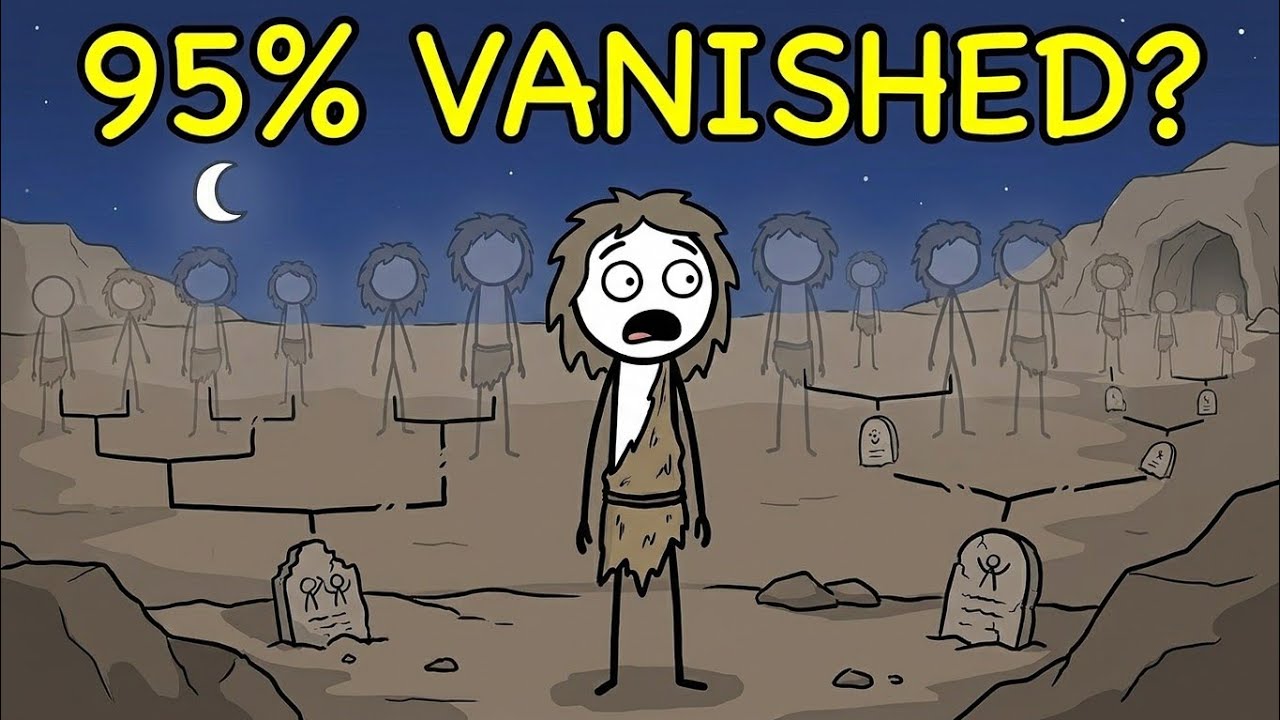
That phrasing is mathematically accurate but misleading. It does not mean 19 out of every 20 men were killed in a global massacre. Instead, the evidence points to a severe reduction in the number of male lineages that successfully continued into future generations, while the number of living men at any given moment likely remained roughly balanced with women. The distinction matters because a true population-wide catastrophe would have affected both sexes equally.
Women and men face the same famines, plagues, and environmental disasters, yet the female genetic line shows no corresponding dip. What collapsed was not the population of living men, but the diversity of male lines that left descendants alive today. In a village of 200 men, if only 10 of them father sons who themselves father sons across generations, the other 190 genetic lines vanish from the record within a few generations, even though none of those men were killed or harmed. In 2015, a research team led by geneticist Monika Karmin published a landmark study in Genome Research analyzing 456 Y chromosome sequences from diverse global populations.
The team identified a second, recent bottleneck occurring within the last 10,000 years, most sharply concentrated between 5,000 and 7,000 years ago, a period aligning with the spread of agriculture and organized settlement across much of the Old World. Researchers have proposed two competing explanations for this pattern. The first, developed in a 2018 study led by Tian Chengzong with researchers at Stanford University, is called cultural hitchhiking. This model centers on patrilineal kin groups, extended clans organized around male lineage where sons inherit land, livestock, and status from their fathers.
Competition between rival clans, sometimes violent and sometimes economic, could cause an entire losing clan’s male lines to disappear at once. The team’s simulations showed that group-level competition, with roughly 15% of males killed per generation through intergroup conflict, could produce a bottleneck of the observed magnitude. This timing aligns with archaeological evidence from the late Neolithic into the early Bronze Age, a period that saw fortified settlements, specialized weapons designed for fighting humans, and mass graves containing victims of organized violence. The second explanation, published in Nature Communications in 2024 and led by Léa Guyon and colleagues, proposes what the authors explicitly call a peaceful explanation.
It is built on patrilineal segmentary systems, where a large clan periodically splits into sub-clans as it grows. Some male lines within the original clan are more successful at producing the next generation of clan founders, while others do not. Run forward across enough generations, this ordinary demographic variation produces the same severe Y chromosome bottleneck, without any war, conquest, or mass killing. Most men in this model lived normal, safe lives, married, raised children, and were never victims of violence.
They simply were not the specific sons whose own sons founded the next socially dominant lineages. There is ongoing scholarly debate about how warlike this period actually was. Some researchers argue that Pleistocene and early Holocene societies exhibited relatively low levels of organized large-scale warfare compared to later periods, with most violence remaining small-scale and interpersonal. Others point to mass graves and weapon-related trauma as evidence of significant organized conflict.
One broad study across many Old World archaeological sites found that violence levels remained relatively stable from early human evolution through the Bronze Age, only increasing significantly during the later Iron Age and medieval periods. If this holds, it challenges the idea that a sudden spike in warfare caused the bottleneck. The scientific debate remains unresolved, and the likely answer involves a combination of both mechanisms operating across different regions and time periods. Some areas may have experienced genuine organized violence, while others may have experienced the quieter dynamics of clan splitting and unequal inheritance.
Both scenarios produce statistically similar genetic signatures, which is why distinguishing between them from genetic data alone has proven difficult. Both explanations agree on one point: the underlying social transformation. The rise of patrilineal kinship structures, organized around male lineage, male inheritance, and male-line social status, emerged and spread rapidly during the Neolithic period as agriculture and accumulated wealth created something genuinely worth inheriting and worth fighting over. Before agriculture, mobile hunter-gatherer societies had little accumulated property, and there was less structural pressure for reproductive success to concentrate among a small number of dominant male lines.
Agriculture changed that completely, creating fixed land, livestock herds, and durable wealth that made some family lines more powerful than others. The Y chromosome bottleneck, then, is not a story about a massacre. The actual men involved were almost certainly alive in roughly the same numbers as the women of their generation, living ordinary lives. What disappeared was not the men themselves, but their specific lines of descent, fading out silently generation after generation, while a comparatively small number of male lines expanded explosively and came to dominate the genetic record.
Around 5,000 to 7,000 years ago, the rules governing which men became distant genetic ancestors changed permanently, at the exact time humans were inventing agriculture, social hierarchy, and inheritable wealth. The Y chromosome in every man alive today still carries the fingerprint of that ancient transformation.


