The romantic image of pirates—tricorn hats, flintlock pistols, and buried treasure—has been shaped by novels, movies, and theme parks. The reality of the Golden Age of piracy, which ran roughly from 1650 to 1730, was brutal, desperate, and almost always fatal. The most famous pirates of the era rarely retired to tropical islands; they died violently, often at the hands of the very empires they had defied. Edward Teach, better known as Blackbeard, is the most famous pirate in history.
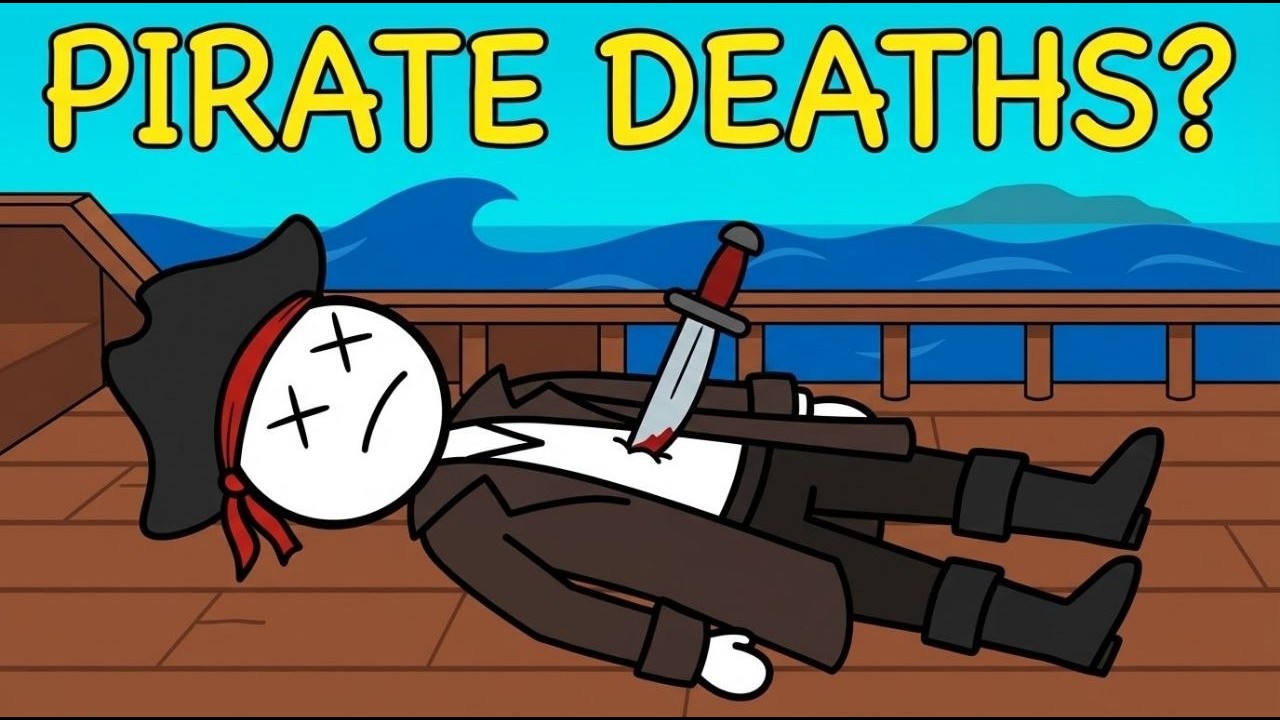
His legend was built on theatrical terror, including a massive beard and slow-burning fuses woven into his hair to create smoke during battle. His entire pirating career lasted just two years. By November 1718, Virginia’s colonial governor, Alexander Spotswood, had grown tired of Blackbeard’s operations near the Carolinas. He privately funded an expedition led by Lieutenant Robert Maynard to hunt the pirate down.
On the morning of November 22, 1718, Maynard found Blackbeard anchored near Ocracoke Island. The confrontation was less a naval battle than a vicious close-quarters fight. Blackbeard’s crew fired a broadside into Maynard’s vessels, killing or wounding many men. Believing Maynard’s deck was cleared, Blackbeard boarded—only for Maynard’s hidden men to swarm back up from below.
Contemporary accounts say Blackbeard absorbed five gunshot wounds and around 14 sword cuts before finally collapsing from blood loss. His body was thrown aside, and Maynard had his head cut off and hung from the bowsprit of his sloop as a warning to other pirates. Blackbeard was about 38 years old. Bartholomew Roberts, known as Black Bart, was statistically the most successful pirate of the Golden Age, having captured over 400 vessels.
He met his end on February 10, 1722, off the coast of Cape Lopez in West Africa. Royal Navy captain Chaloner Ogle had been hunting him for months. Roberts’s crew had been celebrating the night before the encounter. Many were drunk when HMS Swallow appeared.
Roberts himself was reportedly eating breakfast when the naval vessel was spotted. He was struck in the throat by grapeshot and died almost instantly. Following his own standing orders, his crew threw his body overboard to prevent the Navy from displaying it. Over 50 of his men were captured and later hanged, their bodies displayed in cages along the West African coast.
Roberts was about 39 years old and remains somewhere off the coast of Gabon, with no grave or marked resting place. William Kidd, better known as Captain Kidd, is one of the most complicated figures in pirate history. He was originally commissioned as a privateer, authorized to attack enemy shipping and share profits with prominent backers. The arrangement collapsed after his capture of the Quedagh Merchant, a ship flying an Armenian flag but carrying French trading documents.
The prize was legally questionable and politically explosive, drawing complaints from powerful Indian merchants and the East India Company. Sensing political danger, Kidd’s British backers withdrew their support and reframed him as a pirate. Unaware of how badly his situation had deteriorated, Kidd sailed to Boston in 1699, hoping to negotiate his way out of trouble. He was arrested immediately.
His trial in London in 1701 was either a fair assessment of his crimes or a politically motivated railroad that protected his former patrons. Key documents that might have supported his defense disappeared from Admiralty records and were only found in the 20th century. Kidd was hanged at Execution Dock in Wapping on May 23, 1701. The first hanging attempt failed when the rope broke; a second rope completed the execution.
His body was displayed in a gibbet cage over the Thames for three years. Kidd was about 56 years old. Anne Bonny and Mary Read are the most famous female pirates in history. Bonny was an Irish woman who abandoned respectable colonial life for piracy after a failed marriage and a relationship with the pirate John “Calico Jack” Rackham.
Read had spent much of her life disguised as a man and became a pirate through a similarly complicated path. Both were captured with Rackham’s crew in October 1720, when a British naval sloop surprised the vessel off Jamaica. When the British boarded, most of the crew, including Rackham himself, were drunk below decks and offered little resistance. Bonny and Read reportedly fought back.
Bonny’s famous words to Rackham in prison before his execution were brutally dismissive: “I am sorry to see you here, but if you had fought like a man, you need not have been hanged like a dog. ” Both women were condemned to death but delayed execution by declaring pregnancy. Read died in prison in April 1721, likely from fever or childbirth complications. Bonny simply vanished from the historical record—no execution, no death date, no confirmed fate.
John “Calico Jack” Rackham is remembered less for his pirating success and more for his flag design and the company he kept. His Jolly Roger, a skull with crossed cutlasses, became one of the most iconic symbols in pirate history. His capture in October 1720 was deeply undignified. He was hanged in Port Royal, Jamaica, on November 18, 1720, and his body was displayed in a gibbet cage.
Henry Every, known as One-Eyed Jack, committed what is considered the most audacious act of piracy in the Golden Age. In 1695, he led an attack on the Ganj-i-Sawai, a Mughal treasure ship returning from Mecca. The cargo was worth an estimated £600,000, equivalent to hundreds of millions today. The violence involved created a major diplomatic crisis, with the Mughal emperor threatening to expel the British East India Company from India unless Every was captured.
Every was never caught. He distributed the treasure, made his way to the Bahamas, and disappeared from the historical record. Some accounts claim he lived out his days in comfort. Others suggest he returned to England, was cheated out of his share by merchants, and died in poverty in Devon around 1696.
His fate remains unknown, but he is the one major pirate who may have escaped the rope entirely. Charles Vane was known for his brazen defiance. In 1718, he rejected the royal amnesty offered by Nassau’s new governor and sailed past the governor’s warships, firing a broadside as a declaration of intent. His career fell apart about a year later when his own crew mutinied, accusing him of excessive caution.
He was marooned but survived, eventually being picked up by a passing vessel. A hurricane later wrecked that ship and stranded him on an uninhabited island in the Bay of Honduras. When he was finally rescued, the captain of the vessel recognized him and reported him to authorities in Jamaica. Vane was arrested, transported to Port Royal, tried, and hanged on March 29, 1720.
He was probably in his late 30s. Stede Bonnet was possibly the most improbable pirate of the era. He was a wealthy Barbados plantation owner with no maritime experience who, for reasons contemporary accounts attribute to marital troubles, purchased a ship in 1717 and decided to become a pirate. He paid his crew wages, which no real pirate did, and learned seamanship on the job.
He eventually fell in with Blackbeard, who recognized Bonnet’s incompetence and essentially took command of his ship while treating Bonnet as a nominal captain and house guest. Bonnet later returned to piracy, achieved modest success, and was captured by Colonel William Rhett off Cape Fear in September 1718. He escaped custody in Charles Town but was recaptured, tried, and hanged on December 10, 1718. Historical accounts describe him as weeping and writing pleading letters in his final weeks.
He was about 30 years old. The careers of the most famous pirates were astonishingly short. Blackbeard’s lasted two years. Roberts, the most prolific of them all, operated for roughly three years.
The war on piracy waged by the British Admiralty between 1716 and 1726 was methodical and brutally effective. By the mid-1720s, the Golden Age was over. The romanticized legend of piracy—stripped of disease, desperation, gibbeted bodies, and terrified men on the gallows—was marketed back to the descendants of the empires that hanged them.
The pirates got the mythology; the empires got everything else.