A remote burial site in Laos has yielded the first definitive evidence that the famous Plain of Jars was used for human burial rituals, solving a mystery that has puzzled archaeologists for nearly a century. At a location known as Site 75, about 70 kilometers northeast of the city of Phonsavan, researchers uncovered the remains of at least 37 individuals packed inside a single massive stone jar. The discovery, published in 2026 in the journal Antiquity, provides the first solid proof that at least some of these ancient monuments were used as communal burial vessels. The Plain of Jars spans the highlands of northern Laos, where thousands of carved stone vessels, some weighing over 30 tons and standing more than 10 feet tall, are scattered across hilltops and ridges.
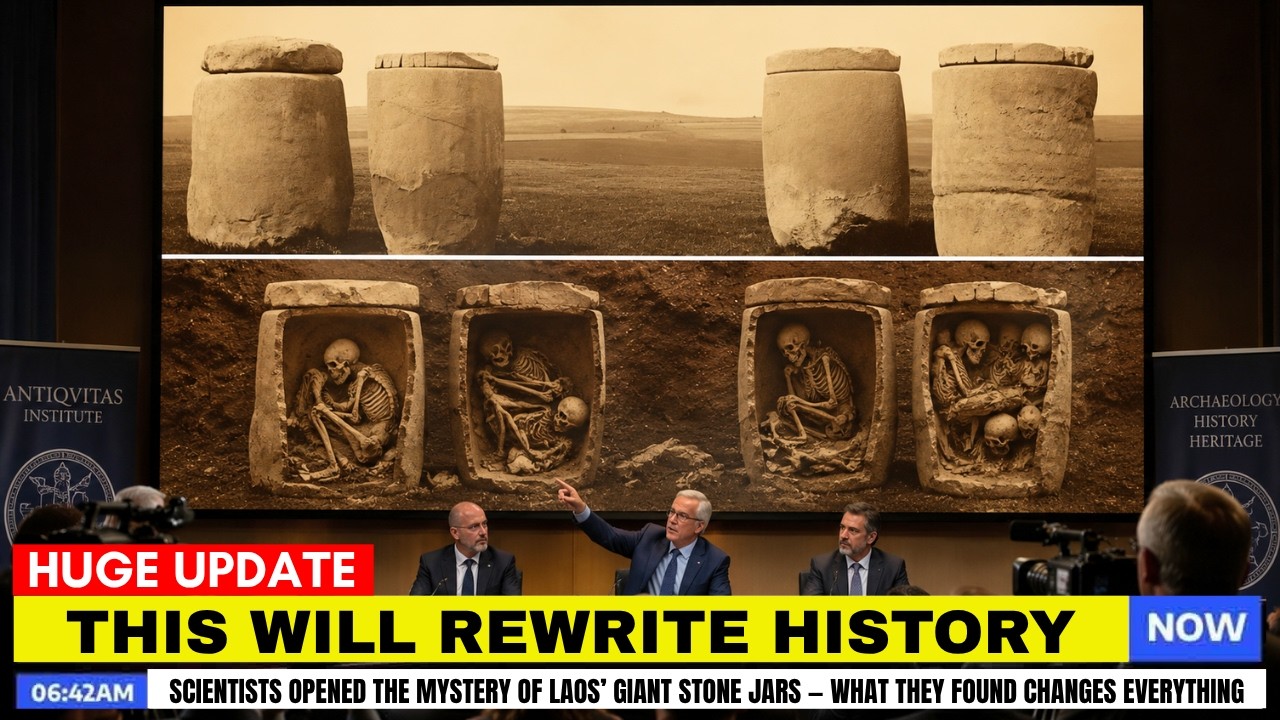
Carved centuries ago without modern machinery, the sandstone, granite, limestone, and conglomerate jars have baffled researchers since they were first documented in the 1930s. French archaeologist Madeleine Colani conducted the first detailed survey of the region in the 1930s. She found burial pits, carved stone discs, cremated bone fragments, pottery, and jewelry near the jars, leading her to propose that the site was connected to funerary practices. However, her theory faced a persistent problem: the jars themselves were almost always empty.
This absence of direct evidence inside the jars sparked decades of debate. Some experts argued the jars were storage containers, water reservoirs, or rice wine fermentation vessels. Local legends claimed giants carved the jars to brew rice wine after battles. None of these theories gained solid physical backing.
In 2016, an Australian and Lao research team launched a comprehensive study of the jar sites, combining GPS mapping, radiocarbon dating, and geological analysis. The collaboration between the University of Melbourne, the Australian National University, James Cook University, the University of Otago, and Laos’s Ministry of Information, Culture, and Tourism identified more than 20 previously undocumented jar sites. The breakthrough came during excavations at Site 75 conducted between 2022 and 2024. Researchers focused on an unusually large jar carved from conglomerate rock, standing about 1.
3 meters tall and stretching over 2 meters wide at its base. Inside, they found densely packed human bones and teeth in a complex, disarticulated mass. Radiocarbon dating placed the interments over roughly 270 years, between approximately AD 890 and AD 1160. The bones belonged to a minimum of 37 individuals, ranging from infants as young as 18 months to adults.
The remains were accompanied by earthenware fragments, stone slabs, an iron knife, a small copper-based bell, and 20 glass beads. The jumbled state of the bones suggests a practice known as secondary burial, in which bodies were left elsewhere to decompose before their bones were collected and placed in the jar. This practice is documented throughout Southeast Asia, both historically and ethnographically. Nearby, researchers found a cluster of seven smaller jars about 500 meters from the large vessel.
These contained no human remains but may represent an earlier stage in a multi-step burial ritual, possibly for initial interment or exposure. The prolonged use of the same jar across roughly ten generations points to a family or kinship-based tradition. Researchers describe the jar as functioning like an ancestral shrine, with the living returning repeatedly to place their dead beside relatives who had passed decades or even centuries earlier. The glass beads found with the remains suggest connections reaching as far as South India and Mesopotamia, indicating the remote plateau was not isolated but engaged in long-distance trade networks.
Many questions remain. The jars themselves are generally dated to between roughly 500 BCE and 500 CE, but the remains inside Site 75 date from much later, suggesting the jar may have stood unused for centuries before being incorporated into burial rituals. The region also remains one of the most heavily bombed areas on Earth, the result of extensive bombing campaigns during the Vietnam War. Millions of unexploded cluster munitions still contaminate many jar fields, rendering large areas too dangerous for excavation.
The site was inscribed as a UNESCO World Heritage property in 2019, with preservation efforts closely tied to ordnance clearance. Researchers are now planning DNA analysis on the recovered remains to determine whether the 37 individuals were related, along with isotope analysis to reveal where they spent their lives. Further excavations at other jar sites are planned to determine how widespread this burial tradition was across the region.