A 2025 study combining physics modeling, 3D scanning, and hands-on experimentation with a full-scale replica has concluded that the massive stone statues of Easter Island were not dragged, rolled, or hauled flat across the landscape. Instead, researchers say, they walked—rocked upright from side to side by small teams pulling ropes, stepping forward one pivot at a time. The finding, led by anthropologist Carl Lipo of Binghamton University and Terry Hunt of the University of Arizona, took seriously a claim long embedded in Rapa Nui oral tradition that outsiders had often dismissed as folklore. The statues, islanders had insisted for generations, simply walked to their destinations.
The research team analyzed nearly 1,000 moai statues, including 62 found abandoned along the ancient transport roads. They discovered that successfully transported statues shared two consistent design features: a wide D-shaped base and a forward lean of 5 to 15 degrees. These were not purely aesthetic choices, the researchers concluded, but functional engineering designed to enable controlled movement. With ropes attached to either side of an upright moai, a coordinated team could pull alternately, causing the statue to rock from edge to edge.
The forward lean meant the rounded front base acted as a pivot, translating the rocking motion into forward steps—the same principle behind walking a heavy refrigerator across a floor by tilting it corner to corner. The team built a full-scale 4. 35-ton replica with the correct design and successfully walked it 100 meters in about 40 minutes using just 18 people. Calculations suggested an average moai could cover roughly1,000 feet per hour once the rhythm was established, with the hardest part being the initial effort to get the statue rocking from a standstill.
The ancient roads themselves appeared purpose-built for this method, measuring about4. 5 meters wide and gently concave—a shape that would hinder dragging but stabilize an upright rocking statue from toppling sideways. Statues abandoned en route, concentrated within 2 km of the quarry, fit the theory as evidence of occasional mechanical failures during the early stages of transport rather than deliberate placement. This study is part of a broader reassessment of how ancient civilizations moved enormous weights without modern machinery.
At the Great Pyramid of Giza, containing over2. 3 million stone blocks weighing up to90 tons each, the leading explanation has shifted away from a single massive external ramp, which would have required more material than the pyramid itself. French architect Jean-Pierre Houdin, working from a hypothesis developed by his father, spent years building a detailed CAD model and proposed the internal ramp theory: builders used an external ramp for the lower30% of the height, then switched to a spiraling ramp built into the pyramid’s interior. This would explain the absence of evidence for a ramp reaching the summit, as those stones were recycled into the upper structure.
A 2012 papyrus discovery also suggested branches of the Nile, now vanished, brought stone blocks closer to the site than previously realized, with wet sand—poured in front of sledges as depicted in wall paintings—reducing friction by roughly half, a principle of granular physics not formally documented for another4,000 years. At Stonehenge, erected around2,500 BC, massive stones weighing up to30 tons were arranged using levers, sledges, ropes, and coordinated labor. But the most baffling challenge was transportation: some bluestones came from quarries in the Preseli Hills of Wales, nearly200 miles away. Archaeologists propose a hybrid method—dragging stones overland on sledges and rollers made from tree trunks, then transferring them to rafts for river or sea travel.
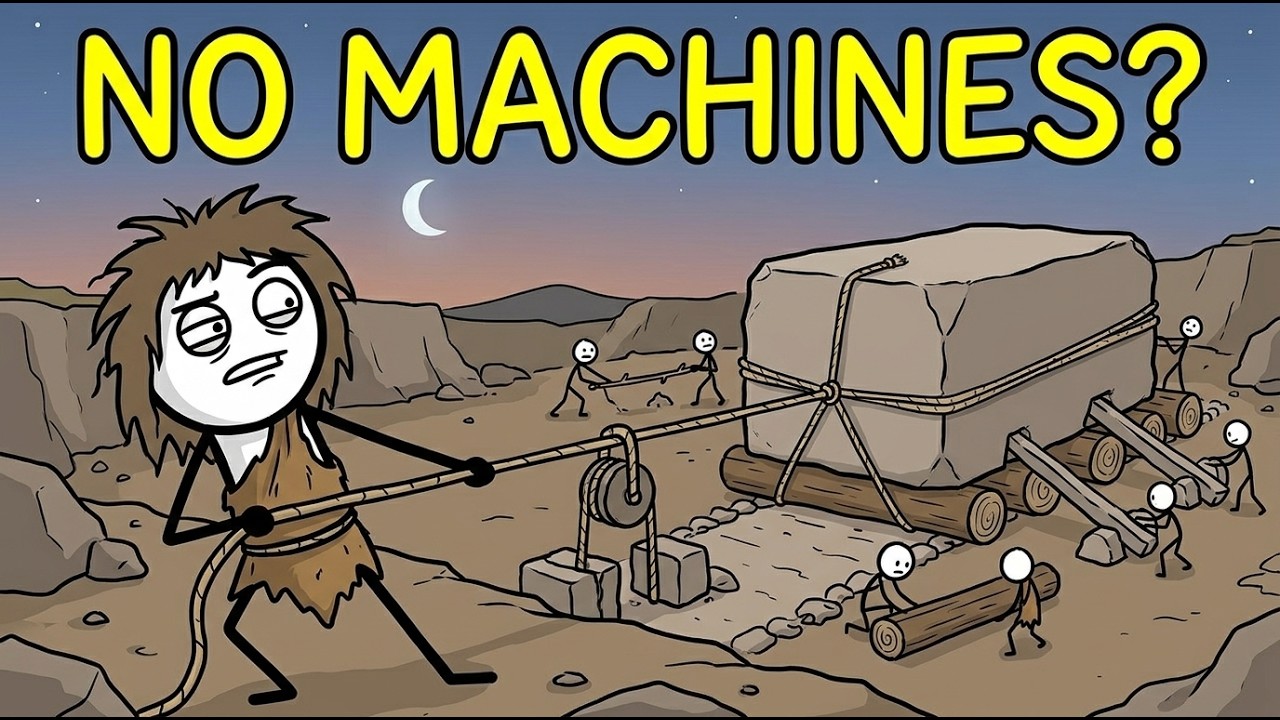
Water, they note, isremarkably effective at supporting enormous weight with minimal friction, a principle each culture seems to have independently discovered. Raising the stones into position at the site likely involved counterweights and a slow, controlled rocking motion to pivot each pillar upright inch by inch. What ties the pyramids, Stonehenge, and the moai together, researchers argue, is a shared approach to immense physical problems using remarkably similar principles, despite no contact between these cultures. None had the wheel for heavy transport or iron tools, yet each arrived at solutions based on reducing friction, breaking one impossible task into a sequence of manageable steps, and letting natural forces—water, gravity—carry much of the burden.
Rather than requiring modern technology, these achievements required societies willing to commit sustained, coordinated effort generation after generation, combined with an intuitive practical understanding of physics that never needed written equations. As the Easter Island study demonstrates, what once seemed impossible was achieved with nothing more than rope, water, wood, stone, and patient human coordination—one rocking step at a time.