Somewhere in ancient Australia, roughly 20,000 years ago, a hunter kneels at the edge of a swamp. About 60 meters away, a flock of ducks rests on the water. He can see them, but he cannot reach them. His spear is useless at this distance, and standing up would scatter every bird into the air before his throw could land.
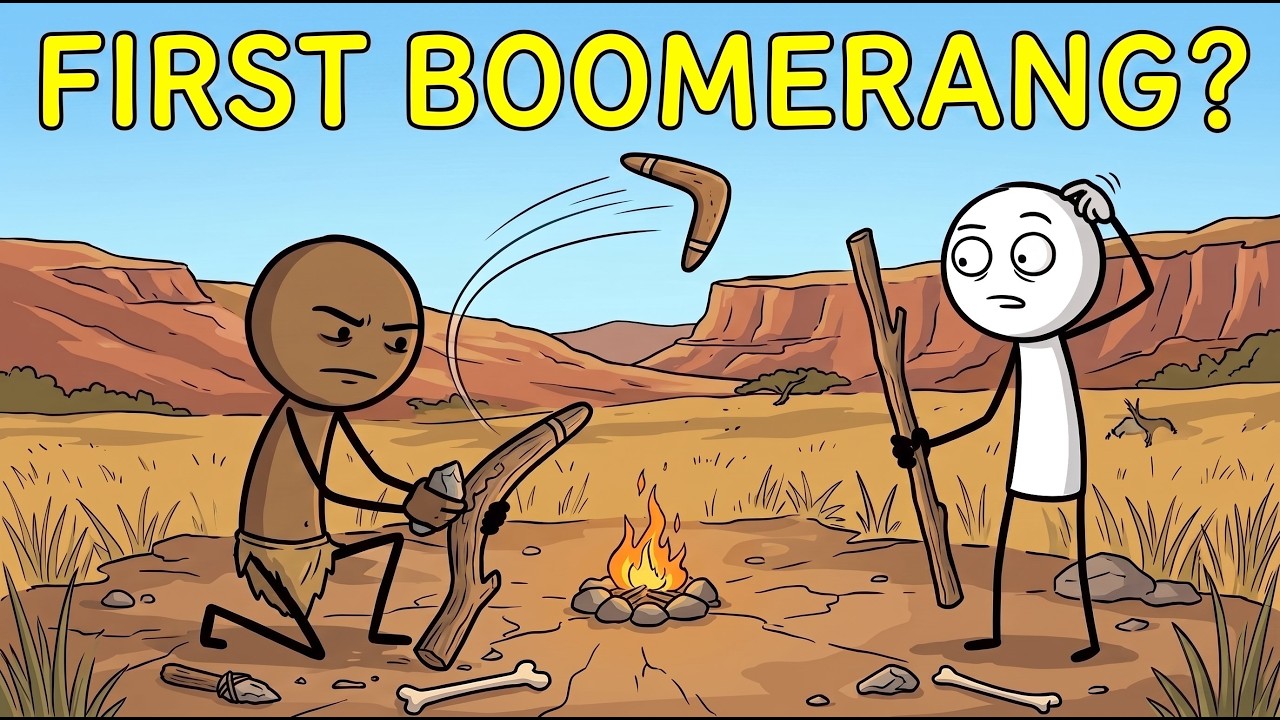
Wading closer is impossible, and swimming would be far didn’t too quietly. Every long-range weapon his kind has ever made demands approach, and approach means losing dinner. But in his hand sits a curved piece of wood, half a meter long, carved from the root of a hardwood tree. Thrown flat, fast, and spinning, it can cover those 60 meters in under two seconds, skim across the water at chest height,, and hit with enough force to break bone.
One throw. One stick. And if he misses, the wooden piece will arc through the air, spin, and return to his hand. Nothing else does that.
No spear returns. No arrow. No stone. Only this strange object, doing something most physicists would need a whiteboard and20 minutes to explain.
So how did anyone ever figure that out? The answer begins much earlier than you might expect,, and it does not begin with the boomerang at all. It begins with a stick. A straight stick.
Among the famous throwing spears discovered by archaeologist Hartmut Thieme at Schöningen innorthern Germany in1994 was another artifact that gets far less attention. A wooden throwing stick with two pointed ends,, polished and balanced,, roughly 300,000 years old,, made by Homo heidelbergensis. Not a boomerang. Not curved.
Just a shaped piece of wood designed to be hurled at an animal with enough force to injure or kill it. Three hundred thousand years. That is how old this concept is. Throwing a shaped piece of wood at something you want to kill.
This matters for the story of the boomerang because the boomerang is not a separate invention. It’s what happens when you take a 300,000-year-old idea and start, over thousands of generations, experimenting with its shape. The history of the boomerang then divides into two entirely different objects,, although most people treat them as one. There are two kinds,, and the gap between them is vast.
The first ist he non-returning boomerang,, sometimes called a kylie,, sometimes called a throwing stick,, or a killing stick. It is a real weapon,, flying in a straight path,, not returning,, built to strike targets with devastating power. A typical hunting kylie weighs between 00 grams and2 kilograms,, can reach a meter in length,, and an expert thrower can launch it at speeds exceeding20 meters per second,, or over70 kilometers per hour. On impact,, the kylie releases more than100 joules of kinetic energy,, concentrated along a narrow wooden edge.
For comparison,, that is like a heavy axe blow. Aboriginal Australian hunters used wooden throwing sticks to shatter the legs of kangaroos and emus from distances up to200 yards. Think about what that actually means. A carved piece of wood.
No metal. No string. No moving parts. No mechanism of any kind.
Just shape,, density,, and skill,, hitting a running animal from200 yards with enough force to break bone. This was not a toy. This was a precision weapon,, and it formed the backbone of hunting and combat strategy supporting people across an entire continent for tens of thousands of years. In warfare,, a line of men hurling kyliat speeds of70 kilometers per hour was genuinely terrifying.
The spinning edge could crack skullsand shatter limbs from distances a spear could never reach. And because every adult male carried several sticks,, the first strike was followed by a second,, anda third,, before anyone ever closed to direct combat range. The non-returning boomerang was not just a hunting tool. It was a weapons system.
The kylie came first,, andthe returning boomerang evolved from it. And it almost certainly began by accident. But the throwing stick itself,, surprisingly,, was never a uniquely Australian invention. Curved throwing sticks appear across every inhabited continent,, made by cultures who had zero contact with each other.
In1985,, inside Oblazowa Cave insouthern Poland,, archaeologists found a throwing stick carved from the tusk of a woolly mammoth. It was72 centimeters long,, precisely polished,, and finely crafted. Initially believed to be about23,000 years old,, a2025 study led by researcher Sarah Talamo pushed its age back significantly,, to between39,000 and42,000 years. That makes it the oldest known throwing stick outside Africa.
It was carved from mammoth ivory by someone living during the Ice Age ineurope during the Upper Paleolithic,, when most of the continent lay beneath glaciers,, and life expectancy was likely shorter than the time it took to carve that stick. Yet they made it because they needed food. When Howard Carter opened Tutankhamun’s tomb in1922,, he found dozens of sticks amongth e pharaoh’s possessions. Some were ornate,, with ivoryand gold fittings,, clearly ceremonial items meant forth e afterlife.
Others were practical and simple,, designed for hunting waterbirds inthe marshes of the Nile. Wall paintings inth e tombs of Egyptian nobles from thee 18th Dynasty,, around1350 BC,, show pharaohs and nobles standing inreed boats,, raising sticks above their heads,, and hurling them at ducks and geese overthe swamps. The young king of Egypt was buried with his sticks. That’s how seriously Egyptians took them.
InNorth America,, the Hopi people used curved throwing sticks called rabbit sticks,, designed to tumble along the ground at leg level and strike small game darting between desert shrubs. InIndia,, a weapon called the valari served the same purpose,, a curved wooden stick used for throwing inhunting,, and insome cases,, inwar. Different continents. Different millennia.
Different languages. The same solution. This pattern of convergent innovation is itself an essential part of the answer to how the boomerang was invented. No one sat down to design a boomerang from scratch.
No one said,, I will invent a projectile with an airfoil cross-section. What happened,, repeatedly,, across the world,, was that someone carving a throwing stick noticed that certain shapes flew more steadily than others. Stick with a slight curve held their path better. Flat cross-sections flew farther.
Aerodynamics are universal. The hunting problem is universal. And when you keep shaping wood,, keep throwing it,, and keep paying attention to what flies better,, you converge on the same answer every time. A curved stick with a flat cross-section.
A boomerang. But making one was not as simple as snapping a branch off a tree,, andthe manufacturing process tells us something important about the minds of its inventors. Aboriginal Australian boomerang makers did not carve their boomerangs from straight wood. They carved them from the junction where a tree root meets the trunk,, from the natural bend where wood grain changes direction.
Hardwoods like mulga grow with these bends,, andthe maker would select a tree with roughly the right angle,, cut out the curved section usingstone tools,, andthen begin a long shaping process. This detail matters enormously. Wood is strongest when force runs along its grain. If you carve a curved shape from a straight piece of wood,, the grain runs across the curve,, andthe weapon will snap at the first hard impact.
But if you carve from a naturally bent section,, the grain follows the curve,, andthe wood stays intact for thousands of throws
Choosing the right tree was only the beginning. After roughly shaping the wood with stone tools,, the maker slowly heated it over hot coals,, not burning it,, but heating it enough to make it flexible,, allowing fine adjustments to its curve by bending it carefully over his knee or a rock while the fibers were still soft. Then the cross-section had to be scraped into a specific shape,, one side flat,, the other gently rounded,, creating an airfoil,, usingstone scrapers and sometimes sand for finishing. The weight distribution had to be balanced so the boomerang would spin evenly.
The angle between the arms had to be set correctly,, with a slight twist between different planes,, so the weapon would generate the right amount of lift during flight. This was not a five-minute job. Days of precise,, skilled labor,, requiring knowledge of materials,, aerodynamics,, and woodworking,, accumulated and passed down through generations via oral tradition. Every step had to be discovered by someone,, at some point,, through trial and error,, then taught to the next person,, who then improved it.
This chain of teaching and refinement is the real invention of the boomerang. Not a flash of genius. Centuries of accumulated knowledge,, encoded in wood
Here,, most likely,, is how the returning boomerang entered the story. Imagine you are a hunting-stick maker,, having carved non-returning throwing sticks yourentire life.
You know what a good stick looks like. You know its weight,, its shape,, its angle. One day,, you carve one that is too thin. Too light.
The cross-section comes out slightly uneven,, one side shaved a bit more than the other. You throw it. And instead of flying straight to hit the ground 100 meters away,, it curves. Sharply.
It keeps curving. Then it comes back toward you. Your first reaction might be confusion. Your second reaction,, once you get over the shock of almost being hit by your own weapon,, is curiosity.
Because that stick did something you have never seen any thrown object do. So you throw it again. And again. That moment,, repeated in one form or another over the years by unknown people,, is most likely how the returning boomerang was born.
Not as a deliberate invention,, but as a manufacturing accident that someone decided to investigate,, reproduce,, then deliberately refine. The returning boomerang is a mistake that someone turned into a tool,, thena tradition,, then into something so precise that it would take a555-page physics thesis by a Dutch scientist to explain why it works. The physics behind the returning boomerang is genuinely strange. When you throw it,, it spins rapidly while moving forward through the air.
Each arm is a miniature airplane wing,, rounded on one side and flat on the other. As the boomerang rotates,, the forward-moving arm,, the one traveling in the same direction as the throw,, moves faster through the air than the backward-moving arm. Faster air movement creates more lift. So at any given moment,, one side of the boomerang generates more lift than the other.
You can see why that matters. Unequal lift means unequal force. That creates torque,, a twisting force,, which logically should flip the boomerang over. But it doesn’t flip.
The reason it doesn’t is something called gyroscopic precession. Because the boomerang is spinning,, it has angular momentum. And angular momentum obeys a counterintuitive rule. Instead of tilting in the direction of the applied force,, as you might expect,, a spinning object shifts its axis of rotation 90 degrees away from the torque.
The boomerang doesn’t flip,, it continuously turns. In a smooth,, curved arc,, if the shape and throw are correct,, that arc closes intoa complete loop and brings the weapon back to the thrower. You have seen gyroscopic precession before,, even if you didn’t know its name. It’s the same reason a spinning bicycle wheel resists tipping over.
The same reason a spinning top stays upright. The same physics,, applied to a piece of wood flying through the air at 00 kilometers per hour
Dutch physicist Felix Hess spent years studying this. He published his paper&34;The Aerodynamics of Boomerangs&34; inScientific American in1968,, then spent seven more years producinga555-page doctoral dissertationat the University of Groningen,, completed in1975,, titled&34;Boomerangs,, Aerodynamics and Motion&34;. That dissertation remains the most comprehensive mathematical treatment of boomerang flight ever written.
Hess mapped out every force acting on a boomerang during flight,, including gyroscopic precession,, air resistance,, gravity-induced torque,, and orbital-coupling effects that behave similarly to the Coriolis force. The flight path of a well-made returning boomerang is,, mathematically,, nearly as complex as the orbital mechanics of a satellite. And someone mapped out that flight path usinga piece of wood. About10,000 years ago,, witha stone scraper and hot coals,, without any theory of aerodynamics,, without mathematics,, without writing.
They did it the only way available to them: by throwing thousands of sticks,, watching what happened,, and remembering which shapes curved more than others
The oldest surviving returning boomerangs come fromWyrie Swamp,, a peat bog near the town of Millicent insouth Australia. Inth e1970s,, archaeologist Roger Luebbers excavated the site,, recovering a collection of wooden artifacts preserved in acidic,, oxygen-poor water that prevents decay. Among them were several boomerangs,, radiocarbon-dated to about10,000 years old. They were not crude experiments.
They were refined,, returning boomerangs,, with two arms set in two slightly different aerodynamic planes,, joined at a sharp angle,, showing exactly the design features Felix Hess would later identify as necessary for return flight. Ten thousand years old,, andalready the product of ancient traditions. Already polished. Made by people who had been making them for long before that particular set ended up in a swamp and stayed there.
The Wyrie Swamp boomerangs are the oldest physical returning boomerangs ever found. They are almost certainly not the oldest ever made,, just the oldest that survived,, because wood doesn’t last ten thousand years except in exceptional conditions. And peat bogs are rare
Now here’s a question that reveals something genuinely surprising aboutthe inventors of the returning boomerang:. Why would you want a weapon that comes back to you?
Think about it. If a thrown weapon hits its target,, it stays there. It does not come back. A returning boomerang only comes back if it misses.
So at first glance,, the returning boomerang seems like a weapon designed to fail. That seems ridiculous until you understand how it was actually used. Aboriginal Australians did not throw returning boomerangs at animals the way you would throw a spear at a deer. They threw them over flocks of birds.
The spinning boomerang,, slicing through the air above a flock of ducks or parrots,, mimicked the silhouette of a bird of prey diving from above. The birds panicked,, dove for cover,, and landed directly in nets the hunters had set across their escape routes below. The boomerang was not a killing tool. It was a herding tool.
It drove prey into traps. And if it didn’t hit anything,, it came back,, saving the hunter the trouble of wading through marshland to retrieve a stick before the next throw. Not a design flaw,, but an efficiency feature ina hunting system so sophisticated that European observers took decades to understand what they were watching
But the returning boomerang was only one tool ina toolkit that defies easy summary. Aboriginal Australians used boomerangs as musical instruments,, clapping two together as rhythm in ceremonies and songs.
They used flat boomerangs as digging tools to pry up roots andubers from hard ground. They used them to manage fire,, scooping up coals and pushing them where they were needed. They used them in games and competitions,, throwing for distance and accuracy,, centuries before anyone thought to make it a formal sport. And they used heavy,, non-returning kyliashas weapons of war.
One piece of shaped wood. A weapon,. adigging tool,. amusical instrument,.
atoy,. anda fire tool. That is not simplicity. That is the kind of integrated,, multi-purpose design that modern engineers spend entire careers trying to achieve,, usually with far less success and far more materials
Here is something that should make you reconsider what technological progress actually means.
Aboriginal Australians were aware of the bow and arrow. They had direct contact with bow-using peoples to their north,, in what is now Indonesia andPapua New Guinea. The bow existed there. Available.
Tested. They chose not to adopt it. Their throwing sticks,, along withthewoomera,, andthe boomerang andkylie,, gave them a ranged weapons system perfectly suited to Australian conditions,, from the open wooded country,, to the specific wild game,, to the extreme heat,, that the bow simply did not offer enough advantage to justify replacing it. A bow requires specific wood.
Specialized string. Arrows with fletching and stone points embedded,. aseparate manufacturing chain for each component. A boomerang requires only a single piece of suitable wood,andknowledge of how to shape it.
For a mobile people traveling vast distances on foot,, carrying everything they own,, the simplest tools that met all their needs were the best ones. Australia reminds us that technological history does not move ina straight line from primitive to advanced. Sometimes,, people using old technology understand their world better than anyone watching them from outside
This connects directly to how the boomerang was invented,, because it was made by people who spent tens of thousands of years studying their environment witha precision most modern observers cannot fully appreciate. Aboriginal Australians have lived continuously on the same continent for at least65,000 years.
That is65,000 years of throwing sticks at animals,, watching how they flew,, noting which shapes worked best,, teaching their children what they learned,, and letting those children improve the designs. Dietrich Stout of Emory University has shown,, through neuroimaging studies,, that complex toolmaking activates brain regions associated with language production. The more complex the tool,, the more brain activity in areas connected to speech and hierarchical planning. The boomerang,, especially the returning kind,, is among the most aerodynamically complex hand tools the ancient world ever produced.
Teaching someone how to make and throw one requires verbal explanation,, practical demonstration,, repeated correction,, and patience. This teaching process is not separate from the invention,, it is the invention itself. The boomerang was not invented by a single genius,, but by a culture capable of transmitting complex knowledge across time,, generation after generation,, without writing down a single word of it
The English word&34;boomerang&34; comes from the Dharug language,, spoken by Aboriginal people in the Sydney area ofNew South Wales. It was first recorded by European colonists in1822.
But there were hundreds of Aboriginal languages across Australia,, andthe boomerang had a different name in nearly every one of them. The Dharug name simply stuck because Sydney was where the British first encountered the weapon. The weapon itself is at least10,000 years old,, while its English name is 200 years old. That tells you who was interested in it,, andwhen
So here is the answer to the question:.
How did humans invent the boomerang? The answer depends entirely on which kind of boomerang you mean. The non-returning boomerang,, or kylie,, or curved throwing stick,, was independently invented by dozens of civilizations on every inhabited continent,, over at least300,000 years,, and probably longer. Homo heidelbergensis shaped throwing sticks at Schöningen 300,000 years ago.
Ice Age Europeans carved one from mammoth tusk at Oblazowa Cave at least39,000 years ago. Egyptian pharaohs used throwing sticks for hunting along the Nile. The Hopi used them to throw at rabbits inArizona deserts. Indian warriors threw the valari.
None of these cultures learned the technique from another. They all arrived at the same solution because the problem was the same everywhere,, andthe laws of aerodynamics do not change with geography or language. How likely is it that the non-returning boomerang was invented independently by multiple cultures,, rather than originating once and spreading? Based on the geographic distances,, the vast time gaps,, andthe complete absence of contact between most of these peoples?
It is almost exactly100% likely. This is convergent invention in its clearest form. Give humans on any continent a piece of wood anda reason to throw it,, andthey will eventually carve it into the same general shape
The returning boomerang is a completely different story. Based on current archaeological andethnographic evidence,, only one culture inhuman history ever developed a true returning boomerang,, a projectile designed to complete a full circular flight path andcome back to its thrower.
Aboriginal Australians. And it evolved from the non-returning kylie through gradual refinements over thousands of years,, as unknown makers in unknown generations noticed that certain shapes and weights caused sticks to curve more than expected,, then deliberately honed that property until the flight path closed intoa complete loop. How likely is it that the returning boomerang is a uniquely Australian invention,, developed independently without influence from any other culture on Earth? Based on the archaeological record,, the absence of returning boomerang traditions anywhere else in the world before European contact,, andthe extreme aerodynamic precision required to produce return flight?
Approximately90 to95 percent
Two things. One name. The curved throwing stick was everyone’s solution to the same problem. The returning boomerang was a purely Australian innovation.
And both began the same way. Someone picked upa piece of wood,, threw it,, and noticed what happened next. Tonight,, insome park,, someone will throw a plastic boomerang andwatch it spin through the air andreturn to their hand. They will call it a toy.
And it is,, now. But the physics that makes it fly,, the asymmetric lift,, the gyroscopic precession,, the angular momentum,, was discovered by people who would never have named any of those forces. They didn’t need to name them. All they needed was to keep carving,, keep throwing,, andkeep watching what the wood did when it left their hands.
Ten thousand years of attention,, encoded ina single piece of curved hardwood doing something no other object on Earth does. It flies out. It comes back.
And the hand that catches it tonight is still connected,, through an unbroken chain of teaching,, to the hand that first threw it