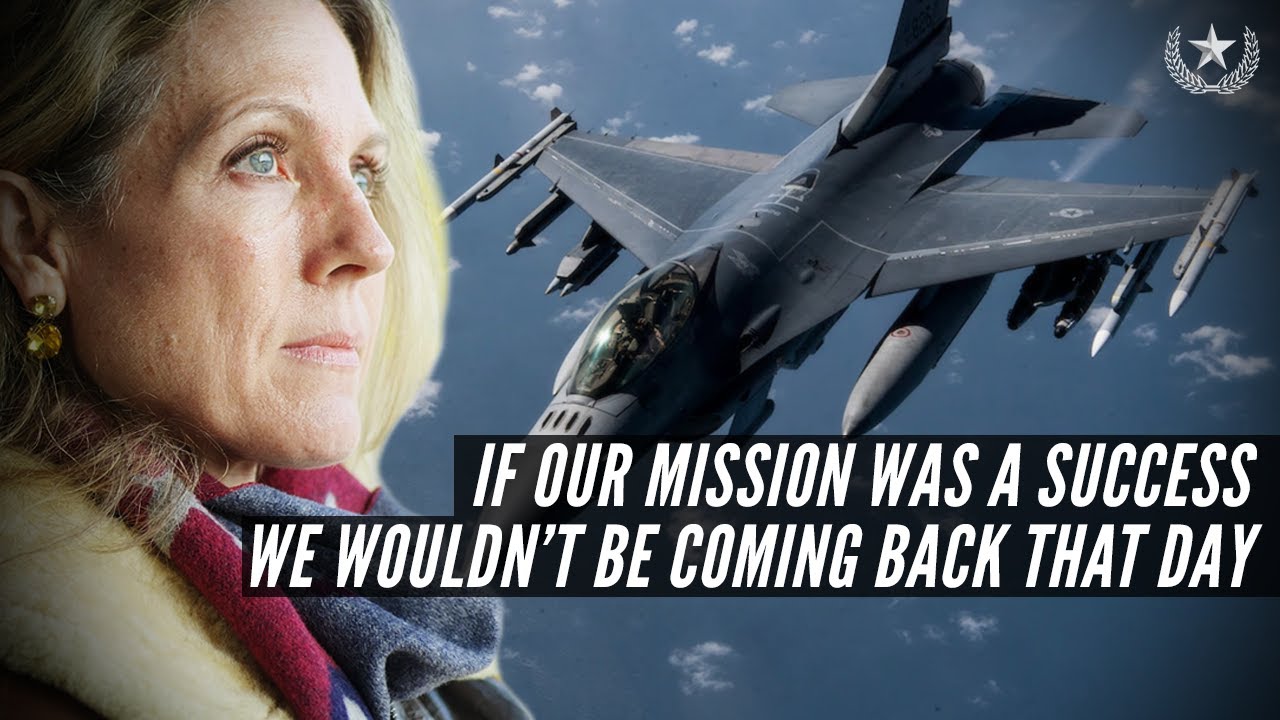
Retired Air National Guard fighter pilot Heather Penney has revealed in chilling new detail how she and her wingman took off on the morning of September 11, 2001, fully prepared to ram their unarmed F-16 fighter jets into a hijacked airliner in what she describes without hesitation as a suicide mission, a desperate act of last resort that she says any American in her position would have made.
Penney, then a young lieutenant flying with the District of Columbia Air National Guard, was sitting in a routine scheduling meeting at Andrews Air Force Base when an enlisted airman named David Callahan interrupted the room to report that an airplane had struck the World Trade Center. The initial report gave no indication that a deliberate attack was underway, and the small skeleton crew in the room assumed a small general aviation aircraft had accidentally gone down.
That assumption collapsed when Callahan returned a second time with the news that a second aircraft had struck the second tower and that the impact was intentional. Penney and her fellow pilots walked to the fighter squadron bar, saw the same horrifying television images the rest of the nation was watching, and understood immediately that the country was under attack.
What followed, according to Penney’s account, was a race against time complicated by two enormous obstacles. As a District of Columbia Air National Guard unit, her squadron did not have a clear chain of command that could authorize a combat launch to defend the capital. The unit’s civilian chain of command ran not to a governor but to the president of the United States, an authority that was rarely if ever exercised, and its federal wartime chain of command did not include the unit at all.
The second problem was even more dire. The squadron was not an alert unit. After the collapse of the Soviet Union in 1991, the nation had slashed its air defense posture and cut the Air Force roughly in half, eliminating the standing alert mission that once kept armed fighters ready around the clock.
As a result, the jets at Andrews had no live weapons loaded, and the weapons troops in the bomb dump were scrambling to build up missiles that would not be ready in time.
Penney recalls that even as the Pentagon burned and the scale of the attack became clear, the pilots still had no orders to launch and no authorization from the proper command authorities. It would be nearly an hour after the strike on the Pentagon before Vice President Dick Cheney, speaking through the chain of command, demanded to know whether there were fighters at Andrews and ordered somebody to get them airborne.

The call that finally sent them into the sky came from the White House Joint Operations Center, which only had the squadron’s number because of the Secret Service. The message was blunt and urgent: get whatever you can airborne, now. Penney’s wingman, Mark Sassebo, known by his call sign Sas, looked at her and told her she was with him.
Fellow pilots Dan Kane, call sign Raising Kane, and Brandon Rasmussen would remain behind to wait for missiles.
Penney remembers running with Sas down to life support to grab their flight gear, and she remembers the plan the two of them had already worked out in those frantic minutes. Sas would ram his jet into the cockpit of the hijacked airliner, killing the terrorists and destroying the flight controls. Penney would ram her jet into the tail, because an aircraft without a tail becomes aerodynamically unbalanced and will dive straight into the ground.
When she first realized she might have to sacrifice her own life to stop an airliner, Penney says she thought about Pearl Harbor and about the long line of airmen and service members across American history who had answered the call. Although the military does not plan suicide missions, she said, if this was what her nation needed, that was her purpose, and she had peace with it.
The Federal Aviation Administration had already begun grounding airliners before the two fighters took off, and the squadron’s intelligence officer, David Nuts McNulty, had been conducting what is now called open source intelligence to determine the air order of battle and identify which aircraft might still be aloft. The pilots believed as many as three aircraft in their region were unaccounted for, and the White House was tracking an airliner that had descended near Cleveland, turned 180 degrees, and was heading back toward Washington.
When Penney and Sas launched, she remembers the sky over the nation’s capital being eerily silent, a region normally packed with commercial airliners suddenly almost empty. They took off to the north on runway one right, stayed low, and as they turned left toward the northwest, the stench of smoke from the burning Pentagon came through the environmental control system. Looking down, she could see the smoke billowing from the side of the building and drifting toward the National Mall.

She had little time to process the scene and no emotional response, she said, because she had a job to do. The two fighters pushed northwest to sanitize the airspace and hunt for the inbound airliner, flying perhaps a hundred miles before Sas concluded they needed to return to Washington to guard against the possibility that their intercept had been slightly off and that they could be flanked by another threat.
Back over the capital, Sas set up a combat air patrol designed to keep one fighter radar looking downrange at all times, and he began teaching the Potomac air traffic controllers how to speak fighter pilot language so they could help facilitate intercepts and filter radar contacts into known friendly aircraft and unknown potentially hostile ones. Penney described the controllers’ mental shift as amazing, transforming from sequencers of airliners along known highways in the sky into partners in a chaotic and confused airspace.
With only two fighters on station, other contacts began appearing on radar, and the pilots had to rely on visual identification because no other methods were available. For each unknown contact, they would leave the combat air patrol and fly out to see whether it was a helicopter, a light aircraft, a twin engine plane, or an airliner, while the controllers helped determine whether it was known and friendly or something far more dangerous.
Roughly forty five minutes after Penney and Sas took off, Dan Kane and Brandon Rasmussen finally launched with live AIM-9 missiles, and Penney said that was the moment her personal pucker factor went down. Sas reconfigured the combat air patrol into an X shape, taking the northwest leg himself, assigning Penney the northeast leg, Kane the southwest leg, and Rasmussen the southeast leg, so that all sectors around the capital were covered.
Penney does not believe she and Sas learned about Flight 93 until after they landed from their first sortie, possibly even after the second. What mattered in the moment, she said, was maintaining vigilance and protecting the airspace around the nation’s capital. On their second mission, they were directed over secure voice to receive a classified notification and were tasked with intercepting Air Force One to escort President George W.
Bush safely back into the Washington area.

After landing from that second sortie, Penney was exhausted, but she insisted that what she and Sas were prepared to do that day did not strike her as anything special or unusual. She said she believes anyone would have been willing to do it, and that any other service member in their position would have made the same choice. She extended that conviction to every American, pointing to the passengers of Flight 93 as proof.
Those passengers, she noted, were ordinary Americans who had never raised their right hand to take an oath like she had, yet they still chose to attack the terrorists, fight their way into the cockpit, and deliberately crash the airliner, sacrificing their lives to protect the rest of the country. For Penney, the most impactful realization came later, when she understood that the nation no longer lived in the same universe it had inhabited before that morning, that the entire world had shifted and changed.
Her account underscores how close the capital came to being defended by a tactic never intended for modern aerial warfare, two unarmed fighters flying a suicide mission because the nation’s air defense apparatus had been allowed to wither in the decade before the attacks. It is a story of improvisation under unimaginable pressure, of pilots who took off knowing they would not return if they succeeded, and of the quiet conviction that duty, not glory, was the reason the universe had placed them in those cockpits.
Penney’s testimony also serves as a reminder of the broader transformation that followed September 11, when the United States rebuilt its domestic air defense posture, reestablished armed alert missions, and reorganized the chain of command that had left guard pilots scrambling for authorization while hijacked airliners bore down on the capital. What happened over Washington that morning, she suggests, was not a story of heroes doing something extraordinary but of ordinary people, in the air and on the ground, doing what the moment demanded.
The passengers of Flight 93, who fought back in the skies over Pennsylvania, and the pilots of the D. C. Air National Guard, who launched without weapons and without orders, are bound together in that history.
Penney’s message is clear and unflinching: the world changed that day, and the willingness of Americans to sacrifice for one another, whether in a cockpit or a passenger cabin, remains the defining answer to the terror unleashed on September 11, 2001.