For more than 300,000 years, humans regularly and successfully hunted some of the largest and most dangerous land animals in Earth’s history, including nine-ton woolly mammoths armed with curved tusks capable of killing a person in a single movement. The fossil record is filled with megafauna bones bearing cut marks and embedded stone points, proving that early humans were not merely scavenging already-dead animals, but deliberately killing these giants with consistency across multiple continents. This accomplishment stands as one of the most remarkable survival achievements in human history, given that our ancestors possessed no claws, fangs, or natural armor, only a clever brain and the ability to cooperate. The oldest confirmed wooden hunting spears ever found come from a site in Schöningen, Germany, now dated to roughly 200,000 to 300,000 years old.
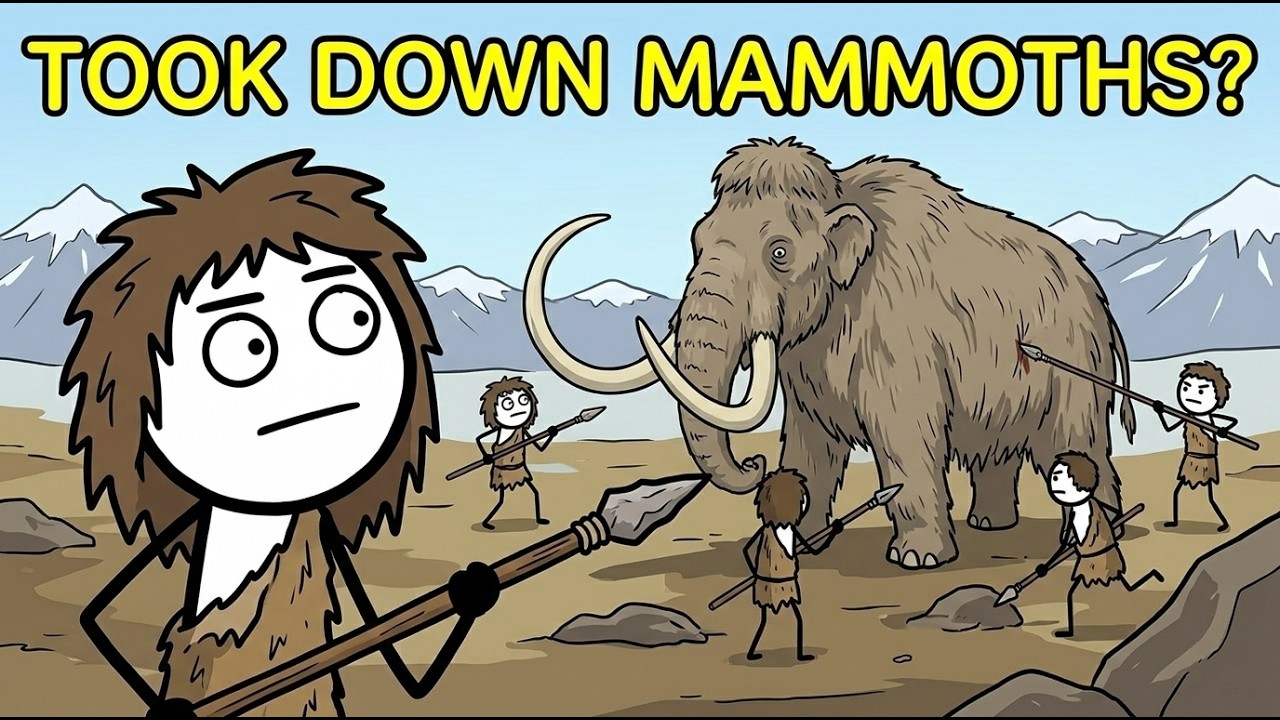
These were not crude sharpened sticks but carefully shaped spruce and pine weapons, between two and two and a half meters long, designed with deliberate balance and engineering skill. They were discovered among the butchered remains of more than 50 horses, all killed in repeated ambush hunts along the shore of an ancient lake. Researchers found that these hunters, almost certainly Neanderthals or their close relatives, preferentially targeted family groups of horses rather than bachelor herds, revealing a sophisticated understanding of animal social behavior and sustained strategic planning. One of the most significant breakthroughs in understanding how ancient hunters killed megafauna came from a 2024 study out of UC Berkeley, which overturned decades of assumptions about prehistoric hunting technique.
For years, the dominant theory held that hunters threw stone-tipped spears at mammoths from a safe distance, expecting the animals to collapse from accumulated blood loss. The problem with this theory was that the human shoulder simply cannot generate enough throwing force to drive a stone-tipped spear deep enough through the thick hide and dense muscle of a nine-ton mammoth to inflict a fatal wound. Thrown spears alone were essentially useless against such an animal. The Berkeley researchers proposed a completely different approach, which they called pike hunting.
Instead of throwing the spear, hunters would brace the base of a long, sturdy pike firmly against the ground and angle the sharpened stone tip upward toward an approaching or charging animal. When a charging mammoth collided with the planted spear, its own enormous body weight and forward momentum would drive the stone point deep into its flesh, generating far more penetrating force than any human arm could ever produce. The researchers described the mechanism as functioning almost exactly like a modern hollow-point bullet, with the wooden shaft splintering and expanding inside the wound channel after the initial puncture, causing catastrophic internal damage. This single tactical insight, using the animal’s own mass and charging velocity against it rather than relying on human throwing strength, may be the most important reason a small, physically unimpressive primate could reliably bring down the largest land mammals.
The strategy did not require overpowering a mammoth at all; it simply required convincing the mammoth to overpower itself. Pike hunting alone, however, only worked if hunters could first get a multi-ton animal to charge directly into the planted spear at the right angle and moment. This required a level of coordination impressive even for a modern professional sports team. Archaeological evidence shows that mass communal hunting developed independently on completely different continents.
One striking technique involved driving herds of migrating animals toward box canyons, narrow gorges, or the edges of steep cliffs, where the terrain itself did the lethal work. A herd would be deliberately spooked and funneled by coordinated hunters toward a natural choke point or sudden drop, and the animal’s own panicked stampede would complete the kill. In 2019, researchers excavating a site near a planned future airport made a discovery that upended long-standing assumptions about prehistoric hunting. They found hand-dug pits deliberately constructed by ancient hunter-gatherers specifically to trap woolly mammoths, dating back as far as 14,700 years.
These were not one-time opportunistic traps; evidence suggests the same pits were reused repeatedly by generation after generation of hunters from the same community for more than 500 continuous years. Five centuries of the same family lines returning to the same patch of ground, carefully maintaining the pit structure, and passing down precise knowledge of how to lure unsuspecting animals into it. This finding forced a reassessment within the archaeological community, which had long assumed ancient humans could only hunt massive megafauna if the animals were already wounded, sick, or elderly. Hunters were engineering long-term, multi-generational hunting infrastructure designed to trap perfectly healthy, fully capable mammoths using carefully dug holes combined with a hard-won understanding of mammoth behavior developed over centuries of observation.
When the hunters eventually abandoned the site, they did not leave the remaining mammoth bones scattered carelessly. Researchers found tusks and shoulder blades deliberately arranged in intentional patterns encircling skulls, an apparent gesture of respect or ritual significance toward the animals that had sustained their communities for 500 uninterrupted years. Another effective strategy relied on persistence hunting, which took advantage of one of the genuine biological advantages humans actually possess. Humans are extraordinary distance runners equipped with a cooling system almost no other large mammal can match.
Humans can sweat continuously and efficiently across nearly their entire body surface, while most other large animals rely primarily on panting, which becomes dramatically less effective the harder they are forced to run. A hunting party tracking a single animal relentlessly across open terrain for hours could run it into total physiological collapse, even though any individual hunter would lose badly in a short sprint against the same animal. Mortality patterns at certain ancient sites, where prime healthy adults dominate rather than old or sickly individuals, are consistent with this kind of deliberate, sustained pursuit hunting. These strategies were almost certainly not separate, mutually exclusive options, but were layered together fluidly, combined and adapted depending on the terrain, the specific prey, and the resources available.
None of this worked without genuine, deliberate cooperation between multiple people executed with precision under conditions of extreme danger. Coordinating a complex, high-stakes hunt demanded a level of social organization and mutual trust that many researchers now believe was a driving force behind the evolution of human cognition itself. The immense demands of cooperative megafauna hunting may have directly pushed forward the development of language, deeper social bonding, and complex collective planning ability across the human evolutionary lineage. In other words, the difficulty of killing these animals may have helped shape the very brain and society that made it possible to kill them at all.
This heroic narrative has a darker side. Hunting animals this enormous and dangerous frequently came at a real human cost. A planted pike occasionally must have failed to stop a charging enraged mammoth in time, and a coordinated drive sometimes went wrong at the worst possible moment. Every strategy was still fundamentally a calculated gamble against an animal that could kill a human in a single accidental movement.
The fact that ancient humans kept doing it anyway, generation after generation, tells us just how essential the meat, fur, and bone were to surviving an Ice Age winter. Many researchers now believe the eventual mass extinction of mammoths, mastodons, giant ground sloths, and most other Ice Age megafauna around 13,000 years ago resulted from some combination of rapid climate change and sustained, increasingly efficient human hunting pressure. The very ingenuity that allowed early humans to survive and thrive alongside terrifying megafauna may have ultimately become too effective, contributing meaningfully to the disappearance of the very animals that had fed human populations for so long.
The same cleverness that let a small, clawless primate succeed may also be a significant reason none of those specific animals are still alive today.