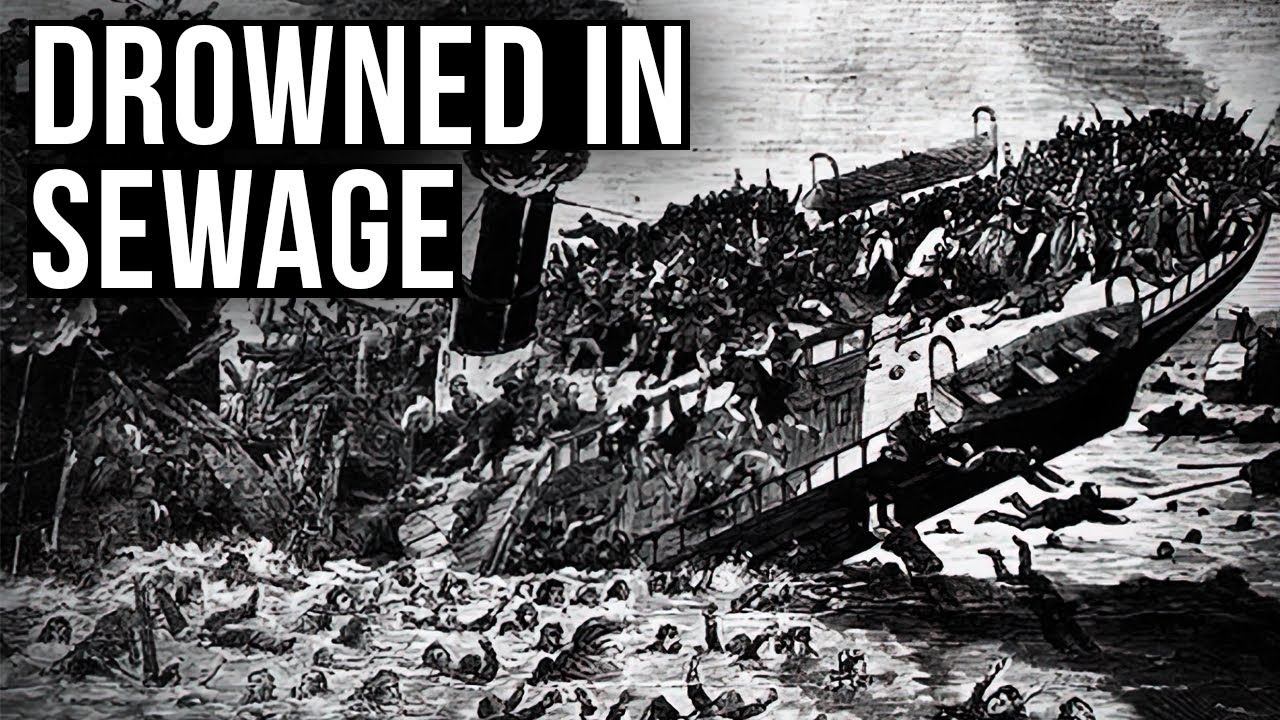
LONDON — The River Thames has claimed many lives over the centuries, but no single inland waterway disaster in British history has matched the sheer horror and scale of loss that unfolded on the evening of September 3, 1878, when the packed excursion paddle steamer SS Princess Alice was sliced in two by a collier and sank in minutes, drowning an estimated 600 to 700 passengers in water so polluted with raw sewage that survivors later described the scene as indescribable.
The catastrophe, which remains the deadliest inland boating disaster ever recorded in the United Kingdom, occurred on what had begun as one of the last glorious summer days of the season, when hundreds of Londoners flocked to Old Swan Pier near London Bridge to board the Princess Alice for a day cruise down the Thames to Sheerness and back.
 The vessel, a 67-meter paddle steamer launched in Scotland in 1865, had originally been licensed to carry fewer than 500 passengers. But in 1878, the Board of Trade upgraded her certificate to permit up to 936 passengers, a decision that would prove catastrophic. On that fateful morning, nearly a thousand day-trippers scrambled aboard, packing the small steamer so tightly that witnesses said passengers were squeezed together like sardines, and the vessel sat dangerously low in the water as she departed at approximately 11 a.
m.
Her captain was William Grinstead, a highly experienced sailor with more than two decades navigating the Thames. The journey south proceeded without incident, with stops at Blackwall, North Woolwich, and Rosherville Gardens in Gravesend, the premier destination on the route, where many passengers disembarked to enjoy the famed Pleasure Gardens. By approximately 6:30 p.
m. , the Princess Alice called back at Gravesend to collect those returning to London, and once again the vessel was filled to capacity. In a decision that would later be scrutinized during the inquest, Grinstead allowed his regular helmsman to remain ashore and replaced him with John Ayers, a seaman relatively unfamiliar with both the Princess Alice and the treacherous currents of the Thames.
As the steamer made her way back toward London, she navigated the twisting channel until reaching a notorious bend known as Gallion’s Reach, a section of the river where experienced sailors knew extreme caution was required, and where more than one serious collision had already occurred. At approximately 7:20 to 7:40 p. m.
, the Princess Alice rounded the corner and drifted into the middle of the river, directly into the path of the much larger collier Bywell Castle, a 78-meter cargo ship displacing 1,376 tons compared to the Princess Alice’s 432 tons.
The Bywell Castle’s captain, Thomas Harrison, was relatively unfamiliar with the Thames but had wisely employed an experienced river pilot named Christopher Dicks. As the two vessels approached one another on the blind bend, Dicks spotted the Princess Alice’s red port light and believed she would pass safely to starboard. Instead, the Princess Alice altered course, bringing her directly across the collier’s bow.
Captain Grinstead reportedly shouted across the water, “Where are you coming to? Oh, good God, where are you coming to?” But it was too late.
 Dicks ordered the engines into full reverse, but the momentum of the massive collier was unstoppable.
The sharp steel bow of the Bywell Castle struck the Princess Alice on her starboard side just forward of the paddle box, plunging through her interior all the way to the engine room and essentially slicing the vessel in two. Passengers who had been waving and cheering at the shadowy figures aboard the collier moments earlier suddenly found themselves fighting for their lives. Water poured into the two gaping sections of the hull.
The forward section sank almost immediately like a dead weight, while the aft section rose slowly until it stood nearly vertical before sliding beneath the waves.
The entire sinking took only four to five minutes. Survivors later described scenes of unimaginable terror. Two saloon decks below were packed with men, women, and children who had virtually no time to escape.
A stampede of hysterical passengers clawed toward the exits, but the sheer density of the crowd made movement nearly impossible. Many were crushed in doorways or trapped below decks. Divers later reported that numerous victims were found still upright, having died where they stood because the crush of bodies was so dense.
On deck, those not immediately thrown into the water were crammed together in a mass of humanity, many unable to reach the railings to jump overboard. One survivor recalled, “She backed out and let water in, and we were all gone in less than five minutes. Children were crying, women screaming for ropes or anything to get a hold of.”
Another described the shrieks as “something indescribable,” adding, “It was something terrible to see. Four or five hundred trying to get on one rope.”
 The water itself was lethal. Just days before the disaster, approximately 75 million gallons of raw sewage had been dumped into the Thames, a common practice at the time. Hundreds of passengers suddenly found themselves submerged in decomposing waste.
Most could not swim, and virtually all were dressed in heavy Victorian clothing, fine suits and voluminous dresses worn for the special occasion. The combination of polluted water, heavy garments, and panic meant that vast numbers sank almost immediately. The Princess Alice carried only a few lifeboats, and there was no time to launch them.
The crew of the Bywell Castle dropped ropes and launched their lifeboat, managing to rescue 14 people. Nearby boat crews rushed to assist, but the thick mass of clawing, screaming survivors made rescue extraordinarily difficult, as rescuers were as likely to push people under as they were to save them. Tragically, some of the Bywell Castle’s own rescue efforts contributed to further deaths.
When the collier began drifting downstream after stopping, crew members were ordered to lower the anchor, unaware that dozens of survivors had climbed onto the anchor chain. As the massive iron anchor plunged into the murky water, it dragged those clinging to it down into the depths.
Of the estimated 600 to 700 people aboard, only approximately 130 were rescued, and many of those died later from ingesting the polluted water. The body of Captain Grinstead was recovered in the days that followed. One man lost his father, mother, and fiancée.
Another woman lost her husband and seven children. A superintendent of the London Steamboat Company lost his wife and four children but continued working throughout the recovery efforts. Perhaps most heartbreaking was the sight of numerous tiny babies lying among the dead, unclaimed by any family.
In the days and weeks that followed, bodies washed ashore along the Thames from Limehouse to Erith. Makeshift mortuaries were established, with many victims laid out in Woolwich Dockyard, where relatives arrived to identify the dead in scenes of inconsolable grief. Divers sent to examine the two sections of the wreck found evidence of the horrifying final moments, with most men having tried to fight their way out while women and children were trampled in the stampede.
 Only two people who had been below deck survived.
The inquest that followed concluded that both vessels shared fault. The coroner and jury found that the Bywell Castle failed to take necessary precautions of easing, stopping, and reversing her engines in time, while the Princess Alice contributed to the collision by not stopping and going astern. The jury also concluded that the Princess Alice was seaworthy but not properly or sufficiently manned, that she carried far more passengers than was prudent, and that her life-saving equipment was insufficient for a vessel of her class.
A separate Board of Trade inquiry placed blame more heavily on the Princess Alice, finding she had breached navigation rules requiring vessels approaching head-on to pass on the port side.
The disaster prompted several safety reforms. During the 1880s, efforts began to purify sewage rather than dumping it directly into the Thames, and sludge boats were commissioned to carry waste to the North Sea, a practice that continued until 1998. The Marine Police Force, which had relied on rowboats, received two steam launches in the mid-1880s.
The Bywell Castle itself continued working until January 29, 1883, when she disappeared in the Bay of Biscay during a severe storm while sailing from Alexandria to Hull, lost with her crew of 40.
In 1880, a memorial to the victims was erected in Woolwich Old Cemetery, paid for by 23,000 public subscribers, a testament to the profound impact the disaster had on Victorian London. Behind the memorial, 120 unidentified victims are buried in rows. Captain Grinstead’s grave lies further down the hill, positioned almost as though looking up at the memorial to those who perished under his command.
The Princess Alice disaster remains a haunting reminder of the perils of overcrowded vessels, inadequate safety regulations, and the catastrophic consequences of environmental negligence. More than 140 years later, it stands as the worst inland waterway tragedy in British history, a day that began in sunshine and ended in one of the darkest chapters the River Thames has ever known.