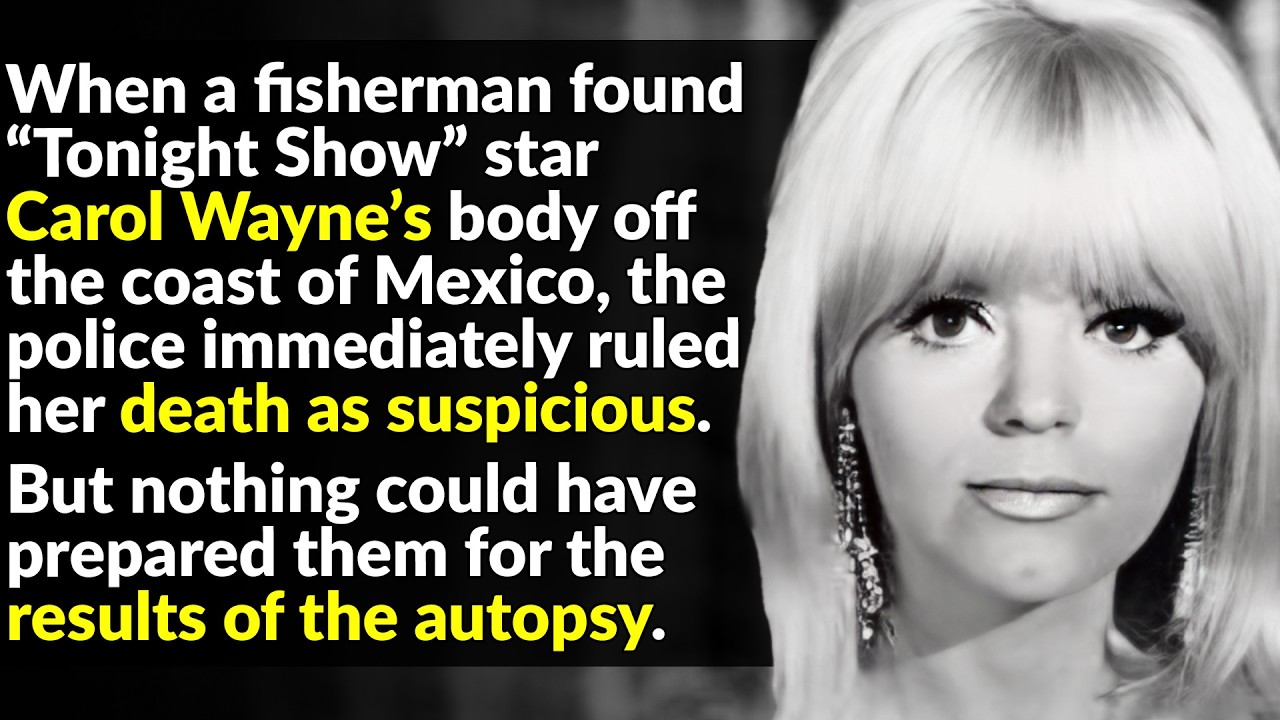
The fisherman casting his net off the coast of Manzanillo, Mexico, on January 13, 1985, had no idea he was about to haul in a mystery that would haunt Hollywood for decades. The body he pulled from the shallow, tranquil bay was that of Carol Wayne, the beloved Matinee Lady from Johnny Carson’s Tonight Show, a comedienne whose bright smile and breathless double entendres had charmed millions. But as the sun beat down on that quiet beach, the glimmer of her television persona began to fade, replaced by the grim shadow of a life that was far darker and more complex than anyone had ever imagined. Mexican police immediately declared the death suspicious. The circumstances were baffling. Wayne, 42, had been vacationing at the luxurious Las Hadas resort with a man named Edward Durston, a car salesman with a murky reputation in Hollywood circles. The trip was reportedly meant to be a chance for Wayne to dry out from a growing dependency on cocaine, a habit that had quietly eaten away at her finances and career. But witnesses at the resort told a different story, describing the pair dancing and drinking, not cleansing. The trouble began on January 10, when Wayne and Durston missed their flight back to Los Angeles. Low on funds, they could not return to the expensive Las Hadas. The staff at the resort, trying to help, secured them a room at the more modest Playa de Santiago Hotel. When they arrived at 8:30 p. m. , Wayne was livid, according to eyewitnesses. She refused to get out of the taxi, unleashing a torrent of anger at what she considered a dump. While Durston and a bellboy brought luggage to the room, Wayne stood alone outside, fuming. When Durston returned to the hotel lobby, Wayne had vanished. Instead of searching for her, he posted up at the bar, waiting. As the night wore on, she did not return. What he did next borders on incomprehensible. Durston checked into a different hotel, making it impossible for Wayne to find him if she tried. The following morning, he flew back to Los Angeles, alone, taking her luggage with him. He told the airline she would pick it up later. He filed no missing person report. He made no frantic calls. For three agonizing days, Carol Wayne was missing. Then came the discovery. Her body was floating face-up in a shallow bay, fully clothed. The autopsy would reveal that she had been dead for 36 to 48 hours, meaning her end came shortly after the fight with Durston. The results held a stunning surprise. Her blood showed zero alcohol and no traces of drugs. Despite her well-known struggles, she was clean at the moment of her death. There were no bruises, no cuts, no signs of a violent struggle. The waters where she was found were gentle and shallow, barely deep enough to drown in. District Attorney Jorge Hernandez was deeply skeptical. He could not accept that Wayne, a strong swimmer who had once been a professional skater, simply stumbled and drowned in what amounted to a bathtub. The investigation turned toward Durston, and his past emerged like a ghost from the shadows. In 1969, Durston had been involved in another suspicious death. Aspiring actress Diane Linkletter had called him to her apartment before apparently jumping out of a window. Her death was also ruled an accident, and Durston was never charged. The parallels were chilling, but Hernandez lacked the evidence to move forward. The mystery of Carol Wayne’s death has never been fully resolved. The official ruling remains accidental drowning, with the theory that she slipped and fell while walking, distracted and upset, along the beach. But the irony is almost too cruel to bear. On the Tonight Show, Johnny Carson had often joked about her hourglass figure, saying, With that chest, this lady will never drown. In one heartbreaking exchange, Carson, then 47, told Wayne, Someday you’ll be 47. She replied, I hope so. She was only 42 when she died. To understand the darkness of her end, one must first understand the brutality of her rise. Carol Wayne was born in Chicago in 1942. At just 15 years old, she and her sister Nina were already on a 42-city tour with the Ice Capades, their childhood sacrificed to the demands of show business. They dropped out of high school. They missed proms, dates, and the normalcy of growing up. Then an accident struck. A fall on the ice left a five-inch scar running down her knee, ending her skating career for good. She was left with nothing but a broken dream and no diploma to fall back on. Desperate for a future, the sisters found work as showgirls at the Tropicana in Las Vegas. Their mother was appalled, once looking at their barely-there outfits and pleading, Could you ask them for a couple more feathers? It was in Vegas that a man approached Carol at a party and said, We’re looking for a girl just like you. She nailed her screen test and landed a role. She would later joke, glancing down at her figure, And I’ve gotten all my parts ever since then. That self-deprecating humor masked a painful truth about how Hollywood valued her. In 1965, she married Lorettto Larry Serra, but the marriage was a disaster. They divorced just one month after their second anniversary. Wayne joked about it, saying skating taught me to be limber, but that marriage really taught me how to be flexible. The humor was a shield. Her star was rising, and she landed guest spots on shows like The Man from U. N. C. L. E. and I Dream of Jeannie, playing characters with sultry names like Ginger LeVier and Bootsy Nightingale. Then came the biggest break of her life. In 1967, the same year she divorced Serra, Johnny Carson hired her for the Tonight Show. She became a regular in the Art Fern’s Tea Time sketches, playing the Matinee Lady, an innocent bombshell who stumbled over double entendres with perfect comedic timing. It was a role that made her famous, but it also trapped her. The chemistry between Wayne and Carson was undeniable, and rumors of a backstage romance swirled. Wayne did nothing to quell them. She once said, He loves me. I love him. It’s an understanding, a given. He still sees me every day in his dreams. Carson never publicly acknowledged such feelings. After her divorce, she married rock photographer Barry Feinstein in 1969. Feinstein was cool, connected to Bob Dylan and Steve McQueen. His first wife had been Mary Travers of Peter, Paul and Mary. Wayne reportedly referred to her predecessor’s band as Peter, Paul and Scary. They had a son, Alex, in 1970, but the marriage lasted only five years. After that divorce, she quickly married television producer Burt Sugarman in 1975. He worked on shows like Celebrity Sweepstakes, giving her steady work as a panelist. But she wanted more, serious acting roles that would finally let her be seen as more than a joke. In the early 1980s, Johnny Carson threatened to leave the Tonight Show. NBC convinced him to stay, but the show was cut to one hour. The Matinee Lady sketch was cut with it. In 1980, her marriage to Sugarman ended. Suddenly, the work dried up. She had been working steadily for over a decade, but now no one would hire her. The few roles she landed were sparse and forgettable. By 1984, she was in desperate financial straits. She posed for Playboy in a conservative but controversial shoot to make ends meet. That same year, she filed for bankruptcy. Her petition to the courts revealed a staggering truth. She had zero income. Her son, Alex, now in high school, reportedly introduced her to clove cigarettes. She took to them with a vengeance, smoking them so heavily that the distinctive scent got her kicked out of Hollywood restaurants. Soon, she moved on to cocaine. Her addiction grew, consuming her money and her health. To her credit, she made one last attempt at a real acting career. She landed a role in the 1984 film Heartbreakers, a dramatic piece that was far more serious than her usual fare. Critics took notice. Roger Ebert singled out her performance, saying it was so good, so heartbreaking, that it pulled the whole movie together. It was her final film. In January 1985, she went to Manzanillo, reportedly to dry out. She went with Edward Durston, who was supposed to help her. Instead, they missed their flight, ran out of money, and ended up fighting at a hotel she hated. Then she went missing. Durston did nothing. He flew home with her luggage. Her body was found three days later. The autopsy found no drugs or alcohol in her system. She had been clean, perhaps for the first time in years, at the moment of her death. That did not save her. The investigation into Durston’s past revealed the death of Diane Linkletter in 1969. She had also been with him before she died. He was never charged. The parallels were too close for comfort, but without evidence, the case was closed. The ruling was accidental drowning, a slip on a dark beach. Those who loved Wayne, including Johnny Carson, were devastated. Carson took the Art Fern sketch off the show for most of a year out of respect. The Matinee Lady was gone. Carol Wayne’s story is one of tragedy, but it is also a story of systematic exploitation. From the moment she dropped out of school to skate, she was treated as a commodity. Her body was her currency, and Hollywood spent it until there was nothing left. She was the naive bombshell on screen, but off screen, she was a single mother, a bankrupt addict, a woman who had been told her entire life that her only value was in how she looked. When that value faded, so did the industry’s interest in her. The rumor of a romance with Carson, whether true or not, underscores a painful dynamic. Wayne was a regular on his show for years. They had undeniable chemistry. But he was the king of late night, and she was a bit player. If there was a relationship, it existed in a power imbalance that could never be equal. Wayne’s comments about Carson seeing her in his dreams suggest a woman who was deeply attached to a man who was never fully available to her. It is a lonely picture. Her marriages were equally fraught. She married men who were either emotionally absent or who used her connections for their own gain. Feinstein was a rock photographer with a notorious past. Sugarman was a producer who cast her in roles but could not help her break into serious acting. She was always the supporting character in her own life, a pattern that began in childhood and never broke. … Read more