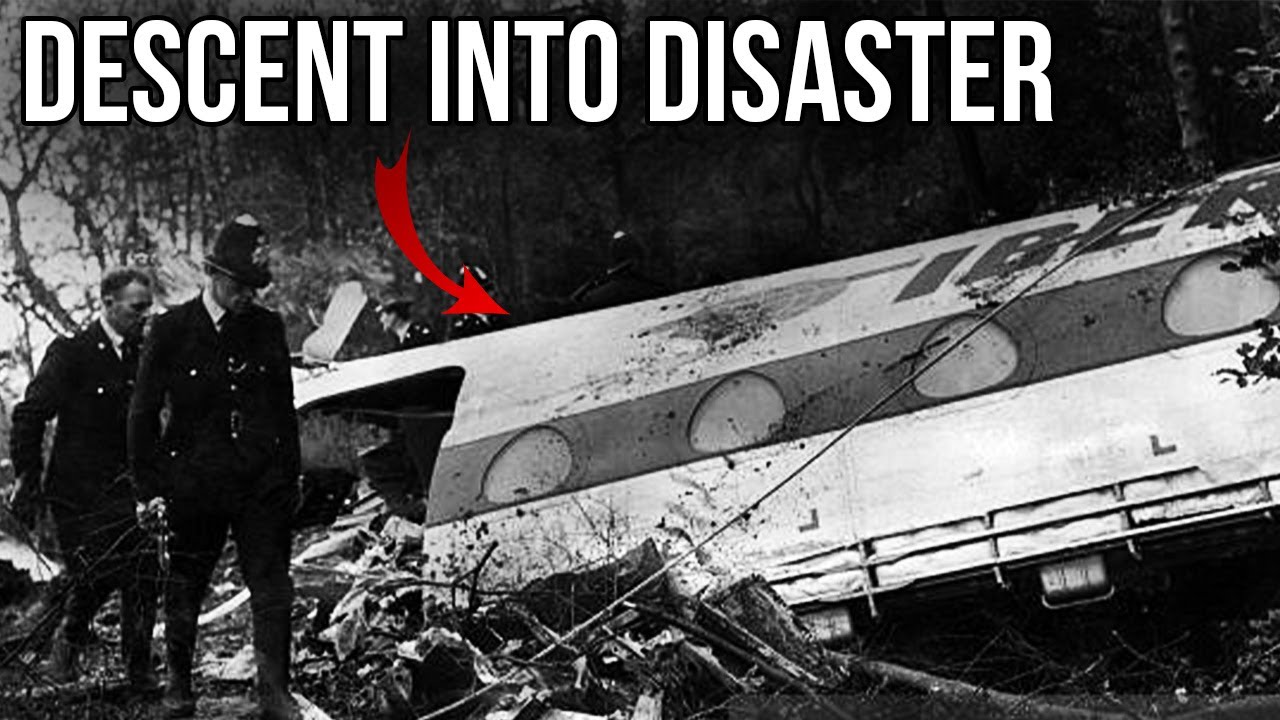
One of Britain’s most baffling aviation mysteries unfolded over the quiet West Sussex countryside on the night of November 4, 1967, when Iberia Flight 062 descended smoothly and without apparent distress straight into Black Down Hill, killing all 37 people aboard and leaving investigators with a question they could never fully answer. The aircraft, a Sud Aviation Caravelle SE210 that had been in service barely eighteen months, was operating a routine evening service from Malaga to London Heathrow with 30 passengers and seven Spanish crew on board. Among the passengers were British film and television actress June Thorburn, who was five months pregnant, Coventry City Football Club vice president John Clarkson, and Donald Campbell of the Campbell Aircraft Company. The flight had proceeded without incident for most of its journey. After departing Malaga at 7:40 p. m. , the Caravelle climbed to its cruising altitude of approximately 30,000 feet and cruised north for roughly an hour and forty minutes. At 9:42 p. m. , while passing over Alden, the crew contacted London Airways to report they were at flight level 310, beginning what should have been a completely standard descent into Heathrow. Air traffic control cleared the aircraft to descend in stages, first to 21,000 feet, then to 11,000 feet, and finally to 6,000 feet. Each descent was clearly transmitted, correctly acknowledged, and properly read back by the crew. Cockpit voice recordings recovered from the wreckage revealed no confusion, no language difficulties, no urgency, and no stress. Everything appeared entirely routine. At 9:53 p. m. , the aircraft reported descending through 14,500 feet, confirming the crew were aware they were passing below 15,000 feet. The final instruction from London came at 9:56 p. m. , directing the aircraft to proceed direct to Epsom on a magnetic track of 050 degrees. The reply came instantly: “Roger. Direct to Epsom heading 050.” Radar showed the aircraft turning smoothly onto its new heading. Nothing appeared out of the ordinary. But what air traffic controllers did not realize was that the Caravelle had already passed through its cleared altitude of 6,000 feet and had failed to level off. Instead, it continued descending at a steady rate of approximately 2,200 feet per minute. Just one minute and forty-seven seconds after passing through 6,000 feet, the aircraft’s altitude had dropped to about 1,000 feet above sea level. At approximately 9:58 p. m. , as the Caravelle descended to around 596 feet, it struck the tops of tall trees on the southern slope of Black Down Hill. The aircraft continued cutting through trees for more than 100 meters as parts of the structure, including the wings, were torn away. It destroyed a garage and narrowly missed a nearby house, causing serious damage but leaving the occupants unharmed. Approximately 400 meters after the initial impact, the fuselage finally came to rest, embedding itself in the hillside just beyond Upper Blackdown House. The first person on the scene was Police Constable William Cooper, the local officer for Haslemere, who was off duty and relaxing at home when his telephone rang shortly after 10:00 p. m. Control room staff informed him that a loud bang had been reported south of Haslemere, and with all other units busy dealing with Bonfire Night incidents, they asked if he could investigate. PC Cooper, known as Bill, had been the local constable since 1964, covering a large rural area on his lightweight police motorcycle. As he made his way to the top of Black Down Hill near Fernhurst, the weather was cold with mist hanging in the air. He noticed a faint glow of what appeared to be fire in the distance and parked his motorcycle to investigate on foot. It was at this point that the battery in his torch failed, leaving him in near-total darkness. With no radio, he could not call for backup. He began walking toward the glow, and as he crossed a field, his leg struck something on the ground, causing him to trip. Feeling around, he realized it was a sheep, and it was very dead. Continuing forward, he stumbled into something else. When he backed up to see what he had walked into, he realized it was a huge wheel. A strong smell, which he described as resembling paraffin, filled the air. Pausing beneath a tree to work out where he had left his motorcycle, he felt something dripping on him. Initially assuming it was rainwater, he looked up and discovered the horrifying truth. What was falling on him was not rain. It was bodily fluids from the victims of the crash. There were bodies in the trees. The accounts from other first responders painted an equally harrowing picture. PC Steve Gilbert and his colleague Doug Brazier were among the first to arrive. The nose of the aircraft was still intact, buried in soft earth. PC Gilbert climbed inside, calling out, but was met with dead silence. He saw the bodies of the flight crew still strapped in their seats. The main fuselage aft of the flight deck was completely broken up, with naked body parts, shoes, and clothing scattered everywhere. Some body parts were impaled on trees. PC Gilbert described it as a sight he would never forget. … Read more