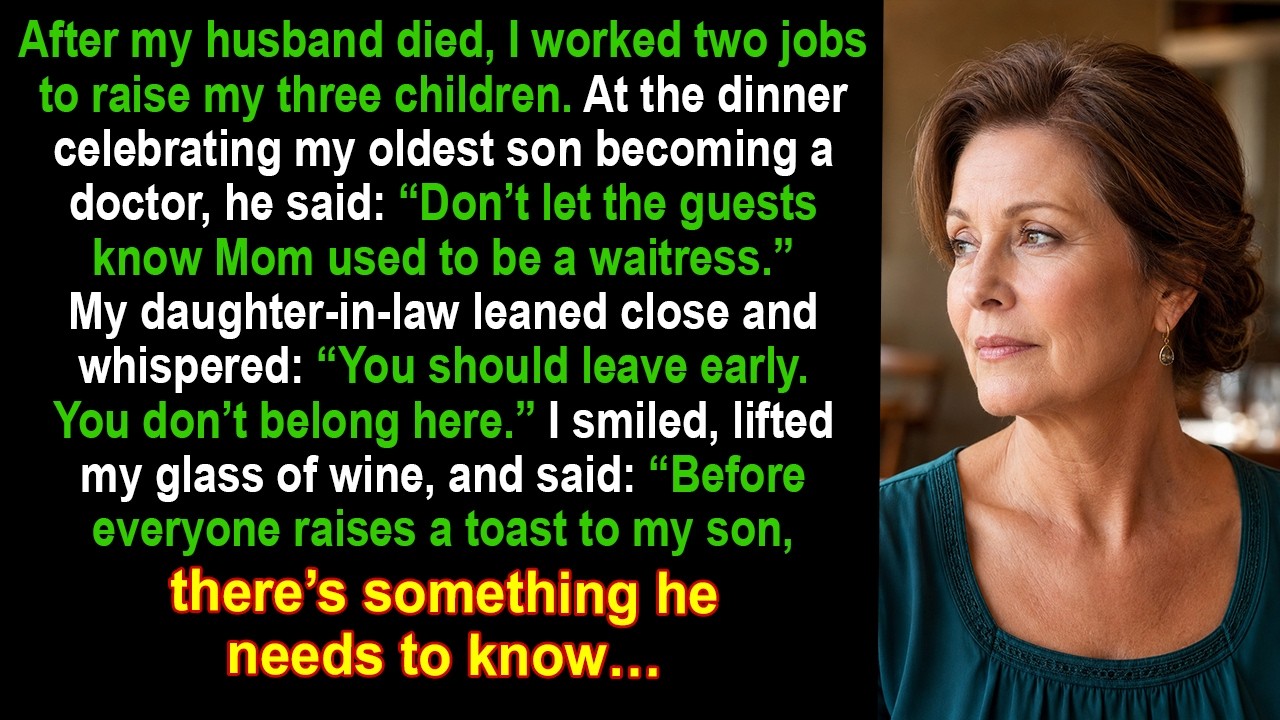
I lifted my glass before anyone else could stand. “Before everyone raises a toast to my son,” I said, “I think there is something he needs to hear. ”
The room went quiet so suddenly that I could hear the soft hum of the air conditioner. My oldest son, Daniel, stood at the far end of the long table, one hand resting beside his untouched wine glass.
He had been smiling a moment earlier, accepting congratulations from the physicians seated around him. Now the color slowly left his face. “Mom,” he said under his breath, “please don’t. ”
Across from me, his wife, Claire, lowered her eyes.
She knew exactly why I had come. Daniel was thirty-five years old that night, newly appointed as an attending physician after finishing a long oncology fellowship. I had never been more proud of him, and I had never felt smaller. The dinner was held in a private room at a downtown Columbus restaurant, with polished wood walls, white tablecloths, and little candles in glass holders.
His department chair, Dr. Samuel Reed, had arranged it to welcome him into the hospital’s oncology team. There were senior doctors, nurses, administrators, and several spouses seated around the table. I had spent an hour getting ready in the navy dress I saved for weddings, funerals, and important church dinners.
It was not expensive, but it fit me well enough. Amy, my daughter, had helped me choose it over the phone. “You’re going to look lovely, Mom,” she had said. Still, when I walked into that restaurant, I knew I did not look like the other women there.
Their dresses were silk, their jewelry quiet but costly. Their hands had never smelled like coffee grounds after a double shift. Mine had, for most of my life. Daniel greeted me near the entrance with a quick hug.
It lasted barely a second. Then two of his colleagues came over to introduce themselves. One of them, a young doctor with a friendly smile, asked me what I had done before retiring. Daniel answered before I could.
“Mom, just don’t let everyone know you used to be a waitress. ”
He smiled when he said it, as if it were a harmless joke. But I heard the warning underneath it. Don’t embarrass me.
Don’t remind these people where I came from. Don’t make them wonder whether I belong here. Before I could decide what to say, Claire stepped close enough that no one else could hear her. “You should leave early,” she whispered.
“You don’t really fit in with this crowd. ”
For a second, my fingers tightened around my purse so hard the leather creased beneath my hand. I wanted to ask her what she thought had paid for the first anatomy books Daniel brought home. I wanted to ask whether she knew how many nights I had come home at two in the morning aching from cleaning offices, only to wake up four hours later and serve pancakes at Millie’s Family Restaurant.
But I said nothing. Claire led me to my seat. It was at the far end of the table, near the exit. Close enough to be included in the photographs, perhaps.
Far enough that I could leave quietly when she decided I had stayed too long. I sat down and smoothed my napkin over my lap. Twenty-five years earlier, after my husband Tom died, I had learned that grief did not stop the mortgage from coming. It did not fill the refrigerator or buy winter coats for Daniel, Amy, and Mark.
Daniel had been ten years old then. Amy was eight. Mark was only five. I worked because there was no other choice.
At first I waited tables during the day and cleaned offices at night. Later, when my knees began bothering me, I picked up whatever shifts I could. I missed school events. I fell asleep sitting upright in church.
I learned to make one chicken last for three dinners. And through all of it, I told myself that if my children had a chance at a different life, it would be enough. Daniel had gotten that chance. But somewhere along the road from our small house on the east side of Columbus to the hospital where he now worked, he had started treating the woman who raised him like a detail that needed to be edited out.
What Daniel did not know was that I had not come to dinner hoping he would suddenly be proud of me. I had come prepared. Three weeks earlier, when Daniel told me Dr. Samuel Reed would be hosting the celebration, I had called his office.
I had asked for only ten minutes of his time. When he heard my name, he had gone quiet. Then he said, “Mrs. Harper, I’ve been hoping to meet you again.
”
I had told him I did not want to humiliate my son. I only wanted Daniel to hear the truth from someone whose respect he could not dismiss. Now, Dr. Reed was watching me from across the table.
Daniel’s face had gone tense. Claire’s hand had frozen around her glass. I drew in one slow breath. Then I looked at my son and began.
I did not tell them about Evelyn Reed that night. Not yet. Before I could say another word, I looked down at the white tablecloth, at the water glass trembling slightly beside my hand, and I remembered the years Daniel seemed so determined to forget. My husband, Tom, died on a Tuesday in November.
He was forty-four years old. He had gone to work that morning complaining about indigestion and never came home. By midnight, I had become a widow with three children and a stack of bills I did not know how to pay. Daniel was ten.
Amy was eight. Mark was five. For the first few weeks, people brought casseroles and spoke softly in my kitchen. They told me to call if I needed anything.
I appreciated every kind word, but grief has a way of becoming very practical once everyone goes back to their own lives. The mortgage was still due. The lights still had to stay on. Children still woke up hungry.
Tom had life insurance, but not much. It paid for his funeral, caught up a few overdue bills, and gave me just enough room to breathe for a little while. Then it was gone. I had waitressed before I married him, at Millie’s Family Restaurant on the east side of Columbus.
It was not glamorous work, but Millie remembered me. She gave me the breakfast shift three days after I came in asking whether she needed help. “I can start Monday,” I told her. She looked at me for a long moment.
“Linda, are you sure? ”
No, I was not sure. I was exhausted before I ever walked through the door. But I nodded anyway.
“I have three children,” I said. “So I have to be. ”
I worked mornings at the restaurant, refilling coffee, serving scrambled eggs, burgers, and pie slices wrapped in plastic. At night, after I got the children settled with our neighbor, Mrs.
Alvarez, I cleaned offices downtown. I emptied trash cans, wiped fingerprints off conference room tables, and vacuumed carpets while men in expensive suits worked late behind glass walls. Some nights I would pass a framed photograph of a family on someone’s desk and have to turn my face away. I missed things I still remember too clearly.
Amy’s second-grade play, because a server called in sick. Mark’s first Little League game, because I could not afford to lose an evening shift. Daniel’s school science fair, because I fell asleep sitting in the parking lot before I could walk inside. Daniel did not complain much then.
That almost made it worse. He would come home, set his backpack down, and ask, “Did you eat today, Mom? ”
Sometimes I lied and said yes. He was always a serious boy.
The other children played outside until the streetlights came on, but Daniel liked books. He borrowed old medical encyclopedias from the library. When he was fourteen, he told me he wanted to become a doctor. “I want to help people the way they couldn’t help Dad,” he said.
I remember holding his face in both my hands and telling him he could become anything he wanted. At the time, I meant it with all my heart. Years later, when he was accepted into college, I cried in the parking lot after dropping him at the dorm. I was proud, but I was afraid, too.
His world was already becoming larger than mine. He had classmates whose parents were lawyers, professors, and doctors. They went on ski trips during winter break. They did not count quarters at the grocery store or wear shoes until the soles gave out.
At first, Daniel still called every Sunday. Then the calls became shorter. “I’m busy, Mom. I have to study.
”
When he came home, he started noticing things that had always been there. The worn couch. The chipped kitchen tile. The smell of fryer oil that clung to my coat, no matter how carefully I washed it.
He never said he was ashamed, not directly, but he stopped inviting friends over. At his college graduation, one of his professors shook my hand and asked what I did. Daniel smiled too quickly. “This is my mom,” he said, steering the conversation toward his research program.
Just my mom. I told myself I understood. Young people want to belong. They want to feel they have earned the life they are building.
But every time Daniel left something unsaid about me, a little more distance opened between us. And still I kept telling myself the same thing. He would grow up. He would remember.
He would understand what it cost to keep a family standing after everything had fallen apart. Back in that private dining room, I looked at Daniel in his tailored suit, surrounded by doctors who admired him. Then I looked at my own hands resting in my lap. Those hands had served strangers their meals.
Those hands had scrubbed office floors. Those hands had held three frightened children together. And Daniel had just asked me to pretend they had never done any of it. Evelyn Reed started coming into Millie’s every Thursday afternoon, always at 2:15.
She sat in the same booth by the front window, ordered half a turkey sandwich on wheat, a cup of coffee, and apple pie if she was having a good day. She was in her late seventies when I first met her, with silver hair pinned neatly at the back of her head and a way of speaking that made you feel she had already thought carefully about every word. The first time I waited on her, she looked at my name tag and said, “Linda. ” Then she smiled.
After that, she always asked for me. At first, I thought she simply liked routine. Plenty of older customers did. But I slowly learned that Evelyn came to Millie’s because her house had grown too quiet after her husband died.
Her husband, Arthur, had been a family doctor for nearly forty years. She spoke about him with affection, but never in a way that made him sound larger than life. “He believed the best part of medicine was listening,” she once told me. “He said people will tell you what hurts if you stop rushing them.
”
Her son, Samuel, had followed him into medicine. Evelyn was proud of him, too. She kept a photo of him in his white coat tucked inside her wallet, along with pictures of his two daughters. “Sam works at St.
Gabriel’s now,” she said one afternoon. “Department chair. Important title. ” Then she gave a small shrug.
“Still my boy, though. ”
I knew that feeling. By then, Daniel was in his third year of medical school. He was studying harder than I had ever seen anyone study, sleeping little, and carrying debt that frightened me even when I tried not to show it.
He had scholarships and loans, but every few months there seemed to be another fee, another expense, another emergency that threatened to push him under. I picked up extra shifts whenever I could. Evelyn never knew the full truth of my life. I did not sit down beside her booth and unload my worries, but she noticed things.
Older women often do. One Thursday, she looked at the bruised shadows under my eyes and said, “You’re working too much. ”
“I’m fine,” I told her. “That usually means no.
”
I laughed softly, but my throat tightened. Over the next few years, Evelyn and I developed a quiet friendship. Sometimes I would bring her an extra roll before her meal came out. Sometimes she would tell me stories about Arthur’s first clinic, when patients paid him with eggs, vegetables, or whatever they had.
She never spoke as if people with less money were less worthy. That was what I loved about her. Then little changes began to worry me. She would forget whether she had ordered coffee.
Once she tried to pay twice. Another afternoon, she called me by her sister’s name and looked embarrassed when I gently corrected her. The moment I truly became afraid was when I found a prescription bottle in her purse beside her wallet. She had taken the wrong day’s pills and was pale, confused, and unsteady on her feet.
I called 911. Then I called the number she kept listed as Sam. Dr. Reed arrived at the hospital later that evening.
He looked exhausted and shaken, not arrogant or distant. He thanked me more times than I could count. “I should have seen it sooner,” he said. “You’re her son,” I told him.
“Not a mind reader. ”
After that day, he arranged more support for Evelyn: home health visits, medication organizers, someone checking in regularly. Evelyn moved into assisted living not long afterward. I visited twice, bringing her pie from Millie’s when I could.
She died the following spring. A few weeks later, I received a letter from an attorney named Richard Coyle. I thought it might be some mistake. Then I opened it at my kitchen table and read that Evelyn had left me a modest bequest in her will.
Not a fortune, not enough to change my life, but enough to change Daniel’s. Dr. Reed had known about it. He told Mr.
Coyle that he supported his mother’s decision because he understood why she had made it. Evelyn had left the gift to me because, in her words, I had made her feel seen when loneliness had begun to erase her. I sat at that kitchen table for a long time crying quietly. Then I used almost all of it to pay down the highest-interest part of Daniel’s student loans.
He thought the relief came from a revised aid package and a little luck. I let him think that. I wanted him to believe he had earned his future through his own work. He had.
But he had not earned it alone. And as I sat across from him at that dinner, I realized that was the truth he needed to hear most. I lifted my glass again. “Daniel,” I said, “there is something you need to know about the woman you asked me not to mention.
”
His jaw tightened. “Mom, please. Not here. ”
Claire reached for my arm, her voice low and urgent.
“Linda, this is Daniel’s professional dinner. You’ve made your point. ”
I looked at her hand on my sleeve until she pulled it away. “No,” I said quietly.
“I haven’t. ”
For a moment, no one moved. Forks rested beside half-finished plates. The candlelight flickered across the faces around the table.
People Daniel had worked beside. People whose approval he had spent years trying to earn. I was not there to take that approval from him. But I would not let him build his new life on the idea that I was something to hide.
I turned toward Dr. Samuel Reed. “Your mother came into Millie’s every Thursday,” I said. “She always sat by the window.
Turkey sandwich, coffee, and apple pie when she was feeling especially cheerful. ”
Dr. Reed’s expression softened at once. “She did love that pie,” he said.
A small, uneasy laugh moved through the room, then faded. I told them about Evelyn. Not every detail, only what mattered. I spoke about the day she became confused at the restaurant, about finding the wrong pills in her purse, about calling for help, then calling the number marked Sam.
“She was scared,” I said. “And she was trying very hard not to let anyone see it. ”
Dr. Reed lowered his eyes.
“I remember that night,” he said. His voice was steady, but quieter now. “I arrived at the emergency room, and my mother kept asking if Linda was still there. ”
He looked across the table at me.
“You stayed until I got there. ”
“I wasn’t going to leave her alone,” I said. “That was the kind of person you were with her,” he said. “You made her feel safe.
”
Daniel shifted beside his chair. He looked from Dr. Reed to me, then back again, as though he were trying to understand how two parts of his life had become connected without his knowing. Dr.
Reed rested both hands on the back of his chair. “My mother spoke about Linda often after that,” he continued. “Not as someone who served her lunch. As a friend.
As the person who noticed when she was struggling before the rest of us understood how serious it had become. ”
The word “friend” hung in the room. Claire’s eyes dropped to the tablecloth. Then Dr.
Reed said, “When my mother passed away, she left Linda a gift in her will. ”
Daniel stared at him. “What gift? ”
I felt my throat tighten.
I had rehearsed this moment in my mind so many times, but rehearsal does not make the truth painless. “A modest bequest,” Dr. Reed said. “My mother had it arranged through her attorney, Richard Coyle.
She was very clear about why she wanted Linda to receive it. ”
He paused, then looked directly at Daniel. “Linda used most of it to reduce the highest-interest portion of your medical school loans. ”
Daniel did not speak.
The young doctor who had asked about my former work looked down at his plate. One of the nurses near the middle of the table pressed her lips together, as if she understood exactly how much pride it must have cost me to keep that secret. Daniel’s face had gone pale. “I thought…” He stopped and swallowed.
“I thought my financial aid office adjusted something. ”
“They did help,” I said. “And you worked hard. You earned your degree.
”
“Then why didn’t you tell me? ”
His question was not angry. That made it worse. I held his eyes.
“Because you were already carrying enough,” I said. “You were exhausted. You were worried about money all the time. I wanted you to believe your future was yours, not something you owed to your mother or to a stranger’s kindness.
”
Daniel looked down at his wine glass. For years I had told myself I had protected him by staying quiet. But sitting there, I understood that silence could protect a person only up to a point. After that, it could become permission for them to forget.
Dr. Reed spoke again, not sharply, but with the calm authority of a man who had spent a lifetime telling families difficult truths. “My mother respected hard work,” he said. “She respected people who showed up for others when there was no audience.
She would have been honored to know that her gift helped Daniel become a physician. ”
Then his gaze stayed on my son. “But she would have been saddened to know that Linda was made to feel that her work was beneath mention. ”
No one applauded.
Thank God no one applauded. That would have turned my pain into a performance, and that was never what I wanted. Instead, the room fell still in a way that felt more honest. Not cruel.
Not triumphant. Just impossible to escape. Daniel looked at me. Not at my dress.
Not at my hands. Not at the woman he had tried to place near the exit. He looked at me as if he were seeing me for the first time. And I knew the hardest part of the evening had only begun.
I set my glass down before my hand could begin to shake. For a few seconds, Daniel did not move. He stood beside his chair with his shoulders stiff, staring at the table as if he could somehow find the right words written there. Then he looked up.
“I didn’t know,” he said. His voice was quiet. Not defensive. Not yet.
“I know,” I answered. Claire finally spoke. “Daniel never meant…”
He lifted a hand without looking at her. “No, Claire.
”
That surprised me. All evening he had let her speak for him. He had let her decide where I sat, how long I should stay, what parts of my life were acceptable in front of his colleagues. But now, with Dr.
Reed standing only a few feet away and the truth spread across the room, Daniel seemed unable to hide behind anyone. “I said it,” he continued. “I told her not to tell people she was a waitress. ”
“Yes,” I said.
His face tightened. “I was nervous,” he said. “I wanted tonight to go well. I wanted people to see me as someone who belonged here.
”
I looked at him for a long moment. “Daniel,” I said gently, “do you hear yourself? ”
He swallowed. “You were afraid that people would think less of you because your mother worked hard to raise you.
”
He did not answer. And that silence told me more than an argument ever could. I had spent most of my life making excuses for him. He was young.
He was under pressure. Medical school was hard. The hospital was competitive. He was tired.
He did not mean it that way. But a person can only hide behind pressure for so long. Eventually, the choices they make begin to belong to them. I turned toward the room one last time.
“I am proud of my son,” I said. “I have always been proud of him. He studied when other children were sleeping. He worked for every exam, every residency position, every step that brought him here.
”
Daniel’s eyes filled, though he quickly looked away. “But I did not raise him to believe that a person’s worth comes from the job printed on a name badge. I only hope that the doctor he becomes will never make another person feel small for surviving the way they had to. ”
No one said a word.
Then Dr. Reed nodded once, slowly. “That is a lesson medicine needs,” he said. The dinner did not end dramatically.
There were no raised voices. No one chased me from the room. If anything, the quiet afterward was harder to bear. People began making polite excuses.
A nurse I met squeezed my hand before leaving. “My mother cleaned houses,” she whispered. “She would have understood every word you said. ”
I thanked her, but I could barely speak.
Claire left first. She did not say goodbye to me. She took her coat from the back of her chair and walked out with her head down, leaving Daniel behind. Dr.
Reed waited until most of the guests were gone before speaking to him. “Daniel,” he said, “I think we should postpone our mentorship meeting next week. ”
Daniel looked up quickly. “Dr.
Reed, I’m sorry if tonight…”
“This is not about punishing you,” Dr. Reed said. “You are a capable physician. You have earned your position here.
But leadership requires more than competence. ”
Daniel’s face flushed. Dr. Reed continued.
“Before you pursue any additional responsibility in this department, I think you need time to consider what respect looks like when there is nothing to gain from giving it. ”
Then he nodded to me and left us alone. Outside, the night air was cold enough to make my eyes water. I stood beneath the restaurant awning, waiting for Amy to pick me up.
I had not felt strong. I had felt old, tired, and ashamed that my son had made such a moment necessary. Daniel came through the door a few minutes later. “Mom.
”
I did not turn around immediately. When I finally faced him, he looked less like the polished doctor from the dinner and more like the boy who used to sit at our kitchen table, frightened that he would not be good enough. “I’m sorry,” he said. “I believe you are,” I told him.
His expression lifted for half a second. “But being sorry is not the same as understanding. ”
That hope disappeared. “You protected your image tonight,” I said.
“And you left your mother standing outside of it. ”
He looked down at the sidewalk. “I don’t know how to fix this. ”
“You don’t fix it tonight,” I said.
“You live differently tomorrow. ”
Amy’s car pulled up to the curb. Before I got in, I looked back at Daniel one last time. “For now,” I said, “I need some distance.
”
Then I closed the door and let my daughter drive me home. It was Sunday afternoon. Amy and Mark were already there, helping me set the table for dinner the way we had done for years. Mark was slicing bread at the counter.
Amy was stirring the green beans, though she kept glancing toward the front window every time a car passed. When Daniel’s sedan pulled into the driveway, nobody said much. I opened the door before he could knock twice. He looked tired.
Not the tiredness of a doctor coming off a long shift, with a wrinkled shirt and a distracted expression. This was different. His face was pale, his eyes shadowed, and he held a small bakery box in both hands. “I brought dessert,” he said.
I looked at the box, then at him. “You didn’t have to. ”
“I know. ”
That was the first honest thing he had said to me in a long time.
I stepped aside. “Come in. ”
He entered slowly, as if he were not sure he still belonged there. The house had not changed much since he was a boy.
The same framed school pictures were still in the hallway. The same clock still ticked too loudly above the kitchen doorway. I had replaced the couch and painted the walls, but it was still the home he had spent years avoiding. Amy stood near the stove with her arms crossed.
“Hi, Daniel,” she said. Mark gave him a short nod. “You finally remembered where Mom lives. ”
“Mark,” I said quietly.
“No,” Mark replied, though his voice was not loud. “He needs to hear it. ”
Daniel set the bakery box on the table. “I do,” he said.
We sat down before dinner. No one touched the food. For a while, Daniel stared at his hands. Then he said, “I’ve been thinking about what Mom said.
About the loans. About Mrs. Reed. About all of it.
”
Amy’s face softened a little, but only a little. “I didn’t know about the money,” Daniel continued. “But that doesn’t excuse what I said at dinner. I made Mom feel like her work was embarrassing.
I knew exactly what I was doing. ”
“Yes,” Amy said. “You did. ”
Daniel nodded.
“I kept telling myself I was trying to fit in. In medical school, everyone seemed to know how to belong except me. Their parents were doctors. They had money.
They knew what to wear, what to say, which professors to impress. ”
He looked toward me. “When someone asked about you, I felt like they could see everything I came from. The house.
The shifts. The bills. The fact that I didn’t have what they had. ”
I listened, but I did not rescue him from the silence.
“I was ashamed,” he said. “Not of you. Of feeling poor. Of feeling like I was always one mistake away from being the kid nobody took seriously.
”
Mark leaned forward. “And so you made Mom carry that shame for you. ”
Daniel closed his eyes for a moment. “Yes.
”
The answer landed heavily in the kitchen. A few minutes later, another car pulled into the driveway. Claire. Daniel looked toward the window, surprised.
I was not. She had called that morning and asked whether she could come by. I had told her she could, but I had not promised her anything beyond a conversation. When she stepped inside, she did not wear the polished expression she had carried at the restaurant.
She looked nervous. Her hands were clasped so tightly in front of her that her knuckles had turned white. “I’m sorry to interrupt,” she said. “You’re not interrupting,” I said.
“Sit down. ”
Claire remained standing. “I should have never said you didn’t fit in,” she said. Her voice shook.
“That was cruel, Linda. And it was not the first time I have treated you that way. ”
Daniel looked at her, but she kept her eyes on me. “I grew up with very little,” she continued.
“My parents worked hard, and when things finally got better for us, they made me afraid of ever slipping backward. I started believing that appearances could protect me. ”
She swallowed. “But that is not an excuse either.
I used my fear to make you feel beneath me. I am ashamed of that. ”
For the first time, I saw something real in her face. Not self-pity.
Not panic over what people might think. But fear that she had damaged something she could not easily repair. I appreciated the honesty. Still, I did not forgive her.
Not yet. “I hear your apology,” I said. “But respect cannot begin only when someone has the power to expose you. ”
Claire’s eyes filled with tears.
She nodded. “You’re right. ”
Daniel came back the following week, then again the week after that. He did not bring speeches.
He brought groceries when my arthritis flared up. He fixed the loose handrail by the front steps. He called simply to ask how my day had been. He also began counseling.
I knew because he told me himself, without making it sound like a favor he was doing for me. And when he met with Dr. Reed, he did not ask for his mentorship position back. He apologized.
He listened. Then he started volunteering with the hospital’s patient financial assistance program, helping families understand prescription costs and payment options. People who were scared. People who were tired.
People who had spent their lives trying not to look poor in front of strangers. It was only a beginning. But for the first time, Daniel seemed willing to do the work of becoming the man I had always hoped he could be. Several months passed before I began to trust the change I saw in Daniel.
Not because I wanted to punish him. I had spent too many years loving my children through hard seasons to confuse punishment with healing. But I had also learned that forgiveness given too quickly can become another way of teaching people that your pain has no lasting weight. So I watched.
Daniel called every Sunday, even when he was tired after a long week at the hospital. He came by when he said he would. He did not arrive with expensive gifts or speeches about how grateful he was. Sometimes he simply sat at my kitchen table with a cup of coffee and asked about my arthritis, Amy’s new job, or whether Mark had finally fixed the old truck he kept promising to sell.
He listened. That was new. Claire changed more slowly, but she changed, too. At first, she sent careful messages asking whether I needed anything.
I answered politely, but I kept my distance. Later, she came with Daniel and helped me sort through boxes in the garage when I decided to donate some of Tom’s old things. She did not try to make that afternoon about her apology. She found one of Daniel’s childhood report cards tucked inside a shoe box.
He had been eleven. On the back, in his uneven handwriting, he had written, “Mom works harder than anyone I know. ”
Claire stared at it for a long time. Then she placed it back exactly where she had found it.
“I understand why you don’t trust me yet,” she said quietly. I looked at her. “That’s not something you can ask me to give you,” I said. “It has to be something you earn.
”
“I know,” she said. And for once, she did not ask me to make her feel better. At the hospital, Daniel kept his word as well. Dr.
Reed did meet with him again, but not as a mentor discussing Daniel’s future in leadership. Their first meeting was simply an apology. Daniel told me afterward that Dr. Reed listened without interrupting.
When Daniel finished, Dr. Reed said only one thing. “An apology matters,” he told him. “But character is what people see after the apology is over.
”
Daniel understood. The leadership opportunity he had hoped for went to another physician. A younger woman in his department, someone Dr. Reed believed had already shown the patience and humility the role required, was chosen instead.
Daniel was disappointed. Of course he was. But he did not blame me. He did not blame Dr.
Reed. He did not blame Claire. He told me he wasn’t ready for it. That sentence meant more to me than he knew.
By spring, Daniel had become involved in a hospital program that helped patients apply for medication assistance and understand their treatment costs. He had seen too many people nod politely in exam rooms while silently wondering how they would afford the medicine prescribed to them. One afternoon he called me after work. “Mom,” he said, “I met a woman today who kept saying she was fine, but she hadn’t filled her prescription in two months.
”
I stood at my kitchen sink, looking out at the tulips beginning to rise along the fence. “What did you do? ” I asked. “I sat down,” he said.
“I asked her what she needed. ”
There was a long pause. Then he added, “I think Dad would have liked that. ”
My eyes filled before I could stop them.
“Yes,” I said. “I think he would have. ”
That June, the hospital held a small event to announce a patient support fund in Evelyn Reed’s memory. The fund would help oncology patients facing transportation costs, medication bills, and the quiet financial fears that can make illness feel even heavier.
Dr. Reed invited me personally. This time when I arrived, Daniel was waiting at the entrance. He did not rush through a quick hug.
He took my hands in his. “You look beautiful,” he said. I wore the same navy dress I had worn to the dinner months before. It still was not expensive.
It did not need to be. Inside, I was seated beside Dr. Reed and his family. Not near an exit.
Not somewhere I could disappear quietly. When Daniel spoke, he kept it brief. “My mother taught me that the people we overlook are often the people holding everyone else together,” he said. “And Evelyn Reed taught our family that kindness can leave a mark long after we think a moment has passed.
”
He looked at me then. Not to show me off. Not to repair his image. Just to honor the truth.
I will not pretend everything became perfect after that. Families do not heal in one speech, one apology, or one public event. Claire and I are still finding our way. Daniel and I still have difficult conversations sometimes.
But he no longer asks me to shrink so he can feel bigger. And I no longer stay silent just to keep the peace. That night at the restaurant, I stood because I finally understood something. Silence had protected my son from the truth for too long.
I had loved him enough to sacrifice for him. In the end, I had to love him enough to let him face what his choices had done.